Edwin Andrade
Core Innovation Capital
“I don’t need to be the loudest person in the room to stand out. I focus on asking the right questions and building conviction.”
The short version
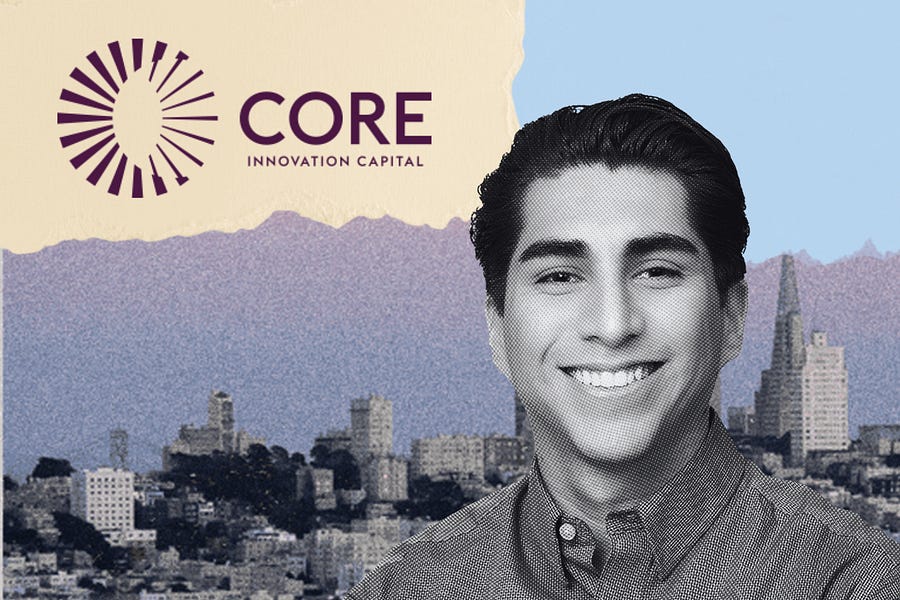
Edwin Andrade is a partner at Core Innovation Capital, a seed and Series A fund focused on financial services, healthcare, and insurance for the everyday American consumer. He favors quiet, unassuming 'silent killer' founders over loud, high-voltage personalities, and argues that Santa Monica's distance from the Bay Area helps him focus on fundamentals rather than hype. Andrade is skeptical that the current AI wave will benefit average Americans evenly, and sees Core's portfolio companies, including property-tax startup Abode, as tools to automate financial decisions for people who lack time or resources to optimize them manually.
- Core Innovation Capital is a lean, four-partner fund concentrated on seed and Series A deals in financial services, healthcare, and insurance for the everyday American consumer.
- Edwin Andrade describes himself as an introvert who builds conviction by asking the right questions rather than being the loudest voice in the room.
- He looks for 'silent killer' founders who prioritize building great products and inspiring others over chasing the title of a venture-backed CEO.
- Andrade believes the AI wave is more likely to widen the wealth gap than narrow it in the near term, which he treats as an investable observation rather than a prediction of doom.
- Core portfolio company Abode automates property tax reduction for homeowners and represents a first step toward treating the home as a manageable financial asset, similar to Credit Karma applied to homeownership.
- Andrade is more bullish than ever on small teams building big companies with AI, but believes holding onto category leadership after proving a market is now the harder challenge.


Connect with Edwin
https://www.linkedin.com/in/edwin-andrade/
Edwin Andrade grew up in the San Fernando Valley without a clear line of sight into venture capital. Nobody in his immediate world worked in tech. Nobody explained what a VC did. When he arrived at Princeton, a first-generation college student who had initially planned on UCLA, he was not just crossing a geographic boundary. He was entering a world that had never been mapped for him.
That experience of discovering what he did not know existed has, by his own account, become the core logic behind how Edwin invests today. “The vast majority of my life has kind of been about uncovering things I didn’t even know existed but were obviously there,” he says. The orientation shapes everything from where he looks for deals to the kind of founder he backs to the physical distance he keeps from the Bay Area’s gravitational pull.
Going on eight years at Core Innovation Capital, he is asking the questions most people are not.
The Uncovered Profile: Edwin’s Ideal State
Edwin lives in Santa Monica with the Pacific in his backyard, but Rio de Janeiro hits differently. His wife is Brazilian and the rhythm of life along Rio's beaches has taken on particular weight since their August wedding. The ideal day begins at the water, chairs small enough to carry, time loose enough to stay a few hours. By evening, sushi and wine, an admittedly unconventional pairing, he has no intention of reconsidering. Then, salsa dancing, which he and his wife have committed to with enough consistency to call themselves genuinely good. The combination, beach by day and dancing by night, is less about luxury than about presence.
The Logic of the Lead
Core Innovation Capital concentrates on seed and Series A, with a bias toward the seed. The fund has stayed deliberately lean, a team of four partners, and has resisted the pull toward later-stage expansion that has reshaped many of its peers. The mandate centers on financial services, healthcare, and insurance, with a specific orientation toward the everyday American consumer, a category that has broadened over time as the financial pressures once associated with lower-income households have steadily moved up the income ladder.
“I don’t need to be the loudest person in the room to stand out,” Edwin says. “I focus on asking the right questions and building conviction.” He is, by his own description, an introvert who has made peace with the demands of a relationship-intensive business by leaning into what that posture actually enables. Listening longer. Synthesizing more carefully. Building trust at a pace that compounds.
The founders that Core backs frequently mirror that quality. Edwin calls them “silent killers,” founders who do not bring the conventional high-voltage energy many investors use as a proxy for conviction, but whose ambition becomes unmistakable if you stay in the conversation long enough and ask the right questions. “I prioritize the ability to inspire and build great products over the desire to chase the title of a venture-backed CEO,” he says.
He was a devoted Kobe Bryant fan growing up. The Mamba Mentality, he says, maps directly onto how he works and what he values in founders.
“It’s about putting in the hours, trusting that they compound over time, and never worrying about someone outworking you. That mindset of quiet, consistent execution is exactly what I look for in founders today.”
Capital as Culture
Core’s stated mission is to unlock wealth and health for the everyday American. Edwin draws a clear line between that orientation and conventional impact investing. Returns come first. In the markets Core targets, that priority and the broader social outcome tend to move together rather than pull against each other.
The reasoning runs through lived experience. Edwin watched his family interact with financial products designed for consumers like them in theory, but rarely in practice. When he joined Core, several portfolio companies were already names his family recognized. That proximity between thesis and personal reality has not faded. If anything, it has sharpened.
The current wave of AI investment is where Edwin parts ways with much of the prevailing narrative. He is skeptical of how evenly the benefits will land. “As this AI wave has kind of hit us all, it’s easy to lose sight of what the typical American is dealing with day to day,” he says. He believes the wealth gap is more likely to widen than narrow in the near term, and he frames that as an investable observation rather than a pessimistic prediction. The companies Core is backing are building toward a world where financial decisions can be automated for people who lack the time, tools, or background to optimize them manually.
One of the portfolio companies, Abode, addresses property taxes. The workflow is nearly entirely automated: a homeowner agrees to engage, the system identifies grounds for a reduction, and the savings arrive with minimal friction on the consumer side. Edwin describes it as a first step toward something larger, a platform that treats the home as a manageable financial asset rather than a static one. The analogy he reaches for is Credit Karma, applied to homeownership.

The broader concept he returns to is agentic automation, technology that does not merely surface information but executes decisions within appropriate guardrails. He is also tracking SMB enablement, specifically how small business owners, many of whom are not highly tech-fluent, can now access tools that remove operational friction at a scale previously unattainable.
The View From Santa Monica
Edwin’s most useful distance from the consensus is geographic and intellectual. Being based in Santa Monica rather than San Francisco is not incidental to his process. “I think the ecosystem would benefit from being less tied to the Bay Area’s craziness,” he says.
“Being based in Santa Monica allows me to step back from the echo chamber and stay grounded when evaluating opportunities. Focusing on fundamentals is where the most meaningful innovation will happen.”
His thinking on fund construction has evolved alongside AI. He is more bullish than ever on small teams. AI has fundamentally changed what two or three people can build and how fast they can move. But he has pulled back from the more extreme version of that thesis.
The solo founder locking up a generational, category-defining company is a harder story to tell today. A lean team can absolutely build a billion-dollar business, but holding the category is a different challenge. The moment you prove out a market, someone will find the capital you left on the table.
“The venture business has never been better structured to fuel outsized outcomes with breakout companies able to access unprecedented amounts of capital.”
Getting to a billion is more achievable than ever. Staying ahead is the bigger problem.
The Founder’s Advocate
One of the less visible dimensions of Edwin’s work is narrative support. The founders Core backs are frequently not the ones building loud public profiles. They are building products. “Many amazing founders are executing well, but are not the first ones to post on LinkedIn because they are focused on the product,” he says.
“As VCs, part of our role is to help them clearly tell their story to other investors, whether that’s refining their narrative, sharpening their deck, or supporting them through diligence.”
There is something specific embedded in that commitment. If your edge as an investor comes from finding founders others overlooked, part of your obligation is making them legible to the next investor in the round. You found them because you ask better questions. Now you have to help them answer the questions others will ask.
Edwin has been asking better questions, in one form or another, since he sat in high school in the Valley, wondering where else to look. The answer has remained consistent: wherever the crowd is not, and wherever the problems are real.
More from Uncovered Media





Questions this answers
Who is Edwin Andrade and where does he work?
Edwin Andrade is a partner at Core Innovation Capital, where he has worked for close to eight years, focusing on seed and Series A investments in financial services, healthcare, and insurance for the everyday American consumer.
What kind of founders does Edwin Andrade look for?
He looks for what he calls 'silent killer' founders, people who do not display conventional high-voltage energy but whose ambition and conviction become clear if you stay in conversation with them and ask the right questions. He prioritizes founders who can inspire others and build great products over those chasing the title of venture-backed CEO.
What does Edwin Andrade think about AI's impact on the wealth gap?
He is skeptical that the benefits of the current AI wave will land evenly across the economy and believes the wealth gap is more likely to widen than narrow in the near term. He frames this as an investable observation, and Core is backing companies that automate financial decisions for people who lack the time, tools, or background to optimize them manually.
What does Core Innovation Capital's portfolio company Abode do?
Abode addresses property taxes through a nearly fully automated workflow: a homeowner agrees to engage, the system identifies grounds for a reduction, and savings arrive with minimal friction. Edwin Andrade describes it as a first step toward treating the home as a manageable financial asset, comparing the concept to Credit Karma applied to homeownership.
Why does Edwin Andrade base himself in Santa Monica instead of San Francisco?
He believes being based in Santa Monica lets him step back from the Bay Area's echo chamber and stay grounded when evaluating opportunities, allowing him to focus on fundamentals, which he sees as where the most meaningful innovation will happen.
Originally published on VC Uncovered · By Nick Madrid