Manifesting the Future: Vinod Khosla, the Instigator Thesis, and the Superhot Geothermal Revolution
Free Energy and Infinite Intelligence: The Blueprint for the Post-Fossil Era
The short version
This article explains Vinod Khosla's investment thesis behind superhot rock geothermal energy, centered on Prediction #10 that fusion and geothermal will replace fossil fuels. It traces a 15-year, three-phase Khosla Ventures strategy from Altarock Energy to Quaise Energy to Mazama Energy, which in October 2025 drilled into rock at 331°C (629°F), the hottest ever reached by an enhanced geothermal system (EGS). The main takeaway is that Khosla operates as an 'instigator,' defining specific technological mandates like superhot rock and sub-5-cents-per-kWh pricing, then architecting companies to meet them rather than waiting for the market to solve problems on its own.
- Vinod Khosla's Prediction #10 states fusion and geothermal energy will replace fossil fuels, and Prediction #12 states entrepreneurs will solve climate change.
- Mazama Energy, backed by Khosla Ventures, drilled into rock at 331°C (629°F) at its Newberry, Oregon pilot site in October 2025, the hottest temperature ever reached by an enhanced geothermal system (EGS).
- Khosla's thesis requires temperatures of 400°C to 500°C ('superhot rock') because power density increases exponentially at these levels, enabling up to 10x more power density than current approaches.
- Mazama Energy targets less than 5 cents per kilowatt-hour to hit the 'Chindia price,' the cost point at which developing nations adopt a technology because it is the cheapest option, and aims for 400°C (750°F) in 2026.
- The Mazama strategy spans three phases over 15+ years: Altarock Energy (proving EGS science around 2008), Quaise Energy (developing millimeter-wave drilling for deep, economical access), and Mazama Energy (spun out of Altarock in 2023 to integrate these advances commercially).
- Rising AI and data center power demand creates a market for geothermal's 'Always-On, Anywhere, Carbon-Free' baseload power, which Khosla says will reach commercialization faster than fusion.

Vinod Khosla operates less like a traditional venture capitalist and more like an engineer. As a prominent “techno-optimist,” Vinod refuses to wait for innovation to appear. Instead, he publicly drafts the blueprints for the future and challenges industries to meet his ambitious mandates. His “12 Bold Predictions” exemplify this approach, serving as a roadmap for how technology can drive a more abundant world. Vinod pushes these ideas into the public sphere to instigate and influence the future he envisions.
This philosophy defines Khosla Ventures. The firm operates “beyond capital” by identifying as “instigators.” Their methodology involves pinpointing massive societal problems, such as the “12 major emitter categories” driving climate change, and defining the specific “hardcore technology development” required to solve them. They then actively architect the companies capable of executing the solution.
A central pillar of this vision is Prediction #10: “Fusion and Geothermal Energy Will Replace Fossil Fuels.” While the Earth’s potential heat is limitless, the geothermal industry has historically failed to achieve meaningful scale. That prediction moved closer to reality in October 2025 with a breakthrough by Mazama Energy. The Khosla-backed startup successfully drilled into the hottest rock ever reached by an enhanced geothermal system (EGS); they accessed temperatures of 331°C (629°F) using proprietary techniques.
This event validates a highly specific thesis. Vinod does not merely predict the future; he engineers it. By defining contrarian mandates, such as the necessity of “superhot rock,” he dismisses incrementalism. He deploys a long-term strategy to back entrepreneurs capable of transforming geothermal from “inconsequential” to essential.
The Philosophy of the Instigator
Vinod builds his approach on the conviction stated in Prediction #12: “Entrepreneurs Will Solve Climate Change.” While he acknowledges a role for the public sector, Vinod argues that only radical innovation driven by instigators can deliver the necessary scale. He points to examples like carbon-capturing cement plants, which can double production while cutting emissions, to show how innovation reshapes industries faster than regulation.
This belief system demands a high-risk, “Black Swan” investment model. Khosla Ventures routinely funds projects that conventional investors dismiss as science experiments with extreme risk and long timelines.
Vinod redefines this risk. By framing the climate crisis as an existential threat, he argues that incremental remedies are insufficient. The true risk is not backing radical attempts, but failing to try. As he has stated, “Some things are too important not to try.”
Vinod acts as an architect investor. He identifies technological bottlenecks preventing an industry from scaling and focuses the firm’s resources on solving those exact problems. He provides the public thesis and partners with or incubates the teams required to execute it. This “venture assistance” goes beyond writing a check; it involves shaping the strategy and structure of the solution. He also leverages the power of boldness, arguing that “improbability is what drives progress.” By publicly challenging established norms, he shapes the technological roadmap to attract entrepreneurs willing to challenge the status quo.
The Geothermal Critique: Clearing the Field
Vinod attempts to build the future by dismantling the present. His critique of the existing geothermal industry is deliberate and foundational to his investment thesis. The Mazama Energy announcement opened with a stark dismissal: “Almost all geothermal startups to date have been inconsequential in affecting the energy picture in the US.”
The repeated use of “inconsequential” is a strategic tool. Vinod dismisses conventional geothermal because it is geographically limited, relies on lower temperatures, and cannot scale. In his estimation, the industry is paralyzed by incrementalism; it focuses on optimizing a flawed model rather than removing underlying technological barriers. Vinod ignores niche solutions. His mandate is “impact at tens or hundreds of GW scale.”
This critique serves a strategic purpose. By framing the existing industry as a failure, Vinod rhetorically clears the field. This creates an intellectual vacuum where the central problem is a lack of massive scale. In his view, only his specific approach to hardcore technology development can solve this.
The Mandate: The “Superhot Rock” Thesis
Vinod goes beyond critique to define a non-negotiable set of technological requirements. His thesis focuses not on improving general geothermal energy, but on accessing a new resource: “superhot rock.”
The central requirement is the temperature mandate. Vinod asserts that scalable geothermal requires extreme heat between 400°C and 500°C. The physics of extreme heat changes the economics: at these temperatures, power density increases exponentially. Mazama Energy is designed to “extract up to 10x more power density” than current approaches. This leap transforms geothermal from a geographically constrained resource to a globally available one.
However, this resource must be economically viable. Vinod insists that climate technologies must achieve unsubsidized market competitiveness. They must hit the “Chindia price,” a cost point where developing nations adopt the technology simply because it is the cheapest option. For Mazama, the target is less than 5 cents per kilowatt-hour (kWh) to compete with natural gas.
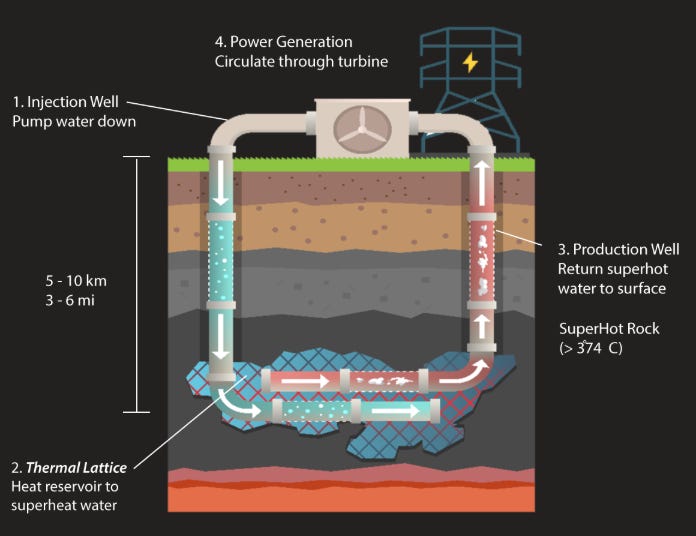
To execute this thesis, companies must overcome two technological barriers. First is deep drilling. Accessing 400°C+ temperatures requires drilling to depths where conventional technology is too expensive. Second is mastering Enhanced Geothermal Systems (EGS). This technology creates artificial reservoirs where none exist by fracturing hot, dry rock and circulating fluid to extract heat.
The Execution: Mazama Energy and the Integrated Portfolio
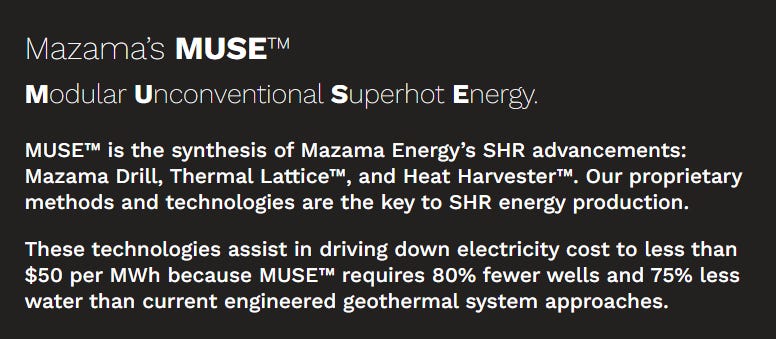
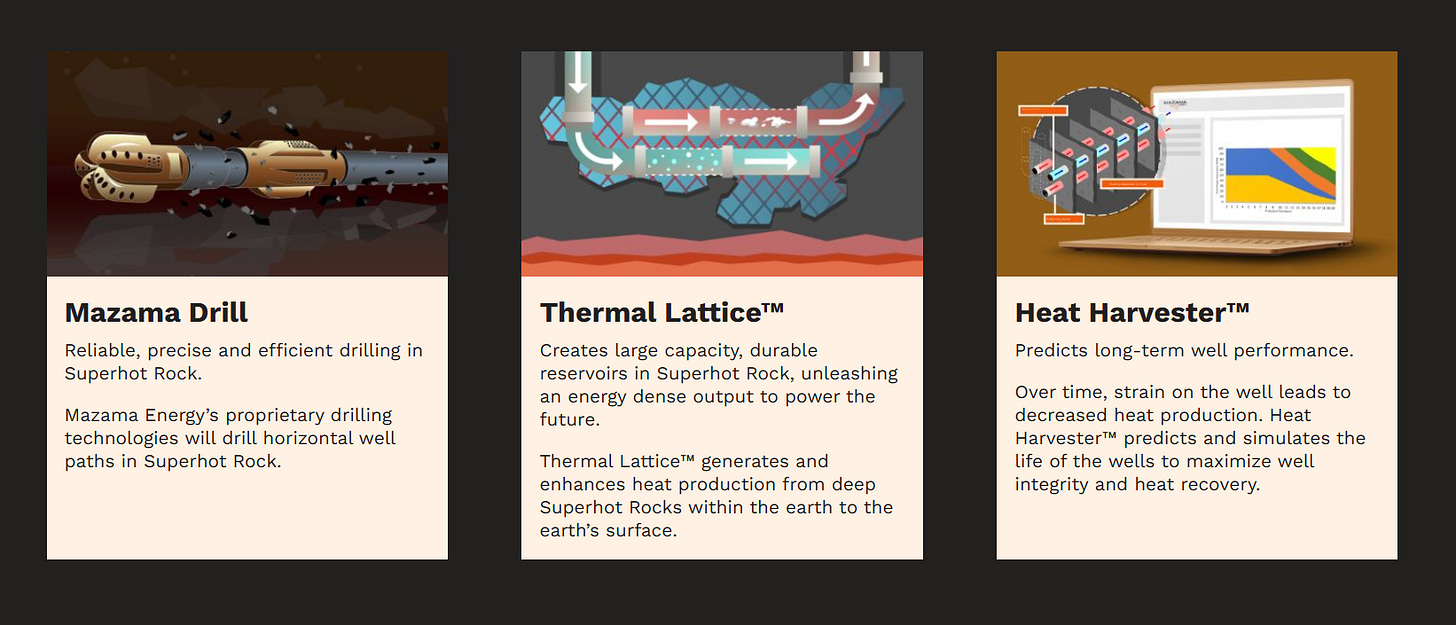
The Mazama Energy breakthrough represents the tangible execution of this thesis. At their pilot site in Newberry, Oregon, Mazama created the world’s hottest EGS, reaching 331°C (629°F). This achievement utilized several key innovations, centered on Mazama’s proprietary Thermal Lattice stimulation. This patented process uses advanced hydraulic fracturing techniques to create reservoirs in previously inaccessible rock. Mazama is hitting the targets set by Vinod and explicitly aims for 400°C (750°F) in 2026 to reach the cost competitiveness required for terawatt scale.
Mazama is not an isolated bet. It is the result of a patient strategy by the Khosla Ventures team spanning more than 15 years. The portfolio is not diversified to hedge risk; it is a coordinated, systems-engineered solution designed to solve the specific problems Vinod identified.
Phase 1 (The Foundation): Beginning around 2008, Khosla Ventures invested in Altarock Energy to prove the science of EGS at the high-heat-flow Newberry site. This was the initial high-risk experiment.
Phase 2 (The Tool): Recognizing that deep drilling costs were the key barrier to global scale, Khosla helped found and fund Quaise Energy. Quaise is pioneering millimeter-wave drilling technology to access extreme depths economically.
Phase 3 (The Commercial Vehicle): In 2023, Mazama Energy spun out of Altarock. Incubated by Khosla Ventures, it serves as the vehicle to integrate these advancements and scale the “superhot” EGS model.
This architected approach defines “venture assistance” in action. It solves foundational science, develops necessary tools, and creates a commercial entity to integrate them.
The Catalyst: AI and the Energy Crisis
The timing of the Mazama breakthrough aligns with a new energy crisis. The surge in AI workloads and hyperscale data centers has created an “unprecedented demand for continuous, high-density baseload power.”
Traditional renewables like solar and wind are intermittent. They cannot provide the uninterrupted, 24/7 dispatchable power required by AI. Natural gas and coal are carbon-intensive and geographically limited. This makes the geothermal platform of Mazama an ideal solution: “Always-On, Anywhere, Carbon-Free.” By developing resources at 300°C to 450°C, Mazama can deliver power globally. This allows data centers to operate independently of weather, time of day, or existing grid capacity.
While Vinod remains a proponent of fusion, he notes that “geothermal will happen much faster” as it is closer to commercialization.
Conclusion
The journey from the prediction of Vinod Khosla regarding geothermal energy to the tangible breakthrough at Mazama Energy illustrates the power of his methodology. The impact of Vinod stems from his role as an instigator. He defines the necessary technological breakthrough, dismisses the status quo, and patiently architects a solution through dedicated partners.
The investment of Khosla in superhot geothermal serves as a pillar of his worldview. He is attempting to manufacture an abundant resource from a previously scarce one. By aiming to provide limitless, cheap, dispatchable energy, Vinod works to create a future where the critical inputs for human progress, energy and intelligence, are abundant and nearly free.
More from Uncovered Media


Questions this answers
What is Vinod Khosla's superhot geothermal thesis?
Vinod Khosla argues that scalable geothermal energy requires accessing 'superhot rock' at temperatures between 400°C and 500°C, because power density increases exponentially at these temperatures, transforming geothermal from a geographically limited resource into a globally available, cost-competitive one.
What did Mazama Energy achieve and when?
In October 2025, Mazama Energy, a startup backed by Khosla Ventures, drilled into rock at 331°C (629°F) at its Newberry, Oregon pilot site, the hottest temperature ever reached by an enhanced geothermal system (EGS), using its proprietary Thermal Lattice stimulation technology.
How does the Khosla Ventures portfolio strategy behind Mazama Energy work?
It spans three phases over more than 15 years: Altarock Energy proved the science of EGS starting around 2008, Quaise Energy developed millimeter-wave drilling technology to reach extreme depths economically, and Mazama Energy spun out of Altarock in 2023 to integrate these advances into a commercial superhot EGS model.
What cost target does Mazama Energy need to hit to compete with fossil fuels?
Mazama Energy targets less than 5 cents per kilowatt-hour to compete with natural gas and to reach the 'Chindia price,' the cost point where developing nations adopt the technology simply because it is the cheapest option.
Why does AI demand matter for geothermal energy according to this thesis?
The surge in AI workloads and hyperscale data centers has created unprecedented demand for continuous, high-density baseload power that intermittent solar and wind cannot provide, making geothermal's ability to deliver 'Always-On, Anywhere, Carbon-Free' power an ideal solution, and Khosla notes geothermal will reach commercialization faster than fusion.
Originally published on Thesis Uncovered · By A Bradley, Sean Lindy