Uncovered Weekly Wrap 8.14.26
Saudi Arabia wants gamer attention. Elon wants more control. Chase wants college jersey real estate.
The short version
This Uncovered Weekly Wrap covers three stories: Saudi Arabia's Public Investment Fund owning 93% of Electronic Arts, Elon Musk's announcement of a planned $119 billion Terafab semiconductor facility in Texas, and Chase's $17 million annual deal to put its logo on Ohio State jerseys across 36 programs. The main takeaway is that each deal reflects a shift toward controlling attention, supply chains, or long-term audience relationships rather than traditional assets.
- Saudi Arabia's Public Investment Fund owns 93% of Electronic Arts, the company behind Madden, The Sims, Apex Legends, and Battlefield.
- EA's value to Saudi Arabia lies in owning the simulation layer of sports and the recurring fan engagement it generates, not just athletes or leagues.
- Elon Musk announced Terafab on Aug. 6, a planned 100 million-square-foot semiconductor manufacturing facility in Grimes County, Texas, with a total cost that could reach $119 billion.
- Musk's chip plant is meant to supply Tesla, xAI, and SpaceX, which all require chips his companies can't currently source enough of.
- Chase plans to pay $17 million annually to put its logo on Ohio State jerseys across 36 programs, affecting more than 1,000 athletes.
- The Chase deal is framed as buying a potential 20-year financial relationship with students rather than simply advertising space, following restrictions from the 2009 Credit CARD Act.
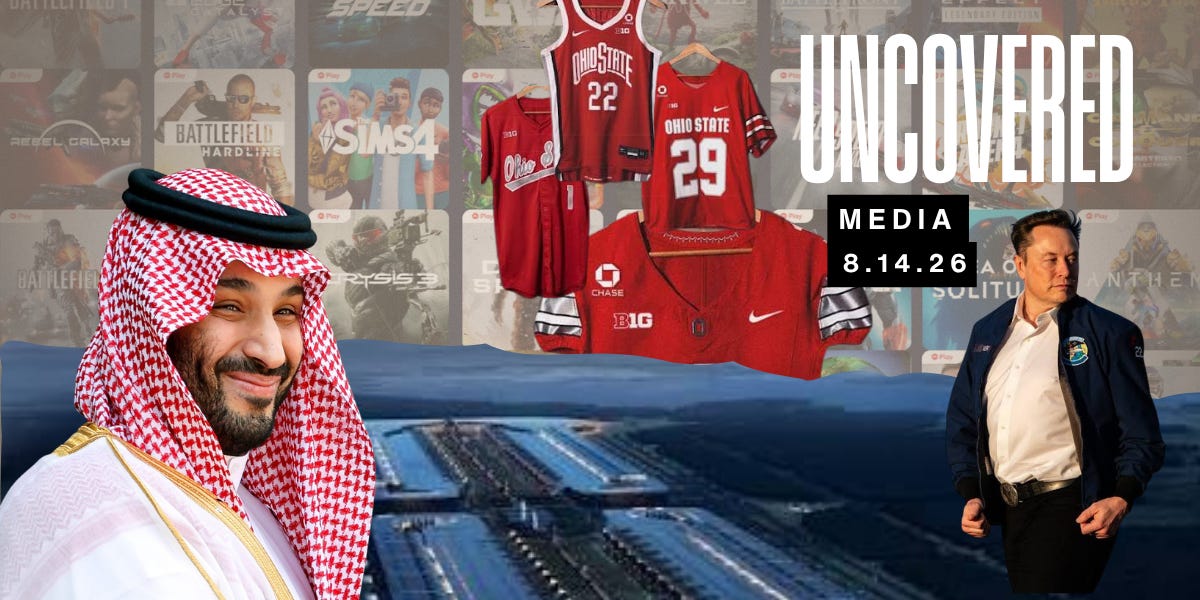
Saudi Arabia/Electronic Arts
The Story:
Saudi Arabia’s Public Investment Fund owns 93% of Electronic Arts. This is the brand that brought you Madden, The Sims, Apex Legends, and Battlefield. Collectively, EA’s games reach hundreds of millions of players around the world.
The Real Story:
Saudi Arabia has spent years trying to buy influence through sports, from golf to boxing. However, owning a player, a league, or a tournament isn’t the same as owning an audience. That’s why EA is different. It owns the simulation layer of sports, not the actual athletes people watch on TV but the versions people play all year long. It’s a recurring revenue engine built on identity, competition, fandom, and emotional attachment.
The Shift:
The competition is moving from oil fields to platforms. Gaming, sports, and media are becoming strategic assets because they control something more valuable than any single commodity—attention. Saudi Arabia tried to build that from scratch. The EA acquisition is the shortcut.
Musk/Terafab
The Story:
On Aug. 6, Elon Musk announced Terafab, a planned 100 million-square-foot semiconductor manufacturing facility in Grimes County, Texas. The total cost of Terafab could reach $119 billion.
The Real Story:
Every major company Musk operates requires chips. Tesla needs chips for Optimus and autonomous vehicles. xAI needs chips to run Grok. SpaceX needs chips for satellites and orbital compute. Current global chip production can’t meet the future needs of Musk’s companies. And if you're Musk, you just build the missing layer yourself.
The Shift:
On the surface, it appears Musk is running individual companies, but he’s actually building an industrial ecosystem where the companies feed each other. The verdict is out on whether it will work, but the ambition certainly changes the competitive landscape.
Chase/Ohio State
The Story:
Chase plans to pay $17 million annually to place its logo on Ohio State jerseys across 36 programs, which means more than 1,000 athletes will wear the Chase logo.
The Real Story:
Banks used to market aggressively on college campuses. They would set up splashy display tables offering college students free food and easy sign-ups. When the Credit CARD Act went into effect in 2009, banks were restricted from marketing credit cards to students under 21. Banks had to find another way into the university ecosystem. The Chase sponsorship is an awareness play that places the brand inside every broadcast, highlight, photograph, and social clip.
The Shift:
Chase isn’t buying jersey real estate. It’s buying a potential 20-year financial relationship. The uniform is the billboard. The university ecosystem provides the distribution channel.
DREAM IN PUBLIC
Building from zero means learning how to choose before you have certainty. Every business reaches points where the path begins to fork, and sometimes it’s all about having enough confidence to pick a direction. You make the best decision with the information you have in the moment, knowing it might be right or it might need to change. That’s the moment we are in right now, and it feels like we are on the cusp of a new chapter. Follow us on Insta: @glovejones.
THE FIND
Sometimes the best tools are small rituals that help you stay sharp when the day starts pushing back. Drew tried almost every energy drink imaginable before settling on CLEAN Cause. When the day is filled with meetings, recordings and decisions, the wrong kind of energy can make you feel terrible. CLEAN has helped Drew stay focused and steady without derailing. Next time your energy starts to leak and you want to have your sixth shot of espresso, it might be time for a gentler alternative.
Every industry, every business model, there is a larger opportunity hiding inside of it. We’re here to help you find them. Follow Uncovered for more tech and AI news.

Questions this answers
Why did Saudi Arabia's Public Investment Fund acquire a majority stake in Electronic Arts?
EA owns the simulation layer of sports that people play year-round, giving Saudi Arabia access to a recurring revenue engine built on identity, competition, and fandom, which is different from owning athletes, leagues, or tournaments.
What is Elon Musk's Terafab project?
Terafab is a planned 100 million-square-foot semiconductor manufacturing facility in Grimes County, Texas, announced by Musk on Aug. 6, with a total cost that could reach $119 billion, intended to supply chips for Tesla, xAI, and SpaceX.
How much is Chase paying for its Ohio State jersey sponsorship?
Chase plans to pay $17 million annually to place its logo on Ohio State jerseys across 36 programs, putting the brand on more than 1,000 athletes.
Why did banks like Chase move from campus tables to jersey sponsorships?
The Credit CARD Act of 2009 restricted banks from marketing credit cards to students under 21, so banks shifted to sponsorships like the Chase-Ohio State jersey deal to maintain brand presence within the university ecosystem.
Originally published on The Week · By Brandy Whalen