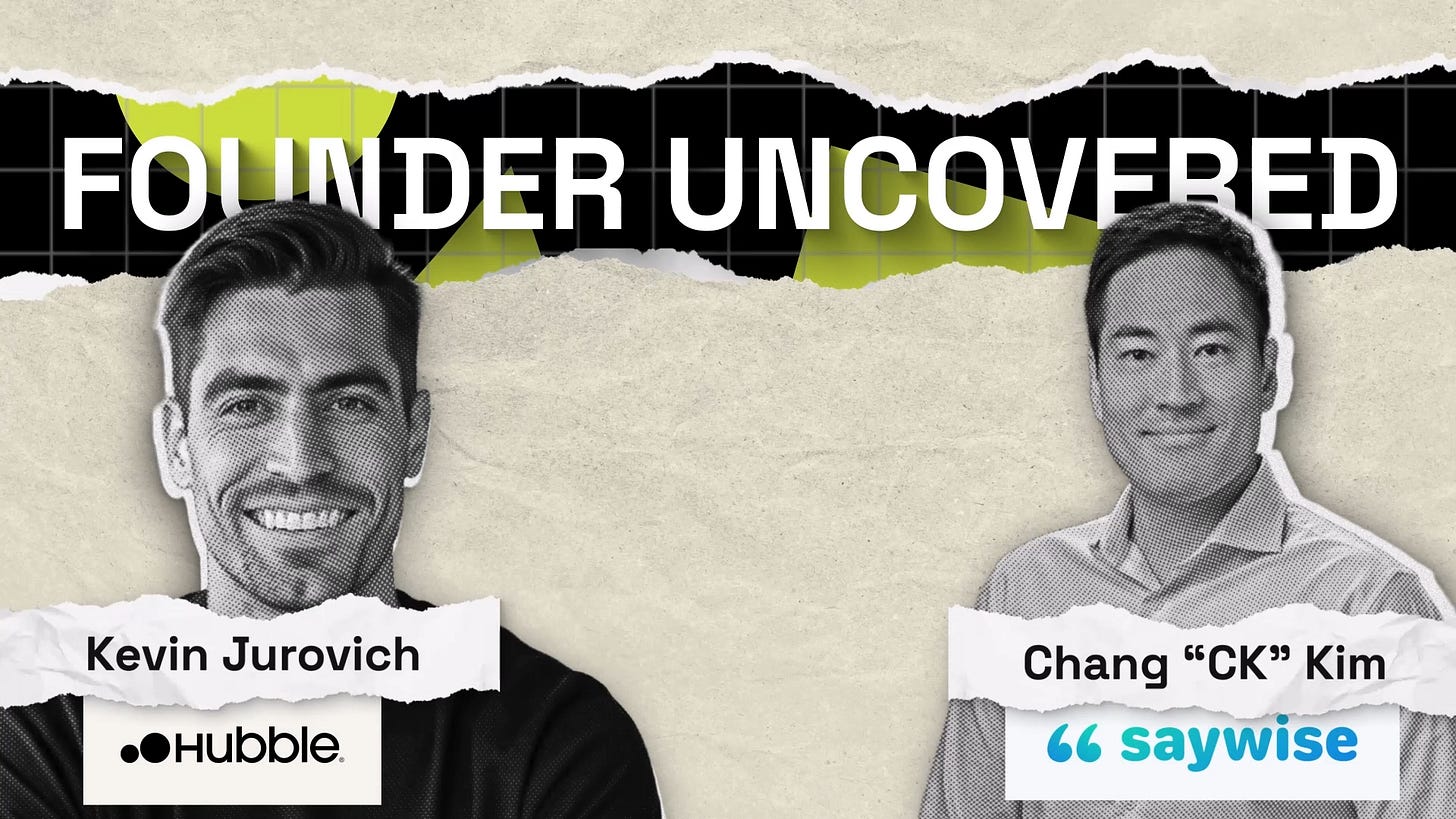
Chang "CK" Kim
Saywise
The Man Who Had to Stop Building to Remember Why He Builds
The short version
Chang "CK" Kim, co-founder and CEO of Saywise, recounts his path from a Korean military-service startup job through a Google acquisition and a nine-year journey to a $510 million company sale, followed by a year-and-a-half sabbatical that reshaped how he works. The main takeaway is that stepping away from constant building helped him rediscover his motivation and led directly to Saywise, an AI platform that helps people create authentic content through conversation rather than AI-generated text.
- CK's first tech job came through a Korean government program letting him fulfill military service at a startup, where he learned fundraising and IPO work with no business background, calling it "the best real-life MBA."
- He co-founded a blogging software company in Korea with Chester that became the leading blogging platform there and was acquired by Google after about a year of deal talks, partly because Google wanted its own indexed content in a market where a local incumbent blocked search indexing.
- His second company, a mobile publishing and storytelling platform, took nine years to reach acquisition and sold for $510 million, producing roughly eight or nine employee millionaires from about 70 staff and a 30x return for Series B investors.
- After 20 years without more than two consecutive weeks off, CK took a year-and-a-half sabbatical, deliberately avoiding plans and instead focusing on conversations that gave him energy rather than drained it.
- A friend's exercise, imagining being told you have three years to live, led CK to realize he wanted to share his knowledge and build another content-creation platform, this time using AI, which became Saywise.
- Saywise uses AI as a conversation partner that interviews users by voice, video, or phone and turns their spoken insights into written posts or videos, with a 2026 focus on team-based use cases for company social accounts.
By the time CK closed his second company’s $510 million acquisition, he had not taken more than two consecutive weeks off in roughly 20 years. Not during the dot-com boom. Not through four years at Google. Not through nine years of building a mobile publishing platform from a napkin sketch to a near-institutional exit. The only real pause in his adult life had been his honeymoon.
For most founders, the narrative would end there, somewhere between the wire transfer and the celebration dinner. For CK, that moment was less a finish line and more a hard stop sign he finally had the permission to read.
From Seoul to Silicon Valley, One Accidental MBA at a Time
CK did not grow up thinking about startups. He grew up in Korea in an academically rigorous household. His father, a university professor, set an expectation that anything short of a PhD represented personal failure. CK aimed for medicine, studied natural sciences, and enrolled at the University of Michigan, though military duty pulled him back to Korea before he could finish his degree.
That detour, as it turns out, was the sharpest education he ever received. The Korean government ran a program during the dot-com era allowing men to fulfill their mandatory military service by working at designated tech companies. CK landed a role at a 30-person startup with no engineering background and no business training. He was, by his own description, cheap labor. When nobody else could handle the non-technical work, including fundraising materials and eventually the company’s listing on the Korean Stock Exchange, it fell to him.
“I was grumbling a lot,” he said. “I was working until midnight. But in hindsight, that was the best real-life MBA I could ever have.”
The company grew from 30 to 300 people during his tenure and went public. Then, like many ventures that succeeded too fast during that era, it struggled under the weight of its own capital. The IPO was successful enough to attract investors and partners with ideas in every direction, and the discipline that had built the business gave way to scattered priorities. CK watched it happen and filed the lesson away.
After completing his degree at Michigan and a four-year stint at Samsung, where he kept one foot in the startup ecosystem even while drawing a corporate paycheck, CK co-founded his first real company with a serial entrepreneur named Chester. They built the leading blogging software platform in Korea during the Web 2.0 wave, growing the service into the country’s top destination for content creators. Three years in, Google came calling.
Korea is one of only three countries in the world where Google does not hold majority search market share, alongside Russia and China. A dominant local player had walled off its content from outside indexing. Google’s response was to acquire a content platform of its own. CK and Chester’s company fit the brief. The deal took nearly a year to close, and on a Friday it was done. CK was at the Google Seoul office on Monday morning.
Nine Years, One Number, and What It Actually Cost
The Google chapter lasted four years and carried CK to California, where he eventually earned his green card and his fully vested stock. Before he officially left, he had already been quietly building the foundation for his next company on evenings and weekends, refining the idea for six or seven months before making any move. That preparation mattered, because what came next was not a sprint.
His second company operated in the mobile publishing and storytelling space, a content creation platform built for the smartphone era. It took nine years to reach acquisition. The exit price was $510 million.
The financial outcome rippled outward in ways CK still speaks about with visible satisfaction. The company had about 70 employees at the time of the deal. Roughly 15 percent of them became millionaires. Investors who came in at the Series B, a round of approximately $7.5 million, achieved a 30x return. Earlier investors did considerably better. “I was really happy about that,” he said simply, and the simplicity of the statement was its own kind of credibility.
But nine years is a long time to carry something. CK describes the founder experience during those years as permanently occupying one edge of his awareness, even when the business was performing well. Sleep was difficult. Stress was ambient. He was expected to project certainty in every room, regardless of what he actually knew. “You’re supposed to know things,” he said. “You’re supposed to be the smartest person in the room even though you may not be.”
When the deal closed and he eventually walked away from the acquiring company two years later, he made a decision that no previous version of himself would have made. He would take a year off. He ended up taking a year and a half.
What Listening Taught a Lifelong Builder
CK approached his sabbatical the way most founders approach a product launch, with research. He read Lenny Rachitsky’s newsletter piece on the subject, absorbed the recommendation that a year is the minimum useful duration, and then did something fundamentally out of character: he refused to make a plan.
“I wanted to kind of unlearn that,” he said, referring to the reflex to schedule and optimize. “I’m not doing work here, so let’s not plan things and see what happens.”
What happened surprised him. He started meeting people. He invested as an angel in 55 companies and participated in a number of funds. He took calls that gave him energy rather than drained it, a distinction he had never meaningfully considered before. Having moved from the Bay Area to Los Angeles in 2020, he deliberately sought out people outside the technology world, people working across entertainment, hospitality, and any number of other industries. He asked them a single question: how is your life going?
“People would speak for 20 or 30 minutes,” he said. “People want to be heard and they have amazing stories.”
His wife noticed the change before he fully did. She told him he was a different person. Coming from the person who had watched him work through 20 years of uninterrupted intensity, including the sleeplessness and the constant edge of stress, he took that seriously.
The sabbatical also produced a question that became the seed of his current company. A friend suggested an exercise: imagine a doctor tells you that you have three years to live. What would you do immediately? CK’s answer included a desire to share what he had learned, to write more, and to build something that helped other people express and distribute their own knowledge. He had built blogging platforms and storytelling tools twice before. This time, he wanted to do it with artificial intelligence.
Building the Platform That Listens Back
CK is the co-founder and CEO of Saywise, a company that uses AI to help people extract and share their knowledge through conversation. Rather than asking users to write, Saywise asks them to talk. The platform generates topic suggestions and talking points, then conducts a voice or video conversation with the user, or calls them directly by phone. The AI listens, asks follow-up questions, and transforms the exchange into polished written content or video.
The premise is a deliberate inversion of how most AI content tools work. “There’s so much AI-created content and it’s going to flood the internet,” CK said. “What we want to do is take it upside down. What if humans continue creating their authentic content, but AI is helping them?”
The 2026 roadmap centers on building team-based use cases, allowing companies to use Saywise to involve multiple contributors and keep company accounts active and substantive. The platform is also integrating with meeting notes, internal tools like Notion, and employee profiles to surface content opportunities from existing internal discussions.
For CK, the arc from a Seoul military posting to a $510 million exit to a platform designed around human expression is not a detour. It is a straight line. Every company he has built has placed the act of sharing knowledge at its center. The only thing that changed during the sabbatical was who was doing the listening.
“What would I do if I’m not doing this?” he said, describing how he kept going through the difficult years of his second company. “I’ll probably do something about content creation. That’s the same thing I’m doing right now.”
He kept going then. There is little reason to expect anything different now.
More from Uncovered Media





Read the full transcript
0:00 You're supposed to know things, you're supposed to be the smartest person in the room, even though you may not be. So I wanted to kind of all learn that, and I was grumbling a lot. It's like, "Oh my gosh, these guys are taking advantage of me. I'm such a cheap labor for them." Blah, blah, blah. And I was like regularly working until midnight, because
0:18 there was so much work. But in hindsight, that was the best real life NBA I could ever have. We are the music makers, and we are the dreamers of dreams. Come on, come on.
0:34 I'm Kevin Jervitch. Welcome to Founder and Covered. The show about those brave enough to dream big and bold enough to swim away from the safety of the shore. Here, we dive into the origin moments before the noise, before the spotlight,
0:52 back when it was just a vision, a hunch, and a Founder crazy enough to chase it . For all the dreamers listening, this is where your story begins. What's up, Seep? Hey, good to see you. Yeah, great to see you. Great to see you
1:08 . I got a confession. I was thinking about this. I was like, every time I do these podcasts, I'm always like, "What would be it ?" "What do I think about this Founder, if I know them?" I'm thinking about you
1:24 men truthfully. I don't know if I've told you this, maybe I have, but you're one of my favorite founders, not because I've known you the longest or any of these other things, but it's the way that when I first met you, I didn't know the success that you
1:39 had had. You were so humbled, dude. So humbled. And it was the humbleness of a first- time Founder fresh out of college. And then the more that I learned about you, I'm like, "Man, we need more founders like that." Thanks. Thanks for saying that. It
1:57 means a lot. It's true. But thanks for being on the show, man. I'm happy that you're here. And you're actually the first Hubble expert that I also get a chance to interview on the Founder and Cover podcast. So that's a cool milestone for me. Yeah, first of many to come, I guess.
2:13 How are you doing? Great, great. The weather has been kind of crazy here in LA, but other than that, yeah, doing awesome. And my daughter has a spring break starting from next week. So we go to travel for the next couple of weeks. So yeah, nothing to
2:30 complain about. I don't know what it's like in LA, but anyone that's not in California, the last week has been crazy hot. I'm in Santa Cruz. Is it hot down in LA? So where I am, so I'm by the beach. So it's not that bad, but like I hear downtown LA, I was like 95. And it's like
2:50 what, like March? Yeah, I'm in Santa Cruz. 65, not 95. I'm in Santa Cruz on the beach, and it was 91 yesterday. So I'm not going outside. Yeah, meanwhile, New York is freezing. Yeah, the
3:07 weather has been going crazy. Yeah, man. Oh, okay, let's dive into it. You're a successful founder like, what was life like growing up? Did you always know you were going to be a founder? Did you want to be a doctor? What was young CK's ambitions? So absolutely no angle to no tie to like
3:29 business or even like tech at all. So my father, so typical Asian family, I guess my father was a university professor, and he really stressed. So about about I was born and raised in Korea, and I came here for college,
3:45 and I went back and came here, came to California. So I've been living in California for the past 15 years. But growing up, I was in Korea, and my family really stressed academics. So my father
4:00 was basically like, hey, if you have anything less than PhD, your life is a failure. And then so I wanted to become a doctor without even knowing why. Like growing up, I thought that I was always going to be like some sort of a doctor, a medical doctor. But if
4:17 somebody would ask me, hey, like, why do you want to become a doctor? I couldn't even answer. So I studied like physics, biology, you know, all of this, natural science. But back then now I'm a naturalized US citizen back then I had a Korean passport. And I had to go back to Korea for
4:36 army military duty, because every Korean man has to serve in the military. Now it's like 18 months, but back then it was three years. So kind of like an Israel, you know, situation where every man has to serve, I think for Israel, it's like men and women. But anyway, so I went back to
4:54 Korea to serve in the military. But I learned that, oh, like this was during the dot com era. And the Korean government had like a special program. If you get a job at certain tech company, that
5:09 could serve as, you know, counter serving in the military. And of course it was very competitive. And I was like, oh, like, I had no idea about it before I went to Korea. And I was like, oh, like, that's, you know, really interesting. I could learn and, you know, even make money
5:26 while serving for military. So long story short, I hustled my way into one of the startups. And I worked there for about three and a half years. So there's a certainly not my company. I was just doing my duty.
5:41 But when I joined the company, it was like 30 people. When I left the company, it was like 300 people. So the company grew really fast. They went public in the Korean stock exchange. So the company was really, really successful. Now, when I joined the company, I
5:59 was the only non-engineer. Everyone else was an engineer. And like a lot of these like non- engineer works, such as raising money, even like taking the company public came by me. So I was like, you know,
6:14 this junior guy, they hired you the junior guy. And then you were basically taking this company to IPO. So it's like, you know, a lot of paperwork, right? And I was a cheap labor for them. And again, I was the only non-engineer. So like, they were like, hey, you know, you
6:32 go do this. And then I had to learn everything. Just imagine as a physics biology major, like, what do you know anything about business plan, raising money, you know, pitching your company? I had no idea. And this was like, you know, early, you know, in early years. So we didn't have
6:48 as much resources either. So probably the Google search, you know, that was the only thing I had, like we had, we didn't have chat to PT or nothing. So I had to learn everything. And also grumbling a lot. It's like, oh my gosh, like, you know, these guys are taking
7:03 advantage of me. I'm such a cheap labor for them, blah, blah, blah. And I was like, you know, regularly working until like midnight. And because there was so much work. But in hindsight, that was the best like real life NBA I could ever have. But I'm really grateful for the
7:18 opportunity now looking back. But anyway, you know, that was my foray into startup, even though it was my startup, I learned so much there. Yeah. So that's how I got into tech. That's an awesome story. I'm glad, you know, maybe I don't know what ended up
7:34 happening to the company, but it's rare to join a company that's mall for your first startup and actually see success. Because most startups that small, they don't turn out to be 300 people companies filing for IPOs. What was the result? Like at the end, did that company, are they still around?
7:52 Did the IPO was it successful? The IPO was successful. And the company is not around. And part of the reason is because the IPO, you know, what happened to a lot of companies in the dot com boom. So part of the reason why the company didn't go well after IPO was because IPO was so
8:11 successful. So they, you know, their stock price was crazy. And they raise a shed ton of money. And then all kinds of like random people show up. It's like, Oh, yeah, can you invest in this? Can you, you know, can we do like joint venture in this? So the company eventually, this was kind of like
8:28 after my time, but the company eventually got into like, they're all is it different things. So I guess the lesson there. And I think a lot of founders took the lesson because if you think about like the dot com craziness, that was the first time the industry ever experienced
8:43 something like that. So a lot of people, you know, made them rookie mistake. And the money was around and he didn't have the discipline. So I think a lot of founders took their lesson. But this company was not exception. I mean, they're like, yeah, I guess like a result of their own
9:00 success. Yeah, I think we hear this often as founders like, Hey, don't raise too much money, right? We don't too much money too quickly too soon. You're going to run into problems . And I think we hear this, but then most founders kind of brush it off. Like, Oh
9:15 , I don't really care. I want to raise a ton of money. One thing that actually the person that introduced us his name is David Yi. And they let our preside round. And there's, he's given me like so many like pearls of wisdom over the year that I've known him. But like one thing
9:33 that has stuck with me, that like I continue to operate under is, you know, we raise our seed round. It 's four million dollars. And we're putting half of this away in a bank account and we're operating on two million, you know, so that we can kind of keep this like, not scarcity mindset, because
9:50 you still want to be on offense and you still want to be pushing the boundaries, but operating under limited resources allows you to be a little more scrappy. Think outside the box. Do you really need that standing desk? Like all these like little things that can add up. I think that
10:07 's so important that idea of like, sometimes it's better to do, sometimes you could do more with less early on and take smaller, more calculated bets. Yeah, so that's a great tip. Not only
10:22 like the philosophy of, hey, you know, out of like X, you know, let's take this much and then pretend that we only have this, but also practical tip there, right? Like, you know, the thing is like, you can create as many different bank accounts you can. And you don't have to put everything you want to count. And
10:37 it's just by seeing the numbers, like human psychology works like, oh, like we have this much in the bank versus if you don't see, you know, that money, it's different. Yeah. I know every time I see money in my bank account, I think about, oh,
10:52 is it time to upgrade my car? Oh, all these little silly things, but it's true. That's a good point. So after that company, you know, your cheap labor, your working hard, your stand up late,
11:07 did you end up quitting and or did eventually you just, yeah, what happened? Yeah, I did, I did my time there. So military duty done and turned out I didn't graduate from college. So like, I went back to Korea, I went to Michigan for college, and I
11:26 had like a semester to go, but I came back to the States and finished up the semester and graduated . And I thought that I was going to go to like MBA or something, you know, some sort of graduate school. I even applied and, you know, got accepted to some schools as well. But, you know, Samsung,
11:42 the big company, came recruiting. You know, they did like a campus recruiting and I went there and just like one thing left another and got accepted and I was like debating, oh, should I go to MBA or like, should I go join this company? And one is like spending money, the other is
11:59 making money. So obviously, you know, I chose the path of making money. And that was my journey of, you know, my Samsung journey. I did not working at the company for about four years. But even when I was working at Samsung, obviously, big company, I still had this, had that like bug
12:18 because I had the startup experience. So I got to experience that and I got plugged into the startup ecosystem. So I was putting together like, you know, beatups or conferences. I was like trying to stay close to the startup community, even though I was working at this big company. And I was
12:37 probably the only person that Samsung would ever like, you know, kept in touch with the startup community. But I met this guy who already had been a serial entrepreneur at that point and he was starting his own company. And now this was during Web 2.0 era. So like,
12:55 I started my tech career in, I guess, like .com. But now this was like Web 2.0 was a big thing. And this was like content creation, you know, UGC, you know, social, these things. And this guy was starting a company. And I was, you know, like we were grabbing dinner together all the
13:12 time. And you were like, literally like drawing some like, you know, stuff on the back of the napkin and kind of thinking about the next company together. So I joined him as a co-founder of my first company. I was a co-founder, co-CEO of the first company. How was being a co-CEO? I know like,
13:29 my first company, that I started, I was a co-CEO. And I think, I think in hindsight, like thinking back on, I haven't actually thought about this until you literally just said this. I think we called each other co-CEOs because it was uncomfortable for one of us to be like, I
13:48 need to make the final say. Did you run into that? Because I, my philosophy now is there needs to be one decision maker. It doesn't mean that that person is a dictator and makes all the decisions, like, like any smart leader, you need to lean into your co-founder and your team for
14:04 some of those decision-making. But did you guys run into issues with like making the final call on something? Or if an investor said, well, who do I talk to? Was there any of those issues? Yeah, I mean, for us, we didn't have that issue because he was clear. He was
14:20 the main guy. Like, I, I defer to him for corporate decisions, you know, things like that. But I had my own, you know, areas as well. So he and I, like his name is Chester. So Chester and I still are good friends to each other. And I have great respect for him. And then I think in,
14:39 so the co-CEOs, it can work when you have like a clear areas of ownership. And hey, for this, you got this. And for this area, you know, I got this. So like a very clear division of decision-making
14:55 and ownership. But at the end, you're absolutely right. I mean, there has to be one person who make the final decision. Otherwise, you have a log jam situation. And, you know , for those, I, you know, I think there should be one person. Yeah, I think even with like co-
15:10 founders, even if you have a different title, like a CTO, right? Obviously, like, yeah, that person is going to deal with more of the tech and the code. But you got to trust, I think at the, at the foundation level, it's like, if you trust your co-founder and the roles are
15:25 explicitly laid out, you need the trust that they can handle them. But I think sometimes what can happen is like, if marketing is kind of lagging, the other person CTO can look over their shoulder and be like, "Hey, what's going on over here? It's okay." But you got to trust that that person has it under
15:40 control. Yeah. Yeah. And not try to step on too many toes because I know sometimes I can do that. Right, right, right. Yeah. No, I know exactly what you mean. So yeah, it's a delicate balance, right? Like trusting. And also, like, if you just trust and then not say
15:56 anything, that could be seen as like, you don't care. And you don't want that either. So, like, I think a good balance would be kind of like presenting your ideas first. So you kind of like put it in your investor time thinking about that problem. It's like, "Hey, in
16:12 my opinion, like, I feel like we should do XYZ." But then you're presenting it as an option . But then, hey, as always, I'm completely trusting you. You can just consider this. But then if you don't like it, you can just like throw this in the trash can right away. Like, I don't care.
16:29 But like, if I were you, I would do XYZ. I think that's a good approach where you proactively suggest the idea so that you care. But then you also trust the other person. What ended up happening to that company that you and Chester co-founded?
16:44 So we got lucky. We got acquired by Google in relatively early years of the company. So we got acquired in year three of the company. So what happened was, so this was right away back in Korea. So we were the leading blogging software company in Korea because we thought
17:01 that, "Hey, Web 2.0, UGC, one of the most important tools for UGC is blogging tools." So we actually bought a small software. This was like an open source software
17:16 that was kind of trending. And we bought that software. And then that person also joined the company as well. But we commercialized the open source software. So we had an open source community as well. But we were also developing sort of like a hosted .com version. Very
17:33 similar to WordPress, actually. We didn't really reference WordPress that much, but we ended up being very similar to that company. So we ran this company and then we had users. We became number one service in
17:48 Korea, a lot of bloggers and creating content. What happened was Google launched in Korea. And Korea is a very interesting market. Google has majority of internet search market shares everywhere in the world. If you go to any country, Google is number one. There
18:06 are three countries. Google is not number one. That's Russia, China, and South Korea, for some reason. Because South Korea, we had a very strong incumbent neighbor. And what the neighbor did was, they kind of blocked off indexing by search engines, any other search engines,
18:24 because they also had a search engine. So they just kind of blocked out everyone from indexing their content. The other thing that they also did was producing a lot of internal content. So they hired a lot of bloggers and created a bunch of blog content and then kept it walled garden.
18:43 So Google didn't like that. So Google was like, okay, so if these guys are playing unfairly, what should we do? And then they thought about like, hey, let's create our own content as well and then index that content. So that's why they bought us. It
18:59 was a good deal. The company, yeah, we had really good engineers and they ended up joining Google. Some of them are still working at the company. So it was a good outcome . Talking about that outcome and maybe one step before that, how does one get
19:15 acquired by Google? I think about acquisitions and Google, Apple, these companies are kind of a dream. You don't usually start a company into thinking about like, oh, I can't wait to sell it.
19:30 But at some point, when you think about getting acquired, that's like a dream scenario, right? Because the resources, the reach, the distribution, the brand, the logo, how does one get acquired by Google? Did they like send you an email out of the blue? Did they reach out? Did they
19:45 call you? How did that work? Yeah, so they reached out to us. The deal took north of a year actually. So it wasn't like, I mean, sometimes Google just goes and then buys a company in like two months or two weeks. But for us, it took like a year. So the mechanics of it is sometimes taking
20:06 pretty long. And part of the reason, I guess, was we were a Korean company and the Google people, Google Korea, people had to always kind of communicate with their HQ. But yeah, we got reached out by a core deaf person at Google.
20:27 So did you think it was spam or did you actually think like, oh, this is actually coming from Google? So I think it was initially, it could have been email, but then like, we eventually ended the meeting in person. And then we became acquainted and then we were like
20:44 talking in person a lot. So yeah, like I, you know, people say companies are only bought, not sold, right? So it's like, you got, you know, like you can try to like sell yourself at that point. You might look desperate, but you got to be reached, you know, out by the acquirer. And then, you know,
21:04 that's typically when the deal happens. But in the meantime, you got to be out there. You got to be known. Like if you're not known, even if, you know, the core deaf person or potential buyer, they try to like buy other companies, you're invisible. So you have to be
21:23 always out there. You have to kind of sell yourself all the time. So you got to be known. But that doesn't mean that, you know, you're trying to sell your company. Yeah. Yeah. But once they reached out, you guys met in person a year of DD back and
21:39 forth. Do you remember just going back to that moment? Number one, I don't know if you can disclose this, but you know, what did you guys get bought? How much did they pay for the company? People love numbers. That's always interesting. And then number two, once the deal closed,
21:56 do you remember that moment or that day that that happened? Yeah. Yeah. No. I can answer the second part. The first part, Google said, no, no disclosure. Happy to talk about my, you know, the numbers for my second company, because the second company acquired, didn't have that,
22:12 you know, clause. The deal, and like I was texting with Chester, I remember very clearly that, you know, everything done and the next morning, you know, we were just like texting each other. And then, yeah, like so happy that the deal was over, first of all, because, you know,
22:32 the deal took a long time. Secondly, yeah, we knew that this was going to go out. And then, you know, this was the first company that Google bought in Korea. And then, you know, we could get that publicity. And then
22:48 we're joining, you know, this company where we learned a lot, where we couldn't learn a lot. So, yeah, everything working together, like we, yeah, we were just like chatting like, hey, like, this is so great. I remember that morning. Yeah, we were like just chatting, like, you know, texting each other. And, you know, from there, it was just like, we got sucked
23:06 into the, you know, the, the, the, the gravity, et cetera, gravity really quickly, because the deal closed on Friday. I remember, like, you know, like literally it was a Friday. And then the next morning, it's the next Monday morning, you know, we started at Google, the physically,
23:24 you know, in the office, we were like at the Google Sol office on Monday morning. So, yeah, it was like, you know, very continuous process, which I think was helpful, because if you have like two months in between, it's kind of awkward and hey, what do you do? But because it was very much a
23:41 continuation, I think it was helpful. I think this kind of underscores you also as a person, like, this whole timeline you've kind of gone through, you haven't taken any breaks. It's like you were in college, university, you get back, you finished, you got a job at this dot
23:56 com company, then you worked at the Samsung for a couple of years, then you started this company with this guy, then literally sell your company on Friday and two days, we get a weekend and we're back to work on Monday. I did read somewhere that you did take a sabbatical. So, I know
24:13 that you do rest. Was this sabbatical? Did you, so I know you sold it, you mentioned you sold a second company. And I think there's a big number floating around the internet with this second company potentially. Was that before the sabbatical? No, no, no. So, what happened was, so like,
24:32 this things happening back, you know, back to back, that was like a pattern that continued on to my second company. So, like, after Google, I started my second company almost right away. So, what happened was, I worked at Google for about four years as well, and my
24:49 stocks got bested. And this was like, and I came to California and I was working at the Google headquarters. And I got my green card and, you know, like, I was pretty ready to move on. And what happened was, before I left Google, and I was like, you know,
25:06 obviously working hard at Google during the day, but during the night, I was like, kind of like cooking up the ideas for the second company. And I was pretty ready. So, but when I started the second company, I had a pretty good idea of what I wanted to build, because there was like a
25:22 lead time. Like, I think like six, you know, seven months, I was kind of cooking up the idea on the side. And then, you know, this second company was a long journey. I mean, it took us like nine years until we got acquired. So, you know, sometimes I see like founders go like, oh,
25:40 I'm so like tired, I'm burnt out. I mean, my year three, I'm like, do you like year three, like you're just starting, like what are you talking about? But year nine got acquired, stayed with the company for a couple more years. So, I ended up working at the company for like 10 plus years. And
25:56 then finally left. And then that's when I realized like, oh, dude, like, you know, man, this is like, I never took, I never took like more than two weeks until then. Like the most time I took off was my honeymoon. So, I was like, I'm going to take at least a year off. And I ended up taking a
26:12 year and a half off. Yeah, that's incredible. You mentioned you got acquired. What was how much did you get acquired for? We got acquired for a 510 million. Yeah, I knew that number, but you were under selling it again. See, this is your humility. So, you get acquired for a 510 million dollars.
26:28 What was that moment like when that money hit the bank account or when that deal was completely closed? What was that moment like? Yeah, so a couple of things there. One is,
26:44 you know, obviously it was great, right? It was not only great for us, the team , everyone involved. We had after the deal, so we had about like 70 people at the company. About 15% of them became millionaires. So, like we produced like eight or nine
27:06 millionaires. And that was really happy. I was really happy about that. And it was good financial outcome for myself. It was good financial outcome for all the investors. Like investors, the last round that we had raised, we were really capital lean.
27:22 So, the last financing that we did before suddenly the company was Series B and we raised some F7.5 million dollars. So, that was the last institution around. They had a 30x return. So, yeah, Series A, C, you know, like they had like a project of 50x, 100x
27:43 return. I didn't calculate, but I do know like a Series B was 30x. If the Series B was 30x, the Series A and the C were extremely happy for sure. Yes, yes, yes. And this was a different time. So, Series B, you know, these
27:58 days would be like 100 million dollars around, but back then it was like 7.5. I think it was like closer to like Series A, you know, back then. You know, it's cool. I'm picking this up in your body languages. You're talking about this and maybe some of the cars may not know this and
28:14 maybe they do. You know, when investors take a bet on you and they back you, there's something inside of you. It's the same thing with early employees. It's like more than anything. I want to prove these people right like more than anything like these early employees that taking a
28:30 bet, they're getting paid less. These early investors are investing when there's like semi-product market fit, but there's a lot of uncertainty. Like that is part of my core motivation every day. You know, of course, you know, the vision of the product and the impact that it has is
28:45 like another core motivation. But being able to pay those investors back one day, that 10 plus X return, or being able to like you said, you know, make eight or 10 millionaires for these early employees that you know sacrificed, there's no better feeling for that. Absolutely. Absolutely.
29:04 Yes. These people trusted in you, believed in you. So you want to definitely return the favor. The other thing, you know, the other of course goes the other way as well. Like people who didn 't invest and you
29:19 have like, it's like, you know, all right, that's fine. You know, it's business , but you want to prove them wrong, right? It's like, hey, a few. The silence. I love it. I have a little list in the back of my mind filed away from early rejections for sure. They don't
29:38 motivate me as much, but I haven't had a 500 million plus exit yet. And so maybe one day, if I do, I'll recall those. You get your, I don't even know how many years that was. That was probably like 20 straight years of work that you did, including college. You finally decide to take some time
29:58 off. Yeah. That was great. That was really great. So when I left this company, my second company, it was a long journey so and I you know like I started researching about like
30:13 before doing sabbatical like you know before you do anything you do research first right so like I actually had a pretty systematic approach to this so I was like hey if I want to do this I want to do this right and I was interviewing some people and I was like researching some articles there was
30:30 this really fascinating article written by Lenny Lenny forgot his last name but he's like a you know very famous podcaster now Richard ski yeah yeah that guy that guy and he had a newsletter article about sabbatical and I read it
30:46 and that was really helpful he said you know one year seems to be the minimum time but if you can't take one year it's fine you can you know still take some time off and then yeah he has some other stuff so I was like hey like I want to
31:01 take at least a year off and what I wanted to do was you know first of all intentionally try not to like schedule or plan for this because you know that's what some people like one of the first mistakes some people make because they they're such a founder they bring found the mentality to everything including
31:19 sabbatical so I wanted to kind of all learn that and hey like you know I'm not doing work here so that's not planned you know things and then see what happens but that's that was my approach removing deadlines is like and calendar invites
31:35 and calls is like way easier said than done so as you remove them at what point in your sabbatical we're like I got to give back to work and then maybe also like during the sabbatical what did you learn about yourself like was there any revelation or realization or clarity into what CK was about to do
31:55 next yeah you know first of all sabbatical was really really helpful and I think sometimes you realize how good something is when older people tell you so my wife for example she's always telling me she could see the change before and
32:13 after sabbatical like she's telling me hey you're a completely different person and if as you like you are the person going through you may not realize but the obviously my wife is the closest to me and if she says I'm a different person I think that's really credible what happened was so sabbatical during
32:33 sabbatical I try to figure out what I want to do next I was like okay so let you know not only like I can maybe try some different things so I ended up like investing in a lot of companies and funds I invested in like 55 companies
32:49 but you know as an angel investor and I was trying to help other founders so that's one thing I did so my schedule was not like empty empty I wasn't working but like I had like zoom calls sometimes even like back-to-back but these are
33:06 like you know energy giving like I could take energy from these meetings so one thing I realized was it's not really about how many meetings you are having or how many people you meet it's really about am I spending energy or am
33:21 I gaining energy and when you meet inspiring people like you get energy right so that was a really good thing but more than anything I try to just like talk to people like being in LA so I used to be the Bay Area for 10 years and
33:36 I moved here in 2020 and one of the things you know very different about LA is tech is just like a small part of the industry small part of the world you have so many different kinds of people so many different you know people doing different things so I intentionally try to get out of my tech bubble and
33:55 then I made a rule of like hey like I want to talk to as many people as possible in different parts of the industry or like walks of life and you know those meetings were just like nothing fancy like I sometimes reach out and then try to grab coffee with them and I typically say like hey you know how
34:15 's life you know how's your life going and people go crazy like you know it's just such a simple question right it's like how's life you know but people would like speak for 20 minutes 30 minutes like are you happy like oh yeah yeah something
34:30 like that right something like that so like that that was my realization like people want to be heard and people have amazing stories and just by you know asking that thought-provoking question and listening you can learn so much so that was my I guess like biggest takeaway from or or you know benefit
34:50 from the sabbatical just being able to talk to so many different people how about the one of the probably most important people in your entire life all time your wife like when they say something like that that means something that means a lot she spends the most time with you more than anybody yeah yeah
35:06 and you know when the people around us that are the closest they see our stresses even though they may not say it or they see our personality courts or changes and being a founder or working for that amount of time is great it's stressful it's hard I was always on the edge I was always stressed out and I
35:26 had like a sleep trouble honestly like I think a lot of founders have sleep trouble like I couldn't easily sleep like when I was running the company even when the company was doing okay you know I was always kind of stressed out and I was on the edge but sabbatical and I like when I was running the company it's
35:45 like you know you're the founder everybody wants to hear from you you're supposed to know things you're supposed to be the smartest person in the room even though you may not be so like I always had to you know be like carrying things around but sabbatical experience was completely opposite I was mostly
36:05 listening to other people I was trying to learn from other people and I realized oh shit you know there's so many things that I can learn from other people so you know you know humility you know like being able to listen being able to read all the people my wife is telling me as well like I you know in terms of like
36:22 my social skills being able to read other people I became much better or after sabbatical because you just took meeting after meeting and you're listening and doing some level of due diligence when you're doing all these investments and you mentioned something about calls today and I've probably for
36:41 the last five months I'll just share something personal like I've been doing so many calls right and I think part of the job as an early stage founders like you got to be the chief everything officer you got to sell you got an onboard new customers you got to grow your team you got to organize sprint
36:57 planning and design meetings and pretty soon like your calendar starts to dominate you I like to say which just basically means I wake up I look at my counter I'm like what the heck do I got to do today okay boom and I'm like in the I'm basically in the matrix from like 6 am to 3 30 and then I finally get a
37:14 little bit of time at the end of the day and I told my team today this morning right before this call actually I needed to have a mind shift because I started looking at these calls as like to-do lists where it was like okay next one's done okay next one's done right instead of looking at each of these as
37:32 opportunities right an opportunity to learn or to grow or to get better or to connect with my team or to connect to the potential investor or partner and I like this idea of focusing on the things and the calls that give you energy and
37:48 even sometimes the ones that don't if we mentally like I'm gonna put a little little sticky note on my computer with one sentence that motivates me and reminds me of these calls that these are opportunities not tasks I like that
38:04 okay so after we we take some time off or we're energized we're feeling good the wife loves us at an all-time high does that lead us into the current company and the idea for this pretty much so one thing was I didn't want to
38:26 put a deadline you I think you mentioned that earlier but I wanted to kind of wait until inspiration hits me and the analogy that I sometimes use is like getting married you know like no one goes like oh like I want to get married by March of next year I mean you know that's like you know kind of wrong and what
38:45 you do is you first kind of wait until the right person shows up and and maybe marriage could be an option right so I wanted to kind of in terms of like finding my next steps I wanted to kind of not put a deadline to this and kind of wait until the inspiration hits me so that's the approach that I took which I
39:05 also recommend to other people as well so the inspiration for me was and you know this was really interesting so like somebody told me okay so I was chatting with that person and I was like oh like I'm trying to figure out you know what I want to do next in my life and it was like yeah like do this
39:22 exercise just like once you know can you can you just like really really try to visualize this and he said was just try to visualize it's a little more bit but just you know imagine you walk into a doctor office and then the doctor says God forbid but like hey you have like three years to live and you know
39:41 if that moment hits what do you what do you want to do and if you have certain ideas that you should do that right now you don't have to wait until the end but I was like you know that's really interesting so I try to kind of like imagine that as much as possible and I had like a million ideas like I you
40:00 know one of the random ideas that I had was this is nothing to look with with my current business but one of the random idea I had was so if I had like three years to live I wanted to meet everyone that I have met you know in my life you know kind of interacted with and then like I try to you know meet them
40:16 shake hands and hey like this is one thing I learned from you this is one thing I like about you and then like just keep going right and then move on to the next person but one of the one of the ideas was I wanted to share more
40:31 about my my learnings and hey before I go like if I have like knowledge up here and then go you know what a waste so I wanted to write more so that you know that's easy part like you know writing is easy and I you know started writing
40:48 more I know you know Kevin you you're awesome writer especially a LinkedIn and stuff and I try to do that as well so I started writing more on LinkedIn and people said oh you know that's really great you know thanks for sharing this so I want to do a business around it so like a not only because you know that's
41:08 that was my background as well because I built a blogging tool before second company I did was a mobile sort of a publishing storytelling platform so that was another kind of content creation platform so I love building platforms for other people to express themselves and share their thoughts so I wanted to
41:26 kind of do that but this time using AI because you know AI came out and I was really amazed by the capability of AI so it's like hey let's combine the power of AI and allowing other people to express themselves and kind of share their insights so that was the beginning of this company and for those that don
41:44 't know so CK is the co-founder CEO of statewides how would you describe like what say why's is and then also like in the same like what do you guys excited now you guys launched what are you excited about for the rest of 2026 in
41:59 the vision of the company good question so what say was is is it's using AI to extract the human knowledge and wisdom better so it essentially what it does is we're creating AI personas that becomes like a conversation partner with
42:17 humans so we know AI has great capability to create content and now you know there's so much like AI created content and it's kind of flooding internet what we want to do is to kind of like take it upside down and then hey
42:32 what if you know humans continue creating their authentic content but AI is helping them so AI being a conversation partner sometimes you can ask you really thoughtful questions but then mostly it's listening and it's like humans who speak their mind and kind of share you know their knowledge wisdom insights
42:51 through just talking you know to AI so that's essentially what we wanted to build so yeah it's like a you know on say wise we suggest topics you know write talking points to you and then once you're ready the AI has
43:08 conversation with you it can happen over browser it can happen over video voice or we also like call you if you want and you can also call so phone call say wise directly as well so just like you know half casual conversation with AI and then AI is going to do a really good job kind of putting that into you
43:27 know post written post you can also create videos based on your voice so that's what we do in terms of 2026 the big thing that we want to focus on is kind of building the use case for teams so as we talk to a lot of users one of
43:46 the common things that people said was oh like this can be used for for me as a founder but also my team can use this as well so it turns out you know every company has many you know every company pretty much has their own social accounts like ads you know something something and sometimes it's collaboration
44:06 effort hey let's make sure our company account doesn't look like it's a ghost town so let's continue like publishing regularly but then you know no one like sometimes people don't really have direct ownership so sometimes it's like a you know like the company account is you know it has not published anything
44:25 for the past three months so yeah we're trying to figure out the use case for companies this the USA-wise to involve their team members and you know create better content that can represent the company what are the things that were
44:40 as part of that one of the things that we're doing is also integrating with a bunch of different sources within the company so turns out like within the company there's so many things happening already you know we have meetings we have you know like brainstormings we have you know this and that so we're
44:58 integrating with meeting notes we're integrating with you know different peoples I guess like profiles even notion things like that slack and we extract the you know really interesting topics that can be turned into content
45:13 and then we surface that to the people you know people on the team hey would you like to turn this into content and I use this as an opportunity to create content for your company so that's you know something that we're doing yes I definitely want to try this for Hubble yeah after this all I'm gonna put you
45:32 on a an email thread with Taylor she Taylor shout out Taylor if you're listening she does all of our writing on our company page but we're always looking for like just better sharper punchier overall more impactful content that more people can see because at the end of the day like platforms like
45:50 LinkedIn are massive distribution channels and company pages and I think in the past a lot of companies it's the voice is so stale of the company like the best companies if we follow them on social media now it's like they're funny they're
46:05 really there there's humor like and so yeah I'm seeing that sort of shift and it's something that we talk about all the time like how can we how can we have a louder voice a more impactful voice a bigger voice I'm so yeah I'm definitely
46:20 gonna do that well yeah I'd love to pilot and I just did really quickly so you mentioned the you know LinkedIn and other places being you know the best I guess like a you know medium for companies yeah it's really remarkable
46:36 like you know content creation in a way has become like a you know it's not on the option anymore if you're if you're not doing that you're kind of falling behind and I know that there are some founders or marketers who are naturally good at it you know it's just like comes out like really naturally so you're
46:55 like gifted but turns out there's a lot of people like founders marketers who want to do it more but they don't know how to do it they don't have time but that's when we can be helpful where hey it was kind of suggesting hey you would you
47:10 like to talk about these five things and then if you're ready you just have a really casual conversation and the rest of it will be taken care of so yeah I definitely agree LinkedIn being a really important channel we'll definitely link the website your website in the show notes and so anybody that's
47:27 interested in that and wants to check out say why's I think one thing that I've learned about you CK is I wouldn't bet against you people say the same thing about Elon don't bet against Elon whether somebody likes him or not it's like there's just a there's a humbleness about you you're much your
47:43 personalities are much different but a lot of the things that you've worked on have been successful I think that's like a common theme even as we went through this timeline today with your life like for somebody early on it's trying to build something what signals should they trust and maybe lean into
48:02 and what in your past have you just completely ignored and trusted your instincts on that's a good question sometimes so like again during my sabbatical I met a lot of founders and sometimes investing and that's when I
48:19 realized this is really interesting like you know I was trying to figure out what wouldn't make investors kind of like go like hey I want to drop everything and I want to write check for this person and versus somebody can be
48:35 really like you know eloquent and smooth but then you're like oh I don't I'm not really sure right so I met these people so sometimes I meet some people I mean of course that doesn't mean that you know every one of them
48:50 will be will turn out to be successful but then we're talking about that first moment where you're like oh my gosh you know this guy's crazy this part's crazy what makes them like that and my conclusion was I got obsession into like one thing like have you like met like you know these people who are like
49:08 crazy about one area and then when it comes to that particular thing you know they go crazy and then they're like completely different person they might be like weak in other areas in life including social skills I mean they might be extremely weak like weird people but it's like when it comes to this thing
49:27 you know this guy this girl is crazy and right and because and they think about it all the time and that's when they form a really unique perspective and then they're like oh my gosh you know I'm surprised that we're not doing XYZ like
49:42 I'm gonna make this happen so and they're like thinking so they're like crazy obsessed about that that one thing though when it comes to that thing you know they they have this certain authority you know a certain aura you know I think it's really that like does that person have this one thing that
50:01 they're crazy about yeah I love that answer yeah that first is like entrepreneurs you know like sometimes you see people who are like hey I want to do startup I don't I don't know like what I want to do but then you know like seems like startups are really good way to make money eventually and you know
50:18 it's a kind of fashionable so I want to do startups I don't know what I want to do but like I want to do startups sure I mean you could succeed that way I mean you can eventually figure it out but I I have seen more people who want to do
50:34 startups kind of like started that way kind of fail early because like a lot of times these are smart people like high-quality people and they like when they when they hit the first wall because I mean startup is like you know
50:49 walls after walls and just like a really really challenging and when they first hit the challenge you know that's when because they have a very weak base they don't have this one thing they're crazy about it was just like a startup that they wanted to do so I saw a lot of people are kind of crumbling at the first
51:06 challenge because they don't have a very deep basis yeah you have to have that like like you're talking about basically we've all seen quotes about being a founder but I'll just be honest most days are gonna be challenging and they're
51:22 gonna suck early on that's just the reality of it and if there's not that obsession and that passion and that undying just when I wake about the morning this my that why of why I'm starting this company just pulls me out of bed if that's not there it's gonna be really hard to make it like you did
51:40 nine years before getting acquired right like there's a lot of rain and not a lot of sunshine early on you know and you got to be able to withstand that when you think back on your life and I look at you just between you and I love the Golden State Warriors and my favorite basketball team shout out Steph Curry
51:56 they're not doing so good right now but during their heyday when we got a bunch of championships I feel like you're right in them you're like right at halftime right it's like and the Warriors they can have an unbelievable halftime or they can even be down at halftime it doesn't even matter and they
52:11 could just go crazy in the third quarter and they win by 30 this happens all the time I feel like you're right in the middle like you've had a you've had a great run you know this first half your career but you're just kind of hitting your stride when you think back on it and the success that you've had if you
52:27 had it attributed to like one attribute or one core thing what would that be I guess mission driven you know not creating easily I mean especially for my second company there were enough moments when I wanted to just like hey
52:44 fuck it out of here but I kept going so you know you could call the energy you could call the longevity but but I think like you know I thought about that actually so why did I keep going is it the you know the the the desire to avoid
53:01 failure or like where did it come from and I think it goes back to like up sometimes it's like a very simple question what what I do it if I'm not doing this and I was thinking okay so like all my life I've been building content creation platform so probably I'll be doing another content creation
53:17 platform and you know and we were in the mobile space and you know mobile was a big thing so I had no doubt that like mobile you know applications will become more important so I'll probably do something about mobile so it's like
53:33 oh dude I mean that's the same thing they were doing right now so like part of it is a calculated move it's like hey if I'm not doing this like realistic speaking what would I do like do I have alternatives and if not then you just
53:48 you just keep going yeah it is your father is your dad still with us yes well I know he wanted you to be a PhD and a doctor but I guarantee you even if he hasn't said it but sometimes parents can be stubborn I know he's proud of you
54:04 what a journey you've been on man and I'm excited to see the second half of this because it is halftime for you unfold and support your companies and your mission and yeah thanks a lot man it was great talking with you yeah thanks man thank you so much thanks for listening to founder and covered if you
54:24 found this conversation helpful please follow the show notes so you don't miss out on next episodes we also have a newsletter where we profile early-stage founders sharing tactical advice you can use right now you can find the link in the show notes one conversation can change everything I'll see you next time
54:43 Perkins Cooey is a leading international law firm known for providing high value strategic solutions the emerging companies and venture capital team councils startups and the investors who backed them supporting clients from
54:59 formation to exit in the past three years clients have raised more than 23 billion with a B in private markets between precede and growth stages Perkins Cooey combines tailored counsel with sector experience so when it's time to
55:15 accelerate whether for the next financing round a strategic deal or even going public your team is ready to learn more visit Perkins Cooey dot com
Transcript generated automatically; it may contain errors.
Questions this answers
Who is CK Kim and what company does he run now?
Chang "CK" Kim is the co-founder and CEO of Saywise, an AI platform that acts as a conversation partner to help people turn spoken knowledge into written posts or videos.
How much did CK Kim's second company sell for?
His second company, a mobile publishing and storytelling platform, was acquired for $510 million after a nine-year journey, producing about eight or nine employee millionaires and a 30x return for Series B investors.
Was CK Kim's company acquired by Google?
Yes, his first company, a Korean blogging software platform he co-founded with Chester, was acquired by Google after roughly a year of talks, partly because Google wanted its own indexed content in South Korea, one of only three countries where Google lacks majority search market share.
Why did CK Kim take a sabbatical after selling his company?
After roughly 20 years without more than two consecutive weeks off, he took a year-and-a-half sabbatical to avoid burnout, deliberately not planning it in advance, and used the time to have energy-giving conversations with people outside the tech industry.
What is Saywise and how does it work?
Saywise uses AI to extract human knowledge by having AI personas hold conversations with users over browser, video, voice, or phone call, suggesting topics and talking points, then turning the conversation into written content or videos in the user's own voice.
Originally published on Founder Uncovered · By Uncovered Media