Mike Peregrina
Amby AI
“Growth at all costs will cost you.”

The short version
Mike Peregrina, founder and CEO of Amby AI, built a mobile-first relationship intelligence platform for real estate agents and loan officers that uses a proprietary Move Score model to identify contacts likely to move soon. The product acts as an AI co-pilot layered on top of existing CRMs rather than replacing them, drawing on lessons Peregrina learned as co-founder of Homie, a venture-backed real estate platform in Utah that went through a reduction in force after interest rates spiked. Amby has grown at 161% average weekly active user growth over 12 weeks, entirely organically, ahead of its planned early September public launch.
- Amby AI's core product is the Move Score, a machine learning model that identifies which contacts in a user's phone are likely to move soon based on life events like a new job, growing family, or marriage.
- Mike Peregrina previously co-founded Homie, a venture-backed real estate platform in Salt Lake City that reached nearly 8% market share before being sold to a private equity firm after a reduction in force during a period of rapidly rising interest rates.
- Amby positions itself as an AI co-pilot layered on top of existing CRMs rather than a replacement, since legacy real estate CRMs average 22 years old and were built for desktop use.
- Over the last 12 weeks, Amby averaged 161% weekly growth in monthly active users, all organic, with nearly 8 out of 10 users uploading their contacts after downloading the app.
- Peregrina evaluates investors using an 'airport test' (would you enjoy dinner with them during a flight delay) and a domain-expertise filter, believing founders should keep building rather than take capital that doesn't feel right.
- Amby's long-term ambition is to build infrastructure for the real estate industry, including mortgage, title, and escrow, extending Peregrina's personal mission of making homeownership accessible, a value shaped by watching his immigrant mother work multiple jobs.


Twenty-five seconds. That’s how long it takes to download Amby AI, create an account, and upload your contact list. By the 30th second, the platform is surfacing someone in your network who is likely to move. Mike Peregrina, the company’s founder and CEO, calls that cycle “time to wow.”
The metric matters because of what built it. Mike has spent 21 years in real estate. He co-founded Homie, a venture-backed platform in Utah that reached nearly 8% market share before interest rates and housing prices reshaped the business. He went through a reduction in force, sold the company to a private equity firm, and started over. The focus on doing more with less at Amby came directly from that experience.
Why Home Ownership Matters
Mike grew up watching his mother, an immigrant from Puebla, Mexico, work four jobs to raise three kids on her own. She understood that homeownership was both shelter and strategy, and that belief shaped her son’s career.
“My personal mission is to make homeownership easy and accessible for everyone. With Amby, my mission is still the same. Now it’s just doing it indirectly.”
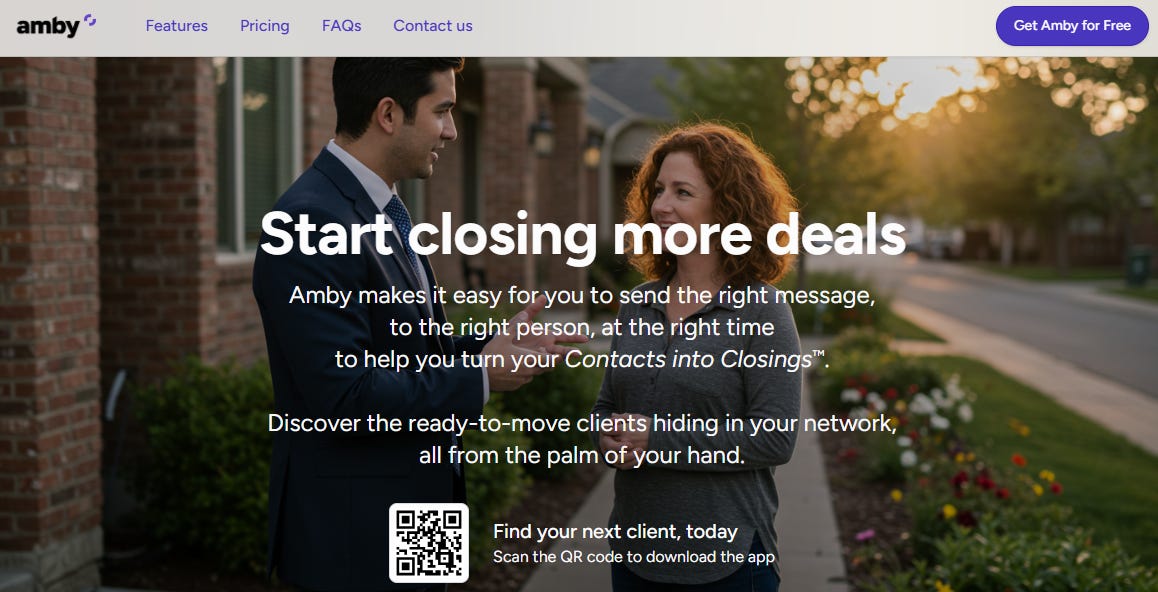
Amby, short for “ambient,” is a mobile-first relationship intelligence platform built for real estate agents and loan officers. The company describes itself as “an AI co-pilot” to the CRM, adding a layer of intelligence that helps users send the right message, to the right person, at the right time to help users turn their contacts into closingsTM. At its core is the Move ScoreTM, a proprietary machine learning model that identifies which contacts in a user’s phone are likely to move soon. The model looks for and monitors the major life events that tend to precede a move, things like a new job, a growing family, a marriage, etc. and weighs how many of those signals are firing for a given contact. That’s the difference between a CRM that just sits on your leads and a “relationship intelligence” app that tells you who to call this week.
“They’re called contacts because you’re in contact with them, compared to leads… yea, those lead you to nowhere.”
Different Wins
Mike’s thesis is that the real estate industry is overdue for a fundamentally different kind of tool. The legacy CRMs that agents and loan officers rely on are, on average, 22 years old. They were designed for desktops in a world where agents sit behind a screen all day.
For Mike, a better CRM still misses the point and that’s why Amby acts as an intelligent layer to the CRM. Their customers do not need to “rip & replace their” current tools.
“If you go out and buy a car, you want a better car. But you also want something different, because different is what wins.”
Amby has been building in stealth for over a year. Mike plans to bring the company out in early September, and preliminary numbers suggest the market is ready. Over the last 12 weeks, the platform has averaged 161% weekly growth in monthly active users, all organic. Nearly eight out of 10 users upload their contacts after downloading the app.
At his previous company, he replaced seven CRMs across mortgage and real estate and lived through the pain of legacy tools himself. “I know the acute pain they’re going through because I’ve felt it, deeply firsthand,” he said.
Amby’s customers are agents and loan officers who are always on the move, meeting clients face to face, rarely behind a desk. They might have thousands of contacts in their phone but no reliable way to know which ones are ready to buy or sell. Nearly all of them have lost a client to another agent because they couldn’t stay top of mind. Mike talks to at least one of them every single day.
That closeness shows in the product. Users have started calling Amby “the easy button” to stay top of mind with their network. They know AI is changing the industry, but they want it to solve one problem: making sure they never lose another client they already know.
Mike’s customers aren’t skeptical about AI. They just aren’t sure what to do with it yet. Most use AI a surface level, polishing listing descriptions or drafting emails. Mike reframes the stakes for them:
“AI is not going to disrupt you… but another agent using AI will.”
The Making of a Founder
Before Amby, there was Homie. Mike co-founded the company as a one-stop shop for buying and selling homes headquartered in Salt Lake City, Utah, bundling real estate, mortgage, title, escrow, and home insurance under one roof. The attachment rates across those services reached 92%, 95%, and 96%. The company expanded to six metro areas and served more than 10,000 customers.
Just as Mike was transitioning into the CEO role in the summer of 2022, interest rates climbed faster than at any point in Federal Reserve history. First-time homebuyers, who made up nearly half of Homie’s transactions, started getting priced out. He simplified the strategy around a first principle borrowed from the industry itself: you’ve got a list to last. The team overhauled its customer acquisition approach, reclaimed unit economic profitability, and then every market reached profitability at their P&L level. But the company still went through a reduction in force.
“I feel like a piece of me died. Having conversations with folks, people that were going to have a baby soon, people that were in a situation where their mother had cancer. I lost months of sleep over that.”
The toll went further. He lost more than 30 pounds during the hardest stretches and missed his kids’ recitals and games. When he stepped down around Thanksgiving 2023, he signed his resignation papers and wept. None of it was caused by a flawed product or a misread market. Interest rates moved faster than anyone could adjust for, and Mike managed the company through it, getting every market to profitability before the end.
What he took from that experience was clarity. At Amby, the founding team began with a shared set of core values and first principles, the kind of alignment Mike now considers non-negotiable before building anything else.
Earned Perspective and Choosing Your Partners
As a repeat founder who has raised funds, navigated a board, and sold a company, Mike knows what he wants in an investor and what he’s unwilling to accept. He still believes in venture capital.
He applies what he calls the airport test: if you’re stuck on a delayed flight with a potential investor, would dinner be enjoyable? If the answer is no, he walks. The second filter is domain. “If I have to convince them about the space, they’re not the right investor,” he said. What’s left is something closer to partnership. He treats the due diligence as fully mutual.
“They’re all going to talk to my previous board members. There’s nothing to hide. It’s a marriage. Here’s everything on the table, the good, the bad, and the ugly.”
For founders who feel pressure to take money from investors who don’t feel right, his advice is direct: keep building. “The best businesses get bought, not sold,” he said. “And that applies to raising venture capital, too.” If the product is growing, the right investors will come. But if one shows up and the fit isn’t there, trust your gut. “If you have a gut feeling around it and you’re tossing and turning at night, that’s the universe telling you you should think twice about taking that capital.”
“It goes back to mission, vision, core values, and first principles. Thosee things that you believe that you should never compromise.”
What Comes Next
With Amby preparing to launch publicly in early September, Mike is thinking about what happens when the platform reaches a larger audience. The Move ScoreTM, the machine learning model at the core of the product, improves with every new user. “Last week was the dumbest it’s ever been,” he said. “This week it’ll get a little bit smarter.” The more agents and loan officers who use Amby, the smarter the platform gets for everyone on it, a network effect Mike sees as central to the company’s long-term value.
The ambition goes beyond a single product.
“We’re going to build the backbone of the eight trillion dollar real estate industry. That includes mortgage and title and escrow and all these things, because I have a perspective on that given my previous startup.”
The founding team of three is based in Salt Lake City, building with a distributed mindset and hiring talent wherever they find it. The growth is organic. The investors are hand-picked. And alongside partnerships the team plans to announce at launch, the mission, making homeownership easy and accessible, remains the same one his mother carried with her from Puebla.
“I would be doing our business a disservice if I didn’t share with the public what we’re building.”
More from Uncovered Media





Questions this answers
What is Amby AI and who founded it?
Amby AI is a mobile-first relationship intelligence platform for real estate agents and loan officers, founded by Mike Peregrina. It acts as an AI co-pilot to existing CRMs, using a proprietary model called Move Score to identify which contacts are likely to move soon.
What is Move Score in Amby AI?
Move Score is Amby's proprietary machine learning model that monitors major life events, such as a new job, a growing family, or a marriage, and weighs how many of those signals are firing for a given contact to predict who is likely to move soon.
What happened to Mike Peregrina's previous company, Homie?
Homie was a venture-backed real estate platform Peregrina co-founded in Salt Lake City that bundled real estate, mortgage, title, escrow, and home insurance, reaching nearly 8% market share and serving more than 10,000 customers. Rapid interest rate increases starting in 2022 forced a reduction in force, and the company was eventually sold to a private equity firm.
How fast is Amby AI growing?
Over the last 12 weeks, Amby averaged 161% weekly growth in monthly active users, all organic, with nearly 8 out of 10 users uploading their contacts after downloading the app.
How does Mike Peregrina choose investors for Amby?
He uses an 'airport test,' asking whether he would enjoy dinner with an investor during a delayed flight, and a domain filter, avoiding investors he would need to convince about the real estate space. He also treats due diligence as fully mutual, letting investors talk to his previous board members.
Originally published on Founder Uncovered · By Sean Lindy