Nia Patel
Montage Ventures
17 for 17: How an “Ownership Mentality” Built the Hardest Working Cap Table in Venture.
The short version
Nia Patel, VP at Montage Ventures, discusses how the seed-stage firm built a 100% follow-on financing rate (17 for 17) in its third fund by acting as a hands-on partner rather than an 'expensive passenger.' She traces her 'ownership mentality' and positive-mental-attitude approach to her time in the Royal Air Force and her operating years at PeerStreet, and explains why Montage favors outsider founders who lack the 'cognitive debt' of industry insiders. The main takeaway is that capital alone is a commodity; the real differentiator for VCs is structured help with recruiting, co-investor introductions, and go-to-market strategy.
- Montage Ventures is a seed-stage fund based in Menlo Park focused on financial services, healthcare, and commerce enablement, deploying its third fund of $75 million with average checks of $1-2 million.
- Montage achieved a 100% follow-on financing rate from seed to Series A in Fund 3 (17 for 17) and 94% across all three funds, which Nia Patel attributes to hiring support, thesis-led content shared with co-investors, and go-to-market guidance.
- Patel distinguishes between a VC as an 'expensive passenger,' who only provides capital, versus a true partner who acts like a third or fourth co-founder.
- Her time in the Royal Air Force's Combined Cadet Force, including earning solo glider wings, taught her that 'Positive Mental Attitude' (PMA) is a necessary mindset for spotting founder potential, not blind optimism.
- Before venture, Patel spent six years at PeerStreet under founder Brew Johnson, rising from analyst to running the underwriting team of 60 people and overseeing $4 billion in transactions, which shaped her belief that 'ownership mentality' compounds faster than capital.
- Montage's investment thesis favors outsider founders over industry insiders because insiders carry 'cognitive debt' and reputational incentives to defend existing norms, while outsiders approach problems as first-principles thinkers with higher urgency.
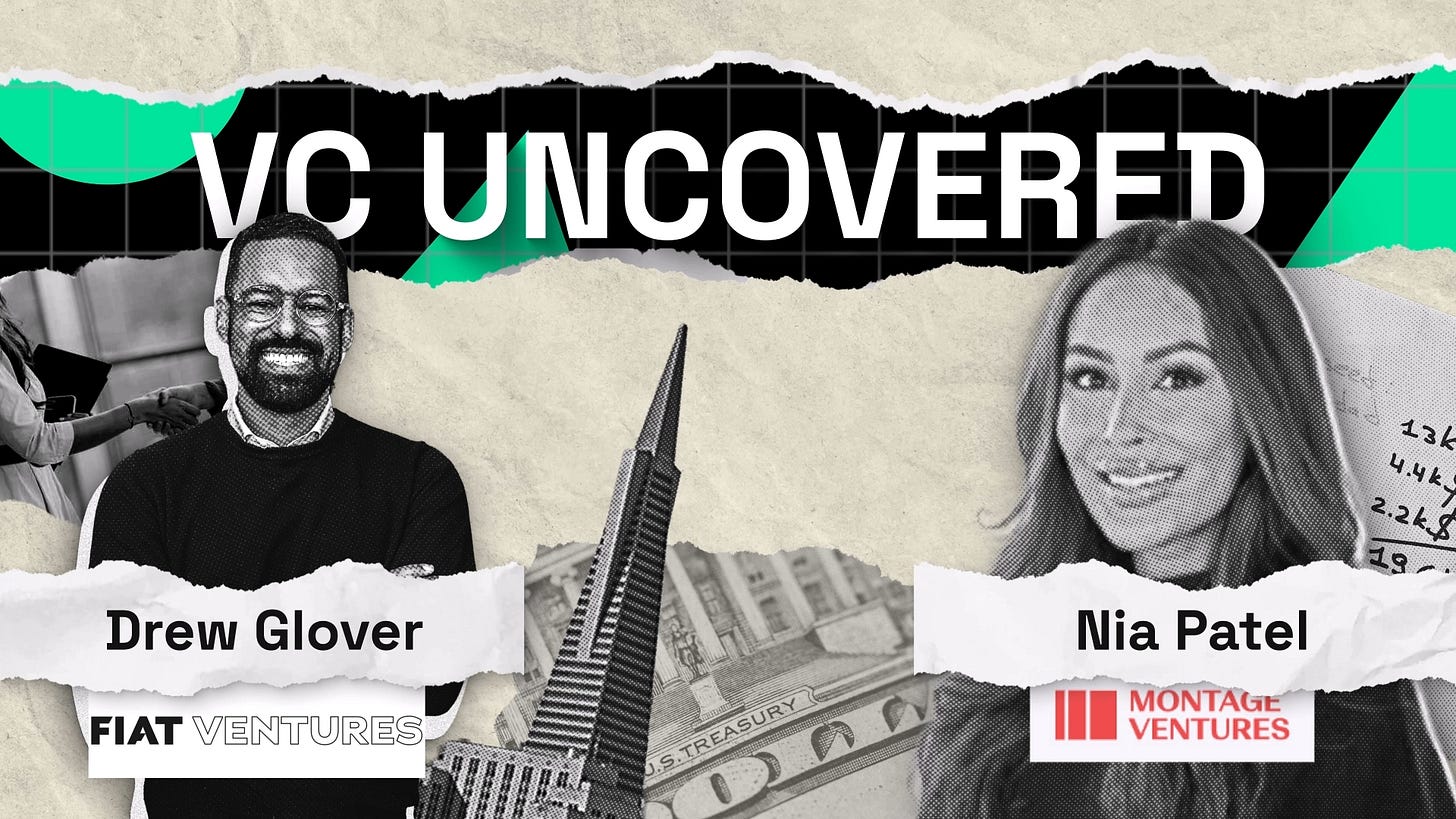
Nia Patel - Montage Ventures
Read the VC Uncovered Profile:
www.vcuncovered.com/p/nia-patel-montage-ventures
In This Episode
Drew Glover talks to Nia from Montage Ventures on the power of “ownership mentality” and the strategic advantage of being an outsider. Nia details Montage’s hands-on approach, describing how they strive to be the “hardest working investors on the cap table” by assisting with executive recruiting and go-to-market strategies. She also draws a fascinating parallel between her training in the Royal Air Force and venture capital, explaining how a “Positive Mental Attitude” (PMA) is critical for identifying potential in the early stages.
The conversation turns heads when Nia defines the difference between a VC acting as a true partner versus an “expensive passenger.” She backs up Montage’s strategy with impressive numbers, revealing a 100% follow-on financing rate for their Fund 3 portfolio (17 for 17). She also offers a contrarian take on founder backgrounds, arguing that “cognitive debt” often holds industry insiders back, while true disruption is usually driven by outsiders who don’t know the rules they are breaking.Drew Glover talks to Nia from Montage Ventures on the power of “ownership mentality” and the strategic advantage of being an outsider. Nia details Montage’s hands-on approach, describing how they strive to be the “hardest working investors on the cap table” by assisting with executive recruiting and go-to-market strategies. She also draws a fascinating parallel between her training in the Royal Air Force and venture capital, explaining how a “Positive Mental Attitude” (PMA) is critical for identifying potential in the early stages.
The conversation turns heads when Nia defines the difference between a VC acting as a true partner versus an “expensive passenger.” She backs up Montage’s strategy with impressive numbers, revealing a 100% follow-on financing rate for their Fund 3 portfolio (17 for 17). She also offers a contrarian take on founder backgrounds, arguing that “cognitive debt” often holds industry insiders back, while true disruption is usually driven by outsiders who don’t know the rules they are breaking.
Sponsor:
This season is supported by SVB. Silicon Valley Bank, a division of First Citizens Bank. Member FDIC.
SVB is a trusted collaborator for the founders pushing boundaries and the investors who back them. We’re proud to have them as our sponsor.
Please note, this podcast is for informational purposes and is not investment, financial, or legal advice. The views expressed are those of the speakers and do not necessarily reflect the position of SVB.
More from Uncovered Media


Read the full transcript
0:00 As I came out of school I was kind of talking to all these successful people and I was like oh like if you were my age like I love real estate just should I go into like real estate investing what should I do and almost like every single person at the MD level so this is like
0:15 2015. They're like near get into tech because at the pinnacle of your career tech is going to be the single most important lever that exists for you to pull. Welcome to VC on Tupper. The series where we highlight the next generation of
0:31 investors who move faster take bigger risks and build shoulder to shoulder with founders. I'm your host Drew Glover co-founder of Theot Growth and general partner at Theot Ventures. Nia thank you so much for joining the VC uncovered podcast with such a huge fan of the issue that we
0:48 did on the uncovered newsletter and I'm one of your biggest fans. We've known each other for years you've been within the gross Theot Ventures ecosystem and I feel like we're always talking and going back and forth on different deals and different trends that we're seeing in FinTech but mainly
1:04 what I lean on you for is like broad FinTech like health care in SureTech these like edge case Fin Tech use cases that I need to have a little bit extra call it educational muscle on really deep
1:20 research in other spaces you've always been like a really great pillar for me as well as like the broader fiat team with that again really excited to dig in and if you don't mind just kicking things off telling us a little bit more about you montage ventures and what you guys are focused on today.
1:35 Yeah well first of all thank you so much for having me huge fan of you and fiat and you guys are just crushing it with all of these events and everything so super excited to be part of the community. Yeah I'm a VP at montage ventures where a seed stage fund had quoted
1:53 in Menlo Park core is a focus for us our financial services health care commerce enablement the way we think about that is you know some of the biggest sectors that power the GDP and really looking at some of the transformative technologies and the most compelling founders within those
2:09 categories to really implement some form of global transformation and yeah currently deploying capital out of our third fund it's 75 million average check sizes 1 to 2 million can lead co-lead and I would like to say that we're a pretty cool team we like to say we're small but my t6
2:26 investment professionals and what I always love to tell founders is that the really cool thing about us is that we're all either kind of like serial founders like our founder managing partner Todd and our GP mat or operators with really meaningful operating experience and that's our core
2:43 value add the way that we underwrite the deals that we look to invest in is really looking to understand what is the one or two things that we think we can do that meaningfully changes the trajectory of the company from our check to the next check and you know we try and be
2:58 pretty structured with how we engage with our founders whether that's helping them place talent introducing them to investors for their subsequent round of financing or just helping them really refine that go to market commercialization to raise that blowout series and you know go to work
3:13 alongside them so we try and be the hardest working investors on the cap table I feel like a lot of EC say hardest working investors on the cap table I mean obviously I've had a front row seat to a lot of the work that you do and I can very confidently and honestly say that you guys
3:31 do a ton of I say just like the extra sauce that's required for every order like that that anyone makes but I'd love to just expand a little bit more about like how that like extra the extra that needs to be brought from a VC has evolved over time because back in the day it used
3:49 to just be it used to just be money like and now I think that cash is more of a commodity we're finding we're finding a lot of founders looking for huge VCs around the table and it's not just about who can deliver money the quickest and so how have you kind of like seen that
4:05 evolution and how at montage have you guys tried to step up to that need yeah well I think one of the things that we love to say is you know capital is just the cost of doing business these days so when you think about partnership and when you think about bringing VCs on just remember that
4:24 every dollar you raise is a piece of the company that you're not going to get back so a VC can either be I like say a very expensive passenger or you know a third fourth co-founder for you and the way that you know we think about that internally is really threefold so we tend to back a lot of
4:43 really technical founders and one of the areas that you know they typically struggle with is really rounding out their team hiring recruiting and this is something that you know we kind of take on full force we will screen a list of candidates for them run the initial interviews and then give
4:59 them five top candidates that they can choose from saves them a ton of time and they're super thankful for kind of our help in that area and to that end we've placed I think a VP or higher up most of our port codes especially within fund three the second area is um having
5:16 really strong thesis led ideas within the organization that then allows us to push out content why papers to our co-investor group and where that becomes really impactful for our portfolio is that when we send a deal from our portfolio to our co-investor group they're typically extremely
5:34 happy to look at the things that we're doing because they're primed on our understanding they have an informed point of view and as a result we actually have a hundred percent fall on financing rate from seat to series A and fund three which is I think one of the only funds that I know if it has
5:49 that were 17 for 17 and fund three 94% across all three funds and I think taught and met in particular do a very good job of kind of building that connectivity with a broader ecosystem and then the third piece kind of comes in tangent with that I would say we're extremely strong at go to
6:07 market commercialization understanding kind of where the growth investor appetite is what the PE funds are kind of looking at and really helping our founders at the seed stage kind of bridge their story and not that we're kind of mandating they need to hit this metric or they need to build towards
6:22 that but I think having a lens into what the broader ecosystem is looking for and then kind of having that in the back of your mind to like build along it's really really impactful when they go out and raise their series A because they know the talking points they know where the appetite is
6:38 and they tend to run like very clean processes yeah and one I think you just did a really good job at articulating you know what what you need beyond capital you know to to be a really great investor I do want to just
6:53 take a go a little bit deeper on this idea of being an expensive passenger as a as a VC I think that's such a a perfect way of explaining it but maybe just for our listeners and for any you know founders out there folks looking to fundraise can you give a little bit more of
7:10 an explanation of like what what that is kind of defined by that that expensive passenger that might be capital but just might be extra weight with that capital yeah and I think in today's
7:25 climate in particular venture has become very transactional right if you rewind 20 years ago it was all about the relationships that like natural synergy you had between the founder and the investor and whether that was some form of emotional support or being the sounding board
7:43 there was this kind of intangible value add that that capital brought on and I think somewhere along the way we've started optimizing for just get the capital build the company hit the metrics and as it relates to being a very expensive passenger in today's world where you
8:01 have so much access to knowledge you have you know pretty much a spreadsheet of all the potential investors that are out there it's so important for founders to figure out who is the best investor for me from a culture fit from a strategic value add standpoint and how can I
8:18 engage with them how can I get in front of them and really put that effort into not just run kind of like a blind process and get any kind of capital in and call it a day but really do the work to understand who is going to have that kind of magnetic benefit to me and like who can I
8:34 call at 11 p.m. and be my sounding board because I think the one thing that holds true for me is that founders don't need more pressure they have a ton of pressure they need a sparring partner they need a sounding board they need someone who can help them find some perspective help them
8:52 understand when to sprint and when to breathe in their building cycles and what I love about us at montage is we all have such deep experience operating and we can empathize so deeply with where founders
9:07 at and what they're going through and I think that's the really really important piece to optimize for so when I say expensive passenger I mean sure you you could raise a bull out round but if that capital is not adding anything to you beyond the cap table then I think
9:25 the opportunity cost there is really high when you look at the landscape of who's out there and who you could potentially be working with yeah yeah and and of course I I bring up expensive passenger but I'm I'm not I'm not finishing the quote that you saw articulately said which is
9:40 they can either be an expensive passenger or a co-founder and obviously if you're looking for a co-founder that is basically like finding someone you want to marry right that there's a lot of work that goes into both sides of that relationship and expensive passenger anyone can get in your car
9:55 right you know but do you want to be if you're going to be in the car with someone for you know 11 hour car ride you want to make it so it's someone that you can really vibe with so yeah I just think that's super articulate I love that makes you want to jump to another another kind of topic here one that I want to pull from the actual newsletter and this is
10:12 really around the sergeant's mentality and your time in the Royal Air Force because I think the mentality that you bring to venture in your mentality you bring to work at least from what I've read but also it's spoken to you a lot of it derives from that mentality that was built in while
10:27 you were in the Air Force that not only helps you do your work but also helps you kind of breathe this life into the founders that you work with and being able to underwrite founders so I love for you to share a little bit more about what that background means to you and like how you brought it into
10:43 this world of venture to clarify this is a program called the combined cadet force where in the UK there's kind of a select few schools that have formal contracts with the Ministry of Defense and then you operate directly under kind of military insight starting from the age of 12 so this is
11:03 very very young and at 12 you're signing a contract with the Ministry of Defense that you will uphold yourself to certain expectations or into quorum certain discipline and I feel very fortunate that I had that experience at such a young age my school happened to have the largest
11:20 contingent in the country so that kind of military mindset was so deeply embedded in our culture and I mean you had to apply to get in and you had to kind of make your case for why he would be a good cadet but I ultimately joined the RAF section and I would say that you know it was four
11:42 years and kind of moved up through the ranks from an NCO to a sergeant but the most kind of formative and defining piece of my entire RAF experience was um I was nominated for this colliding scholarship so you it's really
11:57 prestigious I was super super excited about it you go to an RAF base in Ailes bury and the entire kind of mission is within two weeks you're expected to get your solo wings for a glider so the most that I had ever done was kind of like ridden in a glider with someone and and
12:15 that was it but within two weeks you're expected to kind of log an insane amount of two hours with your flight officer you kind of are up before the crack of dawn you have really really intense training I mean it's emotionally demanding it's it's really physical it's really just the sheer
12:34 amount of exhaustion that I experienced at that time like I can't even comprehend I even to this point in my life I think that was a very very intense period for me and um you know like everyone knows you're there so there's this big pressure to kind of achieve your solo wings if you are
12:52 selected for that and within that two weeks we also had two days of rain um so oh man yeah the time to get your kind of hours with your flight officer and and meet all your milestones was really really diminished and I remember there was a point it was two days before the end of the scholarship
13:11 and I was messing up on all the fundamentals I couldn't even do a pre-flight check I couldn't do a launch procedure I um I was doing my ghost solo which is basically you have to complete two perfect ghost solas which means your flight officers with you but they don't say anything they don't make any adjustments and
13:26 I couldn't even like position my seat correctly and this is like the most defining piece I think of my entire life he kind of looked at me and he said PMA positive mental attitude that's your choice to make and I can't do that for you that's the only way through this and
13:44 I get chills when I think about that moment because something really aligned with me with that and it just clicked and I kind of had this like killer mentality I was like what am I doing I'm the youngest person here this is like my opportunity for the taking and I'm gonna do it and I and I
14:00 ultimately did it and I got my solo wings it's like something that I'm so proud of because I know how difficult that period was for me and I think like what I what I love is how directly that translates to venture right because I think what that taught me is like optimism and positivity isn't naive it's it
14:20 's kind of like a necessary mindset that you have to have and I think that's what I love so much about venture is that's required not blind positivity but you need to have that optimism you need to have that conviction you need to understand that and you need to be able to look at the
14:36 upside when you meet a founder when you see a market and you need to be able to fill that lift before others can and I think that particular mindset is one of the things that translated so strongly to what we do today because I think people forget that right like you like people try and
14:54 be a little bit conservative they're like the data doesn't look good no one's ever done it before this isn't the phenotype of founder that would do this and it's so important I think just going back to fundamentals like venture is all about seeing the upside and being being positive and having that
15:09 informed conviction I would say yeah I I couldn't agree more and and again I was I was not not a part of the RAF but I grew up playing like really competitive American football and
15:24 I played all the way through college and there there is some like military energy when it comes to football I'll put it that way and and I do remember when I was really young I'm I'm I'm I must have been 11 or 12 and I hated football so much at the time like I used to like it's so
15:44 nervous going to practice and there was a play I remember mentally in my brain I was like I'm gonna get hurt on this play I just need to get out of practice and I did the play I like faked an injury I made a big scene of it
16:00 and these coaches pulled me aside after they told me like don't cry which I don 't know if that was that was it they did say to me they said which had a very simple question for you are you hurt or are you injured and I knew exactly what they meant instantly and I was like
16:17 I'm hurt and they're like then get up and go back in but it's a question that I ask myself that I feel like as like in the workplace that's probably not the best thing to ask someone but I will just say it's something that I ask myself all the time and I think about it even when I'm looking at founders
16:32 of you know are these the people that are that are going to make like moments that might hurt them into moments that are bigger than that and they'll call it an injury and they'll kind of walk away from things or give up on things earlier than not but very similar to that moment that that was at PMF
16:48 is that what you called it PMA positive mental attitude I'm thinking product market that PMA but um but yeah like that I go back to that all the time in these moments where I'm like this is tough this is hard or I'm looking at a founder working with a founder and them saying this is tough this
17:05 is hard and being like yo like we got to ask ourselves these very simple questions that ground us and these really positive impactful ways so it's just very clear I know exactly what I need to do to dig myself out of this hole so I love I love that story and also just love that generally
17:20 as a mindset I also feel like you know just as you are you are this really incredible investor kind of how you are underwriting things it's it's all everything that happened in our past is ultimately what makes up our present and you were also an operator before you became a VC and I'm the
17:36 biggest believer I'm I come from the same ilk of having this operator edge coming into the VC side not only helps you understand founders but also brings this empathy to their entire journey and so if you're comfortable
17:51 with it I'd love for you just a little bit more about some of those operator roles that you had and how how those very much impacted how you become how it's made you a better investor yeah absolutely I mean there was a time in my life where you couldn't have paid
18:08 me to leave the operating side um so I was a very very early employee at Pure Street um Br ue Johnson was the founder CEO and I credit that experience entirely to how I show up today to be
18:24 honest um I joined when I was 23 I grew up with that company I I learned so much from Brue we worked so closely together and I spent six years with them and when I joined I was very green right like I was an
18:40 analyst I pretty much begged Brue to hire me as I came out of school I was kind of talking to all these successful people and I was like oh like if you were my age like I love real estate just should I go into like real estate investing what should I do and almost like
18:56 every single person at the MD level so this is like 2015 they're like me I get into tech because at the pinnacle of your career tech is going to be the single most important lever that exists for you to pull and that was just the best advice and that that was kind of across the board I
19:12 spoke to like five or six people like in this coffee chat so you're like give me advice um and so yeah I pretty much begged Brue to hire me he had me interview with like 12 people on the team he was like I love Nia I don't know what to do with her. She's so green. He eventually hired me as an analyst and worked my way up, ultimately ended up
19:31 running the entire underwriting team and then had a couple of other divisions kind of run under me, hired around 60 people from my team and did four billion in transactions. Wow. We were doing the thing. We were in hypergrowth and I think one of the most important things that I
19:50 learned from that experience is ownership mentality. And I love this story because I think it's just, it's so important for founders to hear. But our founder did a really, really good job of, especially in the early days
20:05 instilling this deep sense of ownership mentality and everyone that he hired. No task was beneath anyone. And I think when you build a culture where people feel real agency, you unlock an entirely
20:20 different commitment and creativity that no amount of management can ever give you. And it was a marketplace to invest in real estate back debt. So what that meant is that a lot of the volume that we would do would be back ended. So 80% of our monthly volume would be transacted in the last five business days
20:37 . And as we scaled, that meant that I was getting into the office at 6 a.m. With my team of 60 people who were all getting into the office that early and we were doing hundreds of loans, hundreds of millions of dollars in that five business days.
20:53 And I would stay until like 1 a.m. 2 a.m. Every last five business days of every month. And there was just something in the air. You would like look up around 7 a.m., like it would be quiet or you would hear
21:08 us typing. Everyone was locked in. There was this palpable sense of energy that everyone was so incredibly excited about what we were doing. We fired up, like brew had the sensation energy, like every Monday in all hands , like he kind of reviewed why what we're doing is so transformative, the potential that we
21:26 had. And you know, it's like electricity, right? There was this constant sense of electricity that was palpable at any moment in time. And you didn't only care about your own task, you cared about like, oh, I have an idea for product that helps BD, like let me go talk to them.
21:42 You just cared so much about the company as a whole. And now like how that translates to venture is I think ownership mentality compounds faster than any amount of capital. And when I try and meet founders, that's what I'm really trying to get a sense of. I'm like, do I believe that you can instill that kind of passion and ownership
22:02 mentality in everyone that you hire? And do I believe that the people around you are so bought into your mission that this is their baby and they're going to get emotional about it too and they're going to treat it like their company or do I believe that like, you're just doing this to be a
22:17 founder and to have a company and you're bringing people on board. And I think underwriting for that at the early stages can be the difference between a generational company and one that's not. I 100% agree. I also just love this depiction of like the culture that you were kind of
22:33 painting during that time when you guys were doing, you know, hundreds of loans in five days and everyone just just locked in. I feel like that is, I feel like culture in business is like really shifted and
22:49 it's become a lot more challenging to recreate moments like that. I also think that like, there's just a lot more distraction, there's a lot more things going on in the world, but how do you think about like the helping founders,
23:04 helping these different companies that you guys are leaning into and like helping them build culture like that? Are you investing in that, in the founder with the, with the hope and belief that outside of all the other things that they need to have as a founder, that they're also going
23:19 to be able to create cultures like that? Or is that something that is really built over time? Back in the day, you could just set some, set some rules, say this is the culture, work, work, work, that world is very much changed, very much in tech as well. I feel like it loves her a little bit softer now.
23:36 You don't have to agree with that, I'm saying that, but I'm curious how you're approaching culture within your portfolio, within some of the founders and businesses that you're working with. Yeah, I think to that, I would say culture to some degree is organic and it
23:53 will feed off of the motivation of the founder and I feel very strongly that when I meet a founder, I need to understand that there's this strong gravitational pull to why they're
24:08 choosing to build this and would they build this without the money? Would they build this with no one looking like, do they feel such an innate sense of urgency around the problem that they're trying to solve? Is it a lived problem? Is it something that they couldn't stop thinking about that they ultimately were like, right,
24:23 we got to do something about it because I think when you have that quality in a founder, everything else is sequential. That's going to come. It's going to lead into the culture because I think one of the things I learned from the RAF too is that you lead by example, not by authority.
24:38 I was one of the only females in that entire flight of cadets and no amount of authority would tell a 15-year-old boy what to do, right? You lead by example, you lead by exhibiting the culture that you want to have
24:54 and I think when you have a founder that is so obsessed with the problem and they will make it inevitable, what kind of energy bleeds into your employees, your early employees especially and I think the challenge becomes, as you scale, how do you have that sense of urgency
25:10 throughout the ranks and how do you instill that message when you're like a 100-person company versus a 20-person company and that I think what's really crucial is the leadership folks that you hire have to fill that way because all it takes is for one person to be
25:29 indifferent and that spreads like wildfire in an organization. Your leadership team has to be so equally obsessed with what you're doing and that might be unrealistic, right? Maybe you can't find that. It's a competitive hiring market, but in an ideal world, that's probably what I
25:46 'd like. Yeah, no, no. I think you're right. I think that middle management of the team, they are the nucleus. They are the center of the business and so everything kind of permeates from there and that's where a lot of stuff will break and to your point, 100%, there's folks
26:04 that are going to be obsessed, but the only people that are going to be able to know that, it's not going to be the CEO. It's going to be the person right in the middle that's like, "We made it wrong higher here," or "This one isn't the right one," so I think it's a really good call out.
26:19 One of the last kind of topics that I really want to touch on here is, is your thoughts around this outsider investment thesis where really the people on the margins make the middle. And even me personally, I obsess a little bit more over problem market fifth
26:34 and founder market fifth because I'd much rather find an incredible founder that's obsessed about solving a problem, even if that problem wasn't because they worked at JPMorgan Chase for 50 years and led the lending arm of the business. So I love to learn a little bit more about how you specifically think about
26:53 this outsider perspective. Yeah, I think it's really important. I think at Montage company Y2, it's one of our core beliefs that true disruption rarely comes from inside. And I think the reason is that insiders have this cognitive debt, they have an
27:14 understanding of how things should be. I think there's an element of having perhaps reputational skin in the game because they're incentivized to defend this worldview that they've had. Outsiders have none of that.
27:29 They see the blind spots that insiders can't, they don't inherit any of those assumptions. They're not even trying to play by the rules because they don't know what the rules are. They're completely reinventing the game. And to be honest, that's what you need to build a generational company because
27:44 you need to come at it, especially with some of these larger markets that we're investing in, healthcare. If you, I think the times that we've spoken to an insider, it's just wanting to navigate the same bureaucratic mess, wanting to play by the, it's like, no, I don't want
28:00 to invest in that company that's going to take 30 years to get to some form of meaningful revenue. I want to invest in the founder that's going to flip that on its head. And I think the one thing they have in common is that they approach these problems as first principles thinkers because they literally have no other choice.
28:19 And the other thing about outsiders is there is a higher sense of urgency, right? If you're an insider, maybe as a, as a founder, you're like, all right, well, I have the reputation and I'm at the incumbent. I'm the easily backable person. Maybe you're just doing it to be a founder.
28:35 I'm not saying that's what everyone's doing, but it feels like a natural progression. Like, I feel like the outsider is coming in. They've been personally living in some form of problem, like it's impacted them . And they've made it their mission in life to solve this problem because they're so deeply disturbed by it.
28:50 And I think that's the value that you get. And I do think venture as a whole right now has a pattern matching problem. I mean, we've trained ourselves to spot the right schools, the right logos, like the polished deck.
29:05 And I think what's that, what that's costing us is mistaking familiarity for quality, right? And I think that's how you're going to miss the generational founders, because I think pattern recognition, it's useful for risk mitigation and, you know, necessary
29:21 to understand what those boxes might be, what those phenotypes are, but I mean, it's terrible for discovering the non-obvious upside. I think that that is, that is so well said. And I couldn't agree more.
29:36 There are a lot of very easily backable people that are living in the parameters of a rule set that they believe their career has forced them to follow. And so these kind of rule breakers, as, as our, my friend at, at Antler
29:51 Ventures would say these maniacs, these, these folks that are, they're not even breaking rules sometimes because they don't even know the rules exist, which I think is just like a very refreshing place to be. And, and again, like we can look at history as much as we want, but it truly is
30:08 the people on the margins make the middle and that middle are the ones that are creating general business, generational businesses. I love that. This is awesome. And so I want to actually want to close this up with a couple of speed round questions if you're good with it. Okay.
30:23 Let's do it. All right. Let's do it. What is one AI hack that has been a huge unlock for you as a VC? Granola, shout out to that app. That is like the most amazing note taker that I have ever seen.
30:38 I just feel like I'm 10x more efficient, like my quality of life is just so much happier. I love that team. It is so good. I use granola religiously. If you had to invest in one vertical for the rest of your VC career, what
30:54 vertical would it be? Feel free to throw a trend out there as well if you don't want to just say a vertical. Yeah. I think it's going to be the single most transformative sector for the world and for the human race and we're seeing so much on the longevity side from both the
31:11 quality of life and a therapeutic side, so much from like a cognitive side, which will then enable everything else that we love to back in venture. I'm just so passionate about the health care space. Cool. With that, what is one wellness hack or thing that you do that helps you be a
31:29 better you? Oh my God. I'm the biggest wellness junkie you will probably ever meet. I am obsessed with red light therapy. I have the brand platinum LED. I do it every day. I think that's probably the reason I don't have Botox yet when I probably
31:47 should. Red light is like the single best beauty hack anyone can do for themselves. Can you actually feel the difference? You can see and feel the difference. Yeah. In terms of my energy, sure, like I've been very consistent with it probably
32:02 for over two years now and I feel like I have more energy, I have more mental clarity, also like post-workouts. It's great for muscle inflammation and soreness, great for sleep. It's just like the all around best wellness hack ever platinum LED is the brand
32:20 very, very good. All right. I'm going to check it out. It's in me, you're affiliate link. I know I should be like this one as if we're on the side. Okay.
32:35 Final question, for all the aspiring founders out there currently working as an operator in some company but wanting to start a company, what advice do you have for them?
32:50 Start a company unless you're obsessed with solving that problem and don't start a company, just to start a company. Amen. That's great. Nia, thank you so much for joining again, excited to see you out at the events at Overcoffee
33:05 talking about trans co-investing together all the things but I really appreciate you joining this. It's been a pleasure. Thank you so much for having me. This was so fun. I really appreciate it. This season is supported by Silicon Valley Bank. For decades, Silicon Valley Bank has been a true partner to the innovation
33:21 economy helping both founders and funders grow. Silicon Valley Bank, a division of First Citizens Bank, member FDIC. Please note this podcast is for informational purposes and not investment, financial or
33:36 legal advice. The views expressed are those of the speakers and do not necessarily reflect the position of Silicon Valley Bank.
Transcript generated automatically; it may contain errors.
Questions this answers
What is Montage Ventures' follow-on financing rate?
Nia Patel states Montage Ventures achieved a 100% follow-on financing rate from seed to Series A in Fund 3, described as 17 for 17, and 94% across all three funds combined.
What does Nia Patel mean by a VC being an 'expensive passenger'?
She describes an expensive passenger as a VC who provides only capital without adding strategic value, contrasting this with a VC who acts like a third or fourth co-founder by helping with hiring, introductions, and go-to-market strategy.
What is Nia Patel's background before becoming a VC?
She spent six years at PeerStreet, joining as an analyst at 23 under founder Brew Johnson and eventually running the entire underwriting team of about 60 people, overseeing $4 billion in transactions.
Why does Montage Ventures prefer outsider founders?
Nia Patel says insiders carry 'cognitive debt' and reputational incentives to defend existing industry norms, while outsiders approach problems as first-principles thinkers with no inherited assumptions and a higher sense of urgency, which she believes drives true disruption.
What is 'PMA' and where did Nia Patel learn it?
PMA stands for Positive Mental Attitude, a lesson from a flight officer during her Royal Air Force gliding scholarship when she was struggling to earn her solo wings; she says this necessary optimism and conviction later shaped her approach to evaluating founders in venture.
Originally published on VC Uncovered · By Drew Glover