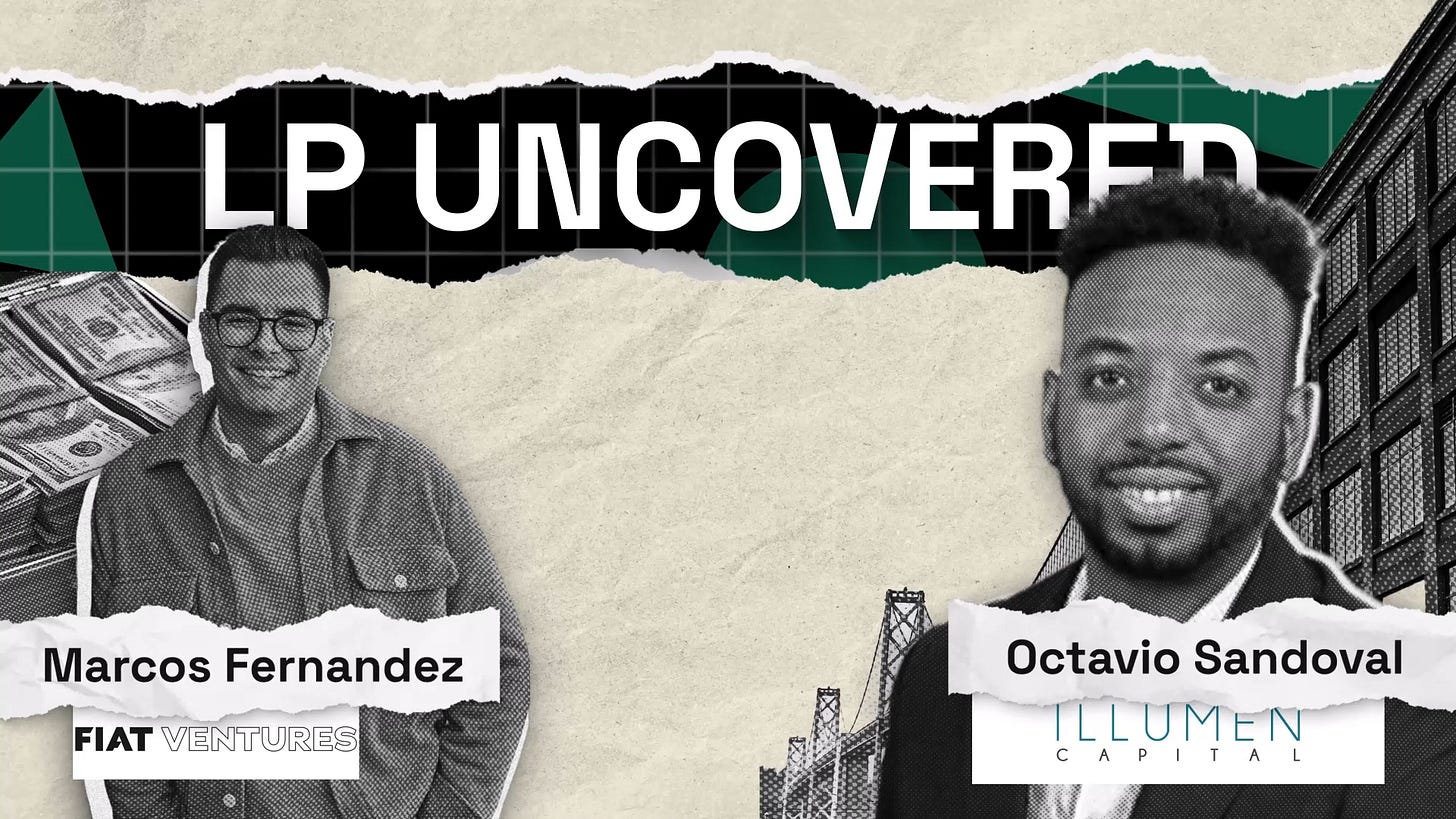
Octavio Sandoval
Illumen Capital
The Architecture of Inclusion
In this Episode
Octavio Sandoval is not interested in the charity of venture capital; he is interested in its inefficiencies. As a principal at Oakland-based Illumen Capital, Octavio is helping lead a charge to prove that bias in asset management is not merely a social failure—it is a data blind spot that leaves alpha on the table.
Octavio’s trajectory from a founding student at a KIPP charter school in the South Bronx to the halls of Choate Rosemary Hall, Cornell University, and MIT Sloan provides him with a vantage point few institutional allocators possess. After years in capital markets and private wealth, Octavio realized that his CFA charter was better utilized uncovering overlooked value than simply compounding existing wealth. At Illumen, he oversees a strategy that combines a fund-of-funds model with a surgical direct co-investment arm, all underpinned by a proprietary bias-reduction curriculum.
The Alpha of the Blind Spot
The venture capital market remains stubbornly exclusive, but Octavio views this through the lens of market friction. Illumen’s primary thesis is that inherent biases cloud investment decisions, leading to a misallocation of capital. By requiring portfolio GPs to undergo a bias-reduction curriculum, Illumen essentially installs a psychological patch for the venture industry’s operating system.
Since Octavio joined in 2021, Illumen’s assets under management have tripled, growing from approximately $88 million to nearly $300 million. This scaling serves as a quantitative validation of the firm’s “Bias Alpha” thesis. In a tightening liquidity environment, institutional allocators are increasingly looking for managers who have a proprietary edge in sourcing; Illumen’s edge is the ability to see what the rest of the market is conditioned to ignore.
The Logic of Network Underwriting
While Illumen began as a pure fund-of-funds, it has evolved into a multi-vertical powerhouse through its co-investment strategy. Octavio leverages the deep underwriting of his portfolio GPs to identify high-potential founders, particularly women and underrepresented leaders who receive less than 2 percent of all venture capital.
“We read every quarterly investor report and attend every annual general meeting,” Octavio says. The strategy is built on signal detection: when a trusted seed-stage fund takes its full pro rata in a Series A round priced by a strong external lead, it creates a de-risked entry point for Illumen. This “network underwriting” allows the firm to deploy capital with the speed of a direct investor while maintaining the diversified safety of an institutional allocator.
“There is an old adage: When you ask for money, you get advice, and when you ask for advice, you get money. The best time to build a relationship with an LP is when you are not actively raising. It demonstrates coachability and allows the LP to feel invested in your journey long before a check is signed.”
The GP Unit Economic
In Octavio’s framework, the most critical metric for an emerging manager is not just a track record; it is the GP commitment. He views “skin in the game” as the venture equivalent of unit economics. For Octavio, a manager’s willingness to commit their own net worth to a fund is the ultimate signal of alignment and resilience.
While the firm remains empathetic to managers from non-traditional backgrounds who may lack personal wealth, they utilize creative structures like management fee offsets to ensure that the “marriage” between LP and GP is built on a foundation of shared risk. It is a philosophy that prioritizes “scrappy DNA” over pedigree, looking for managers who have a history of overcoming the odds—a qualitative metric Octavio knows intimately from his own upbringing.
The 15-Year Marriage
As venture capital shifts away from the “grow at all costs” mentality of 2021, Octavio is looking for builders who understand that this is a relationship business, not a transactional one. He views the LP/GP bond as a 10- to 15-year marriage that requires radical transparency; what he calls “the good, the bad, and the ugly.”
For the next class of builders, Octavio’s approach serves as a blueprint for the future of institutional investing: a blend of rigorous quantitative signals and a deep, intuitive understanding of human resilience. By focusing on sustainable unit economics and the “fight” of the investment thesis, Octavio is not just uncovering new founders, he’s re-architecting how the industry values them.
More from Uncovered Media





Read the full transcript
0:00 The GPs are asking Alexander for money and at the end of the day, it's a relationship and so you should always over-communicate. This is my word of advice. No one likes surprises and this is
0:17 old added. I use it recently. You know, when you ask for money, you get advice. Then when you ask for advice, you get money. In the world of venture capital, where the conversations often focus on
0:33 either the mega funds or these mega unicorn companies, there's a huge piece to the equation that's missing and that's the limited partners in the allocators that provide a lot of the capital to this ecosystem. And I'm your host, Marcos Fernandez, to provide a little bit of visibility to this ecosystem. I'm fortunate to be one of the co-founders in the managing
0:50 partner Fiat Ventures and emerging manager. And on LPN covered, we want to give a voice to these crucial investors. The goal of this is to help you get a better sense of the people who are leading this innovative industry. Today is a very special episode. Octavio Sandoval, he's a principal at Ellumin Capital. Extensive background, both in direct and fund investing, not
1:08 just at Ellumin over the last several years, but at Mass Mutual. And he was one of the early K IP students in those programs that just got off the ground. We'll talk more about that. This is a chalked-packed episode today, not just talking about what he does, but also advice for
1:23 emerging managers. We'll talk about GP commitments. We're going to talk about allocation. We're going to talk about unit economics, founder dynamics, team dynamics, all the good stuff. So if you want to get a sense of what it means to get, you know, partnerships from these types of allocators,
1:38 this is a great episode you won't want to miss. Let's dive on in. Everybody, welcome back to L PN covered. Today, we are so lucky to have someone who I consider one of my close friends, advisors, mentors, therapists. I would even say Octavio maybe in some of the calls and things that
1:55 you've coached me through. Octavio Sandoval from Ellumin Capital, thank you so much for joining us today. Thank you, Marcos. What happened to me? I'm excited to have this conversation with you. Absolutely, man. Thank you so much. And as you know, right, so the goal of
2:10 today is really to uncover, not just, you know, who is Ellumin and what's going on in the market, but who is Octavio himself. He's got, you know, such an incredible story, you know, from your upbringing and all the things that you do both professionally and in your personal life, working with
2:25 groups like Kip. But, you know, for the audience, give them a quick background of, you know, how did you get to where you are today as a principal at Ellumin Capital? And, you know, we'll kind of dive in there to learn more about the things that you're working on now. Wow. So how much time do we have a little bit
2:40 about me? My parents are immigrants from Central America. My mom immigrated from Guatemala, my father immigrated from Honduras, and they didn't have anything. And so when I was growing up in
2:55 the South Bronx, I got to see the work ethic of my mom, really showed she had about four jobs. And I knew education was supposed to be the avenue for me to pursue. They
3:10 sacrificed so much so I could be in a position to take advantage of the educational system of America in particular New York. And you alluded to it. I got lucky, joined Kip since the beginning. I was one of
3:25 the founding members of their classes. And long story short, I attended Kip first charter school at the age of, let's call it 10, so fifth grade Kip open doors that I didn't think
3:43 would be possible. By that, I mean I was able to go from Kip to Chobro's my hall. It's a prep school out in New England, in particular, in Connecticut. J.M.K. was an alum. And so that gives
4:01 you a sense for me thinking about education and how to use it to open doors for myself. And if you're wearing a kit. Octavia, just because in case folks don't know what Kip is, just because I know you and I are finally active. Yeah, you always use acronyms, but then don't think about the
4:23 audience outside of the folk school. What is the ROI on the kid? Yeah, exactly, right. Right. Yeah, but yeah, let people know what it is, because it's more than just a school, right? Like it's a school.
4:38 Yeah, yeah. Kip stands for knowledge of power program. When I started at Kip, this is 1998, I'm dating myself. There was only two Kip schools, one in South Bronx and one in Houston. Now there are over 300 Kip schools throughout
4:55 the country. And I'm proud to be on the board of Kip NorCal covering 22 schools throughout the Bay Area. Not to digress too much, but Octavia invited me one time to visit a Kip school along with our good friend Brian from Kip or what a wonderful experience. These are schools
5:14 that aren't just you walk into a classroom. There's a lot of structure where there's typically not opening up doors for people who don't have access to it. And we walked into a classroom , I think of first graders or second graders, and they're telling me what university they want to go to, which is just such an incredible motion to teach kids who typically don't have access to
5:34 these resources to plan ahead and to think in that way. It's such a powerful thing. So not to digress too much, but Octavia, when you talk about the power of education, you got to see it and you're passing it along now, which is great. So when I was at Kip, the university I wanted to
5:50 go to is Cornell. I'm actually learning that Cornell's classroom. I graduated in 2010 and I was fortunate to get into Cornell and I really took advantage of my opportunity there. I went to
6:05 Cornell today, undergraduate business program to study finance and accounting, and then I started my career 2010 at JP Morgan and Capital Markets, then pivoted to private wealth at Wells Fargo
6:22 , realized that there's more to life than just making rich people money. And so I wanted to experiment a little bit, and the best way to do that is to pursue an MBA. It's essentially a two-year experimentation,
6:37 if you will. And so I was fortunate to attend MIT Sloan in 2015 and I stumbled upon impact investing. And by the way, when I was at MIT, I was a little bit crazy. Not only was I
6:54 taken their very rigorous quad curriculum, I was also studying for the CFV charter. And so I didn't have much time for myself to sleep, really network, and so I was just there to really focus. And so my
7:12 second year of MIT Sloan, when I passed the CFA level three exam, I looked at myself in the mirror and I told myself, I have to do something with this. This is a calling. It's not easy to pass three levels of the CFA exam. And CFA's is a charter financial analyst program, and each level roughly
7:34 40% passive, and so if you don't pass one level, you have to wait an entire year to take it again. And so for people listening, this is almost like the bar equivalent for financial services. This is more than like one test or two tests to make sure that you've done your
7:49 research. This is pretty extensive and provides you with licenses and certifications that are hard to do. So you have to do that while you're pursuing a quant, focuses, yeah, that's a lot of hard work. Yeah, hard work, right? And again, I learned that from my parents.
8:06 I'm just growing up watching them. And so I was fortunate in 2017 to land an institutional investing gig at Mass Mutual. Mass Mutual is a life insurance company, the general investment account, roughly 300 billion, and I was responsible as a
8:25 director focused on attorney of investments. And to be honest, at that time, it was more credit strategies, prior credit structure, credit distress, the list goes on and on. And then 2020
8:40 , George Floyd happened, and Mass Mutual wanted to do something. And I was fortunate to get the call, and I was able to build out an emerging manager's business. And 2020 is really the year that revolutionized how I thought about investment management in particular. And let
9:00 's just say I was given a mandate of 100 million and was finding a lot of opportunities to invest in emerging managers. And so in 2021, when I finished deploying that capital, not only into
9:15 emerging managers, but also into direct startups, I wanted to increase that mandate. And the response was, let's just see how the portfolio shakes out. I remember we went into the investment committee, why there's abundance of opportunities to generate outsides return into space.
9:36 And again, the response was, let's just wait and see. And I didn't want to wait to see how the portfolio shakes out. So I tested the market was fortunate to submit an application to the Lumen capital. I was fortunate to be out 600 applicants to become the director
9:54 of the investments at a Lumen. And what resonated with me with a Lumen was fighting a pain point or addressing a pain point in the market. And that pain point is very simple. The market isn't inclusive,
10:09 because we have a lot of inherent biases. We all have inherent biases. So a Lum en secret sauce is to allocate to GPs, exactly GPs, emerging managers, and work with them by having them go
10:24 through our by-production curriculum so that they can make not only better business decisions internally, but better investment decisions. And then they're probably in a position to influence these companies. And so help these companies see that by checking
10:43 their inherent biases at the door that this is an outward generating strategy, or this is a way to create a competitive edge. And so joined the Lumen November 2021. Since then, it's
10:58 been a beautiful journey. When I was at a Lumen in 2017, I believe there was, excuse me, 2021, I believe that there was just 88 million assets under management. And we had to re-fold that in a few
11:15 years that probably can't talk about our fundraising. So we have grown a ton. We have grown a ton. And it's just exciting to be here talking about a Lumen and our investment
11:32 thesis. Yeah. And that's it. Even before we jump into the things that you're working on today, maybe talk really quickly, because there's so many wonderful people out of Lum en that I know I've gotten to meet outside of yourself. Joanna, Maria, Jeremy, the whole team,
11:50 even under Darren, has the same kind of ethos about it. So before we jump into investment strategy and how you're deploying, talk a little bit about what attracted you and how that aligns with the values that you talked about growing up with. What are kind of the main mission statements? And
12:07 then how do you take that into practice when you think about making investments? Oh, yeah. For sure. And so as context, I was living on the East Coast when I got the offer to join a Lumen
12:22 . I met that I had to relocate on the East Coast to the West Coast where a Lumen is . We are based in the Bay Area, East Bay, Oakland. And so what really drew me to join a Lumen was
12:40 the culture. And so if you look at Maria, again, similar background, she was born and raised in Oaxaca, Mexico. And her parents are from Mexico. And she went to Stanford. She was able
12:59 to capitalize on the opportunities that were provided to her by being in America and working extremely hard. And so that resonated with me. And so in our business, again, we try to back G
13:17 Ps that gets it. And at the GP level, it's extremely hard to get there. And there's a required hunger. There's a required ethos, required work ethic that you need to make it to the next level.
13:34 And so as an institution investor, we try to back the next generation of GPs and by getting to know how they overcome adversity or how they think about pain points and how they
13:51 plan to address those really resonated with me because we want to grow together. And the best way to grow together is through common beliefs and through conflict. I love that. Now, you kind of
14:06 focused on GPs. And certainly that's a big part of what a Lumen does. But I also know that you do a lot of direct investing as well. So maybe walk the audience through what types of investments are you making from a Lumen? How is that structured just so that they can get a sense of
14:23 unlike some fund of funds who are just purely focused on emerging managers or that segment, you're focused on a wider array of investments. So kind of walk us through what that looks like. Yeah. And I should say that at a Lumen, we historically have been a fund of
14:40 funds, pure fund of funds. We're focused on investing in GPs. And we noticed that there's a need to invest in direct fund investments. If you look at market, to this day, less
14:56 than 2% of all founders that are women are getting access to the capital. And so that screams to me that there's a major pain point in investment management. And that just means that there's
15:15 inherent biases. And we need to address that. And also that creates an opportunity for us to show by investing. And this is just one example. Women founders, you're able to unlock the potential.
15:31 And once the markets see the traction of your unlocking, they tend to come in. And so as part of our investment strategy, I won't give you too much of the secret sauce. But we like to leverage the underwriting of our GPs. And so we already have a robust,
15:51 and rigorous investment screening process. And so once we decide to allocate to GPs, and if we're doing our fiduciary duty rate, meaning we're reading a quarterly investor report, we're going to every annual general meeting. We know the companies that GPs are
16:11 excited about. And this obviously, Mr. Alignment, it shouldn't be hard for us to invest alongside them when it comes to these current investments. So what Gil looks like, if we invested in a seed fund,
16:26 so this is a fund that invested at the seed stage. And they take their pro-rata at the series A for a company and there's room for us. And so we want to be part of that. And
16:41 we have a growing book of corn investments. And we're trying to see other big names come in after we make those investments, which is a good proof of concept for us. Yeah, solid
16:56 indication. And there's a few things that you mentioned here that I think are worth it to maybe over explain to the audience, especially those who are just beginning their fund journey is, there's often this question early on is what is the value of co-investments, particularly for your LPs, for your
17:12 backers? And it's a good conversation to have early in those discussions. But in this case, for Octavio, and this is something that we've actually found very helpful is you make investments and of your initial investments, there's certain ones that really outperform and hit that trajectory. You work
17:29 with your closest LPs, have monthly meetings, they come out to your events, you make those introductions, so that then they get direct access to them in future realms. Whether you're reserving capital to do so or not, that's a huge value add in for groups like Alumen, they have
17:44 certain mandates where they can only do that in GPs that they back. But I'm guessing, and correct me from wrong, Octavio, it's really a way for you to be able to funnel out the good from the great and to do so so that then you're allocating into a smaller funnel already prevented by your GPs.
18:00 That's correct. Awesome, awesome. That's a big thing. So back to emerging managers, there's so much going on. Co-investance source, you want to create a cadence of it. We typically do two to four a year and you can put together easier SPV structures, but it's one
18:16 , it's a good way to make sure that your existing LPs get great access. Two, it's a great way to showcase potential future LPs, the access that you have. And three, it shows people the rigor of diligence that you perform within these investments. On the contrary, there's a balance because
18:32 single investments are inherently more risky than a pooled investment. So you're investing into a fund which typically has 20 to 30 investments. Individual ones are a little bit more risky. So you also want to make sure that you are doing your job as a manager to really vet the opportunities
18:47 and not just bring anything to market, but it really has to feel special and you need to make sure you can defend that. And that's why in our process, we leverage signals. So again, back to that case study, what it looks like if we invest in a seed stage fund, meaning that they invest
19:07 in seed stage companies, and that company has a lot of traction to earn a Series A, if you will, that Series A, what we look for, the question we would ask is, is that Series A led by an external
19:23 investor? So is it priced by an external investor? And that's a good signal that that company is on the right track. Yeah, I love it. Let's talk about signals for a bit,
19:39 specifically on the direct side, but you mentioned, so net new investor and hopefully through a competitive round. So the market's really telling you what it should be priced at. What are the other things that you're looking for when you're trying to identify the opportunities that you should consider for an
19:54 investment directly? Yeah, do we believe that Tam is, I should say, total addressable market? Yeah, I said Tam, yes, Tam, total addressable market. It has to be a big Tam,
20:12 meaning that there's a big problem. There's a pathway for this company to take a big piece of the market. And so that's very, very important to us. We focus on unique economics,
20:28 we're not in 2021, where we grow at all costs. We want to make sure that the founder, even at the earliest stages, it's really focused on having strong, you know, economics. And that's just a few,
20:43 few nuggets that we try to share with. Now, any RLP's per perspective, LPs as well. Well, let's dive into those, right? So unit economics, like you mentioned, 21, it was how quickly you're growing, even in some cases, how big is the wait
20:58 list, like we'll figure out monetization later. Unit economics refers to, you know, a term around like, what is the output for the input? Is there sustainable growth here? Is there sustainable revenue generation over time? But maybe dive a little bit more into like, what
21:14 are you looking for? How are you educating both your managers and your LPs of how do you assess good value there? Yeah, and so how much does it cost to create a unit? And then how much does it cost to sell
21:29 that unit is important? And then how much are you charging? Pain and simple. And if the focus is, we're just going to have a high cap of customer acquisition costs and, you know
21:44 , the rest will follow and we can monetize down the line that that doesn't work for us. If it's, you know, we're addressing a huge pain point and the value created by having our product out there and we're able to have a healthy margin, meaning that you're selling
22:06 more or higher than the price it costs to create that product, then that's what we like. And then, obviously, we do analysis on the traction and pipeline of future customers or
22:23 clients or businesses that might benefit from your product. Yeah, absolutely. And we kind of talked a little bit about, call it like the things that you can under it really clearly, the data, the traction,
22:38 unit economics, let's maybe shift over to some of the things that are a little bit more fuzzy. It's not the right term, but, you know, it's a little bit of an art and science in making these investments. And I think one of the tougher ones to really quantify are founder dynamics, right? Co-founder dynamics, founder market fit. So how do you assess the fit of the
22:55 founder? How do you underwrite that? How do you compare that and value against some of the more quantitative things that we just chatted about? Yeah. So when you invest early on, you're essentially betting on the founder or the team. You're betting that they
23:15 can figure it out. We all know the statistics that most startups fail. And so in our industry, a lot of folks like to back cereal entrepreneurs, meaning these are folks who built businesses
23:30 before, maybe have exited out of them. So they know how to build one. That's one. Dynamic, one piece. There's other pieces that fit. And we try to go into
23:46 how the founder overcomes diversity and really trying to understand the founders. As part of our process, we try to meet with the founder and person and develop that relationship. So when that founder is in the market to raise around, we already know that the
24:06 founder has been vetted and fits our DNA. And the DNA is very simple. You have to be very scrappy. The market is hard. And despite all the odds, have you been able to overcome those odds? And
24:22 what is it about your DNA that helps you overcome those odds? And that gives us the comfort when we tend to back these founders. Yeah, I love that. There's a little bit of a hit factor in going after these. You'd mentioned cereal entrepreneurs, just
24:38 those who have gone through this before. Obviously, it's better if it's come out to some sort of exit that you can underwrite. But also, it's okay if those companies ran into challenges, because you just want to make sure that someone is willing to learn from it. And I think the other thing that is important, right, is not just someone who can run through walls, but someone
24:55 who knows which walls to run through is also something that you see with cereal entrepreneurs. They tend to know how to prioritize certain problems or challenges or navigate them a little bit more seamlessly, because you've done that before. So kind of shifting over, that's, we talk a lot about directs. But
25:11 you also do spend a lot of time in non-directs, right? So you're focused on fund managers. What are some of the similarities between how you underwrite opportunities? And then what are the big differences between those? Yeah, that's a great question. And so the
25:27 mindset is pretty similar. So Marcos, you're a GP, and you invest in startups, I think art myself is very similar. If you look at emerging managers, for instance, these are fun ones. And so when
25:45 you think about investing in fun ones, or I should say you typically are fun ones. And so when you're thinking about that, think of GPs and how they underwrite for, let's call it a C stage investment or a series A.
26:00 It's pretty similar. It's like, okay, well, get limited information around their traction. And so what are you betting on? You're betting on the team to actually figure it out. And so there's a lot of similarities there. And that's just one good example.
26:19 Yeah, I'll tell you, I developed a lot of empathy for alligators and sitting in your shoes through events that we've presented at, but I've sat in it like the raises of the world or some of the things. And we've also developed such an incredible set of friends and peers
26:36 who are also emerging managers, who are so incredibly talented and really good at what they do. And so it gives a lot of empathy. Similarly, for how we look at founders, there's a lot of really great founders, a lot of really great stories. So it's difficult to come to that conviction. And I don't know if there's ever a perfect deal because there's a lot of
26:55 opportunities out there in market shift. So a lot of times you're betting behind teams who you know can figure it out and make the right decisions at the right times. We did spend a little bit around like unit economics for direct investments. Is there any equivalent that you look at for emerging
27:11 managers though? I know if you're a fund one, it's it's pretty difficult. But what are some of the quantitative fundamentals that you really spend time on when you're evaluating? Yeah, and this one might be a little controversial. It's the best. Let's make this podcast spicy, if you will
27:29 . And so the GP commitment is is our equivalent of unit economics. And what I mean here is does that GP have enough skin in the game? And the reason why this is controversial
27:46 one, sometimes a lot of the GPs that come to market as emerging managers, they don't have the wealth to you know start their fun. And so you'll see
28:01 promissory notes, meaning that they'll you know allocate the management fee to actually let's like get that technical. But let's just say it's a cash list of mechanism to to make
28:19 sure that they aren't cash constrained when when it comes to building that firm, building that fund. And you know if you take a step back, the reason why we like skin of the game is
28:35 because the chances of success is you know a lot more. If you put all of your network into a business, then chances are you're going to fight and fight and pivot so that that
28:50 business can be successful. That if you're not putting any skin in the game, as soon as something gets hard, my fear is that they'll walk away. And so that's why we like to look at GP commit. And obviously
29:05 we have to use the word empathy Marcos. Yeah, obviously you have to have empathy and part of our diligence is you know if you came from a fund that you know wasn't established and you have good traction in terms of deal flow and you have a track record and you
29:23 want to start your own fun and you're not you know there in terms of well, so we'll all the same. You won't say notes of that GP just because they don't have enough skin in the game, but there's one important factor. I think it's a great call out and to dive a little bit more just for the
29:42 audience and I know a lot of the fund managers will know this, but GP commitments are very common in the industry. Essentially what it's saying is I will match my LP investors with an investment of my own. Typically you see for emerging managers, especially those who don't have
29:57 established track records around one percent, you'll see this with established funds as high as even you know call it three or four percent depending on on how much capital is being raised. The equivalent right so if you have a one percent GP commit, you raise a thirty million dollar vehicle. It's a three hundred thousand dollar investment from you as a GP saying you are putting your money
30:16 in LP. I am also putting my money in and it's really a mechanism that's historically been in a lot of these asset categories, not just venture. You'll see this in PE sometimes as a way of saying my money's into therefore I have a long vested interest in not just being stewards of your
30:32 capital, but returning you cash on cash returns over time because I need to return myself cash on cash returns. In some of the mechanisms Octavio mentioned, there's management fee offsets. So instead of taking that into the management company, you can offset it. There 's a tax advantage
30:47 strategy, but Octavio's point, it means that there's less money that has to come from the GPs to contribute which can throw off some questions around that. Octavio, this is a big topic and to your point, it's very different by GP because everyone has their own
31:03 circumstances, their own backgrounds, parents that they're caring for, how they've done successfully, professionally in the past. How do you recommend GP's approach this topic with their LPs because it is a very important one that's almost not really talked about as often until you're almost towards
31:20 the finish line of a diligence process. So what do you recommend to GP's who are kind of struggling with this? How do you bring it up to LPs? How should you position it? What do you want to make sure that you address in a very straightforward and clear way? Obviously, terms and
31:35 conditions vary by GP and the GP's are asking allocated for money and at the end of the day, it's a relationship and so you should always over communicate. This is my word of advice. No one
31:55 likes surprises and this is old added. I used it recently. When you ask for money, you get advice and when you ask for advice, you get money and so if I'm a GP and you're not raising, I think
32:11 that's the best time to fundraise. You're not currently raising and you're just literally building your network and pipeline of prospective GP's, I'm assuming of prospective LPs, I would either ask these
32:28 prospective LPs questions about everything, questions around your thesis, your strategy, how do you think you should market yourself and then that just shows coachability and how should you think
32:44 about certain terms, whether that's the GP commitment and then when it comes time to come to market, you go back to those prospective LPs and say hey, thank you so much for your
33:00 advice. This is what I've done so far. I'm actually in the market. I would love to have you give me feedback on the data room and that prospective LP is so investing you and you just reminded the
33:16 LP that chances are that LP, if they don't do anchor checks, they'll come into your AF fun because it's a relationship business and they see how comfortable you are, they see how you're able to make
33:35 shifts or pivot and so it should be easier for the prospective LP, assuming that LP has a dry topic to allocate to your fun. Yeah, I love this. This might be one of the best pieces of advice that
33:50 we've had on this podcast. Seriously though, I think there is a perception and you see this from founders too is I'm not going to engage with you until there is a wall at open moment. I'm in market. Are you in? Are you not in? But it's
34:08 relationship. We're in an unlike a founder to venture where typically it's shorter cycles. Let's talk a bit about the GP to LP. These are years-long relationships that need to be cultivated. It is a
34:23 minimum of 10-year marriage but if you follow on on two or three funds, you're looking at 15, 16, 17-year marriage. You gave some great advice just around seeking advice but talk a little bit more and maybe
34:38 help when GPs think about prioritization because candidly and probably for the oversharing on this but when I look at our CRM, we've got over 500 names of people that we've engaged with at some time periods. So you also as a GP need to be mindful of how do you allocate
34:56 your time accordingly. What advice do you have for GPs when they're thinking about not just cultivating relationships but where do you allocate that time and how do you respectfully qualify opportunities without burning bridges or relationships? How have you seen that kind of done
35:12 in a good way? Again, take us up back to be a successful GP. You have to raise money. You have to source the best deals. Get into the best deals. You have to work with your portfolio companies
35:29 to add value or to drive value and then if that's successful, you have to do it all over again and so yeah, it's a cycle that repeats itself over and over and over again and so that
35:45 just tells you you don't have that much time to just focus on one aspect of that cycle and so and that one aspect that we're talking about is building the relationship so that you can fundraise
36:01 and so if you know I am on the board of endowment and we don't do fund ones and you want to spend one hour pitching me to think about allocating to you and also as an
36:18 institution investor we typically have rules and one of the rules is we don't want to be more than 10% of a fund size and if you know this endowment minimum ticket size is 10 million and you're already a manager let's call it and the VC space wanting to raise 50 million is no way this end
36:37 owment would entertain you but yet you want to spend an hour pitching I'm hoping for the best or swinging for defenses and that's just a recipe for disaster and again that one hour of the pitch and then
36:54 you send a follow-up email and then you send you know updates and once performance is better than the market then that creates formal that creates excitement about oh you're in the market for
37:12 another funding you crushed it with your initial fund yeah lots of listen because you were able to generate not only TV PI but you were able to generate a deep PI so that would be my
37:27 advice there to focus on the the perspective of ease that that makes sense and it requires discipline and when you're not you know fund raising after you raise your first funding the buying capital then it
37:42 probably makes sense to check in with the hotter names these are the big stick ier tickets from institutional investors like endowments pensions yeah I think this is great advice and
37:57 it's one that we give to our our founders right is we almost say disqualify quickly in the sense of if you if a founder starts to call the VC you should say I cannot wait to share more about what I'm building but before I get started do you mind if I ask some questions about you for founders it's
38:12 typically where do you invest is this a thesis fit do you lead do you co-lead do you participate what is your typical check size do you have ownership there's a few things there but what you find is it's when founders ask that question sometimes it can feel uncomfortable but if you do it in a genuine way it actually and in the VC signal sets a good standard it's
38:29 like okay you understand the game and and it's it took some time you know for us but it's the same thing for GPs with LPs it's catching up it has anything changed and respectfully asking these questions but if it's an early relationship to your point if you're talking to an endowment
38:45 who has a 10 million minimum and 10 threshold this is someone who you should build relationships with and meet with twice a year over a long time period as opposed to you know going all in because there's just there's there's no way that they can even take the time to allocate and maybe other thing to kind of get
39:00 your perspective on that we've seen be good with building LP relationships is L Ps are also fundraising so LPs are not all the same you know what we can kind of dive in for for aluminum what that means but there are certain LPs who are also raising from groups so one thing that we
39:15 see be really helpful is certainly if we know an endowment they can't allocate into us but they can allocate into a potential fund of funds or LP so one of the things that can work really well as a GP is don't necessarily disqualify these long-term relationships but what you can do
39:31 is you can turn a no into you into a potential yes into someone else and it just cultivates this good will around what you're doing and tell me I'm wrong here but if you can help an LP get a check from a large endowment you can bet that all of a sudden the value that you drive to that
39:46 firm in the way that they look at you shifts a little bit because they can see that you understand the way the game is being played all right all right well set that's awesome awesome we can spend a ton of time into here but I want to be mindful of our time I've already learned a ton of things
40:02 so I'm going to shift into a quick like quick fire round with your Octavio and I want to pick your brain on this so we talked a bit about this indirectly but what are maybe one or two things that emerging managers do that you wish they did less so what are some of the bad habits that you see
40:19 almost become the common practices that you wish just didn't exist anymore yeah so as a again as a emerging manager your fun one may be fun too and so the pressure for success is much
40:36 higher and so you just want to show the great the good and exclude the negatives or the bads and at the end of the day this is a relationship business so communications should always be there and so we want to hear the good the bad and the ugly and so what I've seen is for instance with like val
40:58 uations and you know as a fund of funds we see companies that other funds are in as well and so we'll see if that valuation is consistent across and there was a company that there was a
41:13 markdown in valuation and I asked one of the emerging managers that has exposure to it why is the valuation the way it is and the response you know was was not genuine and so that's that's an issue so
41:30 that's one thing that we could work on two is double down on the fundraising efforts which takes away time from what makes you great you know if you're probably great at fundraising probably
41:49 not great at when it comes to you know picking the best companies and then if you're very picking the best companies fundraising should come because you're able to you know generate output and a lot of institution investors are looking for ways to you know grow their their their balance sheet
42:10 so that they can make great investments for you know if you're going to give money back to the university and help grow the facilities if you will yeah those are great great advice as
42:25 always vice versa what have been some unique things that you've seen some emerging managers do that you wish more did or maybe creative ways of you know having themselves stand out yeah um they really know LP and and so with uh with our emerging managers they know we have um pools of
42:47 capital for excited gps and obviously emerging managers and so that always asks me or a little man you know what are some things that the excited gps are doing that you think we should
43:02 incorporate at the end of the day we don't want to be at the emerging managers bucket or be labeled emerging managers we want to graduate it do well and so this is a good question that you should be asking
43:18 and and again remember the the DNA that that we like pivoting being able to you know roll up your sleeves and these other folks that tends to be more successful because they're always
43:33 asking the right questions and they're always pivoting so that you know whatever the market throws at them they're ready back to if you want great advice ask for money if you want some money ask for great advice it's it's um it's showcasing that you're thinking of things the right way and would
43:50 you say that's a little bit around firm building it's it's talking to managers and they're asking the questions because you can tell that they're looking ahead towards future funds and in the steps they need to get there yeah yeah awesome awesome um jumping ahead because that's a whole thing that we could spend time on what i want to remind for that we've already taken up a lot of yours is
44:09 um any podcast that you listen to regularly uh that that you recommend for not just emerging managers and VCs but just folks in the in the space well every so at a moment we love Charlie Munger um and Warren Buckman
44:26 yes we read the financial times every day walk into dinner every day um every day economists every Saturday um and you know a lot of the books that really resonated with me
44:43 happened to be by David Rubenstein you know there's one that helps invest that that I really like um so it's just essentially um a book of the world's most famous investor it doesn't matter
45:00 what the strategy is and how they think about it and so when it comes to you know coming up with your investment strategy and why you think you'll succeed I think everyone should read that David Rubenstein's helps invest book that's it that's a great uh great recommendations all around
45:18 um for those listening aren't it familiar Charlie Munger was the business partner of Warren Buffett I think Warren Buffett is more of the forward-facing individual most notably known for his his his letters but Charlie Munger was a phenomenal investor but also a wonderful human being who
45:34 really encapsulates human character and doing the right things into investing strategy and in almost compounding not just interest in your investments but relationships over time and so I'll throw in a podcast the acquired podcast is a well-known one they they have a few great
45:51 episodes on Charlie Munger for anyone who is not familiar those are really good ways to quickly just get a sense of probably one of the brightest minds and best you know human beings in the investment world you know that we've ever seen so that that's that's that's awesome um Oct
46:06 avio this is amazing any any parting words anything that you want to leave people with uh today yeah um let's keep fighting the good fight if you have an investment thesis or you're trying to solve a pain point and you think you have an edge fight the good fight and if they want
46:27 to share with you the fight that they're fighting what's the best way to get in touch either with you or folks from aluminum i promise we love them bound we love them bound we respond to every uh mbound requests and so my email is fine for sure cool cool um thank you so much
46:48 this this was a great one email linked in um ping me i'll send you as i'll send you his cell phone just kidding just kidding no Octavia this is awesome i learned a ton from you yeah all of a sudden i'm gonna get
47:03 a bunch of spam i'm happy to meet with any emerging manager and share notes unfortunately uh i my GP commitment keeps me from allocating to anything other than my own fun and my my kids diapers uh at this stage of life so yeah yeah awesome thank you so much Octavio learned a ton
47:19 today uh and just grateful to have you on here that thank you thank you that is one of my favorite episodes octavio is not just a great friend who tells it like it is but he has such an elegant way of keeping things very simple what did i learn from this relationships matter it's not about
47:37 transactions if you want great advice ask for money if you want money ask for great advice it's not just about presenting this picturesque view to your potential lp's and allocators it's also about making sure that you're asking for advice that they know that you're looking around corners that they're
47:53 helping be a part of that journey that is incredibly important not just in building trust but them knowing that you are going to do what you say you're gonna do thanks so much Octavio uh shout out to alumin who is really doing some great things both in the asset allocating uh as well as direct
48:08 investment space we've got a whole bunch more lp uncovered is coming your way that we're recording this week and next i cannot wait to share with you more stories but for now i'm just grateful to have you listen in and thanks again octavio for joining us today we'll see you on the next one and that's a
48:23 wrap for this episode of lp uncovered i'm marco's frananda so i'm one of the co-founders and managing partners if you have ventures and we appreciate you listening we'll see you next time as we continue to uncover this world of limited partners and allocators that place such a key role in both the founding and funding of these world-changing and innovative ideas and founders to
48:42 explore more insights you can find a lot more related to this publication and other publications on lp uncovered dot com and i encourage you to take a look at a whole bunch of the different things that we have going on uncovered media get to know the teams the thesis is the founders and everything that's driving the industry around this we'll see you on the next episode
Transcript generated automatically; it may contain errors.
Originally published on LP Uncovered · By Marcos Fernandez, Brandy Whalen