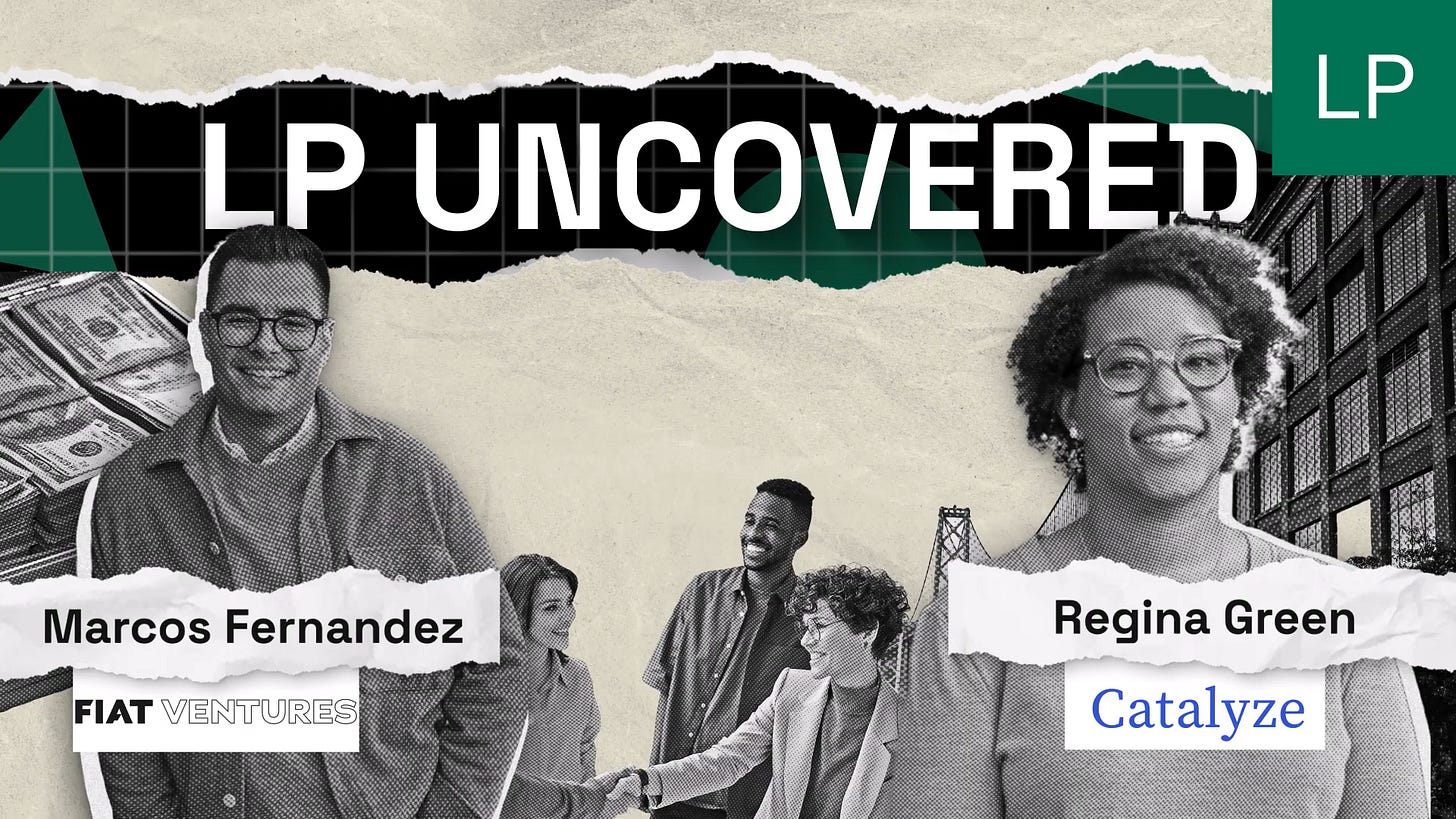
Regina Green
Catalyze
The Capital Before the Capital: Funding the Next Generation of VCs
In This Episode
Regina Green shares her journey from her upbringing in Georgia to her extensive career at Goldman Sachs, where she navigated through various roles during tumultuous market conditions. She discusses the origins of Catalyze, a platform aimed at supporting underrepresented fund managers through their Fund Fellowship and the launch of GP Runway Fund, which provides non-dilutive capital to help them build sustainable firms. Regina emphasizes the importance of understanding the unique challenges faced by emerging managers and offers valuable insights for those looking to succeed in the finance industry.
Key Quotes
“My parents also instilled the value of education as the one thing no one can take away from you.”
“I now operate with the assumption that the person across the table sees the world differently, and I’m curious to learn what I can from them.”
“Lead with what makes you different. The thing that will win an LP over is your unique story and the thing that differentiates you from the pack. Lean into that.”
“I wanted to find a way to connect my passion for finance to something with a deeper purpose.”
About Catalyze
Founded in 2022, Catalyze is a national platform providing Capital Entrepreneurs — underrepresented and innovative investors – with the capital, capacity building, and community they need to build enduring firms. The company launched GP Runway Fund to provide flexible working capital loans to firms raising funds 1-3.
Catalyze offers firm-building support through its Fund Fellowship program, Capital Solutions to bridge financing gaps for GPs, and Investment Consulting Services for LPs backing the next generation of investment firms. They partner with Capital Entrepreneurs and Allocators across private markets to improve the flow of capital to overlooked businesses.
Who is Regina Green, and what shaped your early life and career?
A lot of my life’s context is built around this idea of being just a little bit different. I grew up in the suburbs of Atlanta, but my parents weren’t southerners. My dad is from Brooklyn, New York, and my mom is from a tiny town in Southern Illinois also coincidentally, named Brooklyn.
They were also a bit older than was typical for parents in the 80s, having been born in the 40s and 50s. They grew up in a very different cultural and legal world than I did. For example, my dad was recruited to IBM through a partnership with the National Urban League right after the Civil Rights Act passed. This history definitely informs how I think about diversity and inclusion today.
Both my parents worked at IBM for most of their careers, for 30 and 40 years, respectively. This idea of longevity at one institution was normal for me. When people are shocked I spent 17 years at Goldman Sachs, my reaction is, “I barely made it half as long as my parents!”
Between my parents’ backgrounds, their large families (my dad was one of nine, my mom one of seven), and me being an only child, I learned from a young age that people see the world through very different lenses. I hope this shaped a deep sense of curiosity and empathy. I now operate with the assumption that the person across the table sees the world differently, and I’m curious to learn what I can from them. This is vital in my work, where I’m evaluating potential fund managers. You’re investing in a “blind pool,” so you have to understand how their lived experience and unique perspective informs their investment thesis.
My parents also instilled the value of education as the one thing no one can take away from you. I ended up getting a scholarship to NYU, which wasn’t a long-held dream, but a last-minute decision. I think moving to New York without any preconceived notions helped me assimilate really well. I majored in Math and Economics, interned at Goldman Sachs, and fell in love with macroeconomics.
I started full-time in 2007 in sales and trading, which was a chaotic time to join Wall Street. My first couple of years were insane: watching competitors cease to exist was stressful, but it was also an incredible learning opportunity. It “leveled the playing field” because everyone, even senior folks, was coming in asking, “What’s the Fed going to do today?”
After that role shrank due to market changes, I moved to the Conflicts Resolution Group for 10 years. Our team was the traffic cop, reviewing every significant investment or advisory assignment to ensure the firm avoided conflicts of interest or reputational risk. It was a unique, high-level seat where I got to learn about every single business line at the bank.
You built your adult life in New York instead of returning South. What kept you there?
It’s true, a lot of my friends have moved back home. I always say New York is where I learned how to be an adult. You quickly learn you can only buy as many groceries as you can physically carry home!
But I love that it’s a surprisingly communal city. When you’re walking everywhere, taking public transportation, and spending time in places like Central Park, you feel a real sense of community. That feeling was amplified during COVID, seeing the city band together.
I’ve built deep roots here, including a strong church community. You need that sense of community, or the stress and energy of New York will overwhelm you. It’s also a place with unparalleled access to theater, entertainment, and, most importantly, a diversity of industries and perspectives. You can always pivot or learn something new here.
Plus, it’s a place people love to visit, and with three major airports, it’s easy to get anywhere.
What compelled you to pivot to Launch with GS during the 2020 pandemic?
In early 2020, I was the COO for the interest rate trading business. My job became figuring out how to keep our trading desk resilient during a global pandemic. It was one of the hardest seasons of my career, trying to solve an unprecedented problem: How does a trading floor, which relies on people yelling across the room, operate from home?
Once we settled into a remote-work steady state, I was watching the news, overwhelmed by the fact that people who looked like me were serving as essential workers, risking their lives, while I was safe at home.
It caused a lot of reflection. I love finance, but I felt the industry wasn’t serving people as broadly as it could. So many of my friends hate talking about it. I wanted to find a way to connect my passion for finance to something with a deeper purpose.
As I was exploring the venture and growth equity world, an internal role at Goldman’s Launch with GS initiative opened up. They had been focused on gender equity and were expanding to include founders and fund managers of color. In the interview, they told me, “This is a new thing. Nobody knows how to do it. We’re going to figure it out together.“
It wasn’t just an investing role; it was a chance to build an ecosystem and infrastructure from scratch. Goldman didn’t really have an emerging manager practice, so my job was to be a bridge between the bank’s massive platform and this new ecosystem we were trying to support. It appealed to the creative problem-solver in me.
What led you from Goldman to joining Catalyze?
At Goldman, we successfully executed on the firm’s $1 billion commitment over five years, and then the program was concluded. From everything I had learned, I knew the ecosystem still desperately needed support, particularly for emerging fund managers.
You can’t just decide to back diverse managers if you don’t also have an intentional way to incorporate new managers. It’s not like there’s a huge pool of underrepresented managers who have somehow already built institutional-quality firms while being underfunded. That infrastructure needs to be built, and that’s the gap I saw. I wanted to work with an organization tackling this challenge.
Why is it so much harder to underwrite an emerging manager versus an established firm?
Institutional allocators (like pension funds or banks) focus heavily on a repeatable track record. A first-time fund, by definition, doesn’t have that data.
But it goes beyond that. Allocators also have a fiduciary duty, so they need to see that you have the professional controls, processes, and service providers in place to handle their money. They’re asking, “Are my funds going into the right accounts? Are you complying with all regulations?”
All of that operational infrastructure—legal, compliance, fund administration—costs a lot of money and requires a meaningful team, which new managers just don’t have on day one.
How did you connect with the Catalyze team, and how are you helping emerging managers scale?
Historically, new venture managers would start with small “friends and family” funds, then raise from high-net-worth individuals, then family offices, and then finally graduate to institutions. That process, while slow, is important because it gives the manager time to learn and build their systems.
In 2020, many institutions wanted to short-circuit that process to improve representation, but they either struggled to find satisfactory managers or were trying to invest without all of the typical infrastructure being in place.
Catalyze was founded to provide that operational support and technical assistance. We’re not here to teach someone how to be a great investor; we’re here to bridge the information gap. We help talented managers avoid costly mistakes and build the firm infrastructure that institutional LPs (Limited Partners) actually care about.
I got connected to the Catalyze team (Maegan and Brendan) through two separate mutual friends around the same time. I joined as a consultant to help build out a new product, the GP Runway Fund.
We built it to solve the “chicken and the egg” problem: You need firm infrastructure to entice LPs. You need LP commitments to get management fees. You need management fees to pay for the infrastructure. Underrepresented managers who don’t have personal wealth or wealthy networks get stuck in this loop.
What exactly is the GP Runway Fund, and how is it different from a typical LP investment or a GP stake?
The GP Runway Fund is our first investment strategy. We provide flexible working capital loans, typically $100,000 to $500,000, directly to the manager’s management company.
Unlike an LP investment, which goes into the fund to make investments, this capital is to build the firm itself. The loans can be used for formation and growth expenses such as hiring, engaging service providers, and fundraising costs.
And critically, unlike GP staking, our capital is entirely non-dilutive. We are not taking any ownership in the firm or the GP (General Partner). We believe diluting a manager’s ownership is counterproductive to our mission of closing the wealth gaps and increasing access to capital in historically overlooked communities.
You mentioned GP staking. Why can that be detrimental to a new manager?
When you’re just starting, selling 20% or 30% of your management company for a check might seem cheap because the company isn’t worth much yet and you aren’t required to make cash payments early on.
The problem is, if you’re successful, if you go on to raise multiple funds and generate significant carry (investment profits), that 20-30% stake becomes massively expensive over the life of your firm.
More importantly, it can create incentive misalignment. An LP’s interests are aligned with the GP’s: make good investments, and everyone wins. The management fee isn’t what makes you wealthy; the carry is the real incentive. If you’ve given away a huge chunk of your firm and your carry, it impairs how much you’re tied to that investment performance, which can be a concern for future LPs.
What are the most common use cases for the GP Runway Fund?
We often say you need at least $150,000 just to get started. That’s just for legal counsel to draft the documents, to engage basic service providers, or travel to meet LPs, and it doesn’t include a salary for the GP.
For Fund 1 managers, the capital is used for those initial formation costs, hiring the first team members (like a platform or operations lead), and travel.
For Fund 2 and 3 managers, it’s often about scaling. They need to hire more people to manage a larger fund. They also need to invest in more robust, institutional-grade infrastructure, like cybersecurity and compliance, which LPs may ask to see before they commit capital.
We want managers to see this as strategic growth capital to invest in their firm’s execution capacity.
What’s one common mistake you see new managers make?
They don’t run their fundraising like a sales process.
There are many different types of allocators, and they all care about different things and invest at different stages. Too many managers approach their “later close” LPs (the big institutions) way too early, before they have the initial traction and capital raised that those LPs need to see.
You have to qualify your LPs and run a disciplined process, just like you’d advise your startups to do with their customers.
What’s a great tactic you wish more managers would use?
I recently saw a manager in our network bring a founder from one of their portfolio companies to an in-person LP meeting.
It was brilliant. It makes the GP’s strategy feel concrete and real. It’s also a creative and different way to provide an update. LPs are in meetings all day, and they told the manager, “A GP has never done this before.” It was memorable.
What’s your final piece of advice for fund managers?
Lead with what makes you different. Yes, there are basic, fundamental best practices you must have in place. But at the end of the day, the thing that will win an LP over is your unique story and the thing that differentiates you from the pack. Lean into that.
How can people learn more about Catalyze?
You can definitely reach out to me on LinkedIn.
You can also visit our website: catalyze.community. We have an inquiry form right on the site where GPs can express interest in the GP Runway Fund and learn more about the Fund Fellowship. We’re always happy to chat with GPs, even if it’s early in their fund-building journey.
More by Uncovered Media


Read the full transcript
0:00 There's not really a concept of kind of a pre-seed or seed investor in the emerging management space. For the most part, you're raising LP capital, that LP capital or limited partner capital. There's management fees that you would use to pay for all of this
0:15 infrastructure. You don't get that until you're able to close on LP commitments. And so you kind of can end up in this chicken and the egg where you don't have a stream of cash flow and you don't have a pile of cash laying around to invest in that
0:30 firm infrastructure and you need that from infrastructure to entice LP's. In the world of venture capital where the conversations often focus on either the megafuns or these mega unicorn companies, there's a huge piece to the equation that's
0:46 missing. And that's the limited partners in the allocators that provide a lot of the capital to this ecosystem. And I'm your host, Marcos Fernandez, to provide a little bit of visibility to this ecosystem. I'm fortunate to be one of the co-founders in the managing partner Fiat Ventures and Emerging Manager. And on LPN Covert, we want to give a voice to these crucial investors.
1:04 The goal of this is to help you get a better sense of the people who are leading this innovative industry. Today on LPN Covert, I'm really excited to welcome Regina Green to the podcast. And today, Regina Green is the Director of Investments for a group called Cat alyze. What Catalyze does is it's more than just allocating capital to emerging
1:22 managers. What they do is they provide debt financing, accelerator service, and ment orship as you think about growing that business. And there's the old saying, you know, teach someone to fish versus catch them a fish. This is a group that definitely teaches you what to do in building out those processes to be a successful firm builder.
1:38 I'm really excited for today for two reasons. One, Regina is one of those really amazing people in the ecosystem that's driving this change forward and really building a name for herself. And two is similarly to other episodes, the goal here is to provide visibility to all of the resources available to emerging managers.
1:54 And a lot of that is more than just capital and capital allocation and Catalyze does an incredible job of that. So buckle up, sit in, we have a really special episode for you today. Excited to get started. Regina, thank you so much for joining us today on LPN Covert.
2:10 It's really exciting to be able to chat with you. Yeah, it's a pleasure to be here. Thank you so much for having me, Marcus. Yeah, absolutely. And so by this time, anyone who's been listening in, you know, they already know a little bit about you and your background on what you've done. But what I really want to try to uncover is, you know, who is Regina?
2:26 So maybe take us back to your upbringing in the South, I know we've talked about it in the past, but really what shaped you to be who you are today and maybe a little bit about what got you even up to the early professional career. Yeah, I guess kind of going back to the beginning, you know, reflecting on some
2:44 of our conversations and what has shaped my perspective and we may start with, yeah, yeah, I'm originally from Georgia, just outside of Atlanta, a group in the suburbs there. And I think, you know, when I look back, a lot of the context of my life is
3:01 sort of built around this idea of being just a little bit different from everyone else around me. I think even kind of starting with my parents. So, you know, two things that might seem like irrelevant details, but I do think shape a lot of how I view the world are both my parents are not, not Southerners.
3:19 My dad is originally from Brooklyn, New York. There's maybe a little bit of returning to my roots now that I live in New York . And my mom is originally from a very tiny town, like the total opposite of being from New York, but a very tiny town in Southern Illinois, also called Brooklyn,
3:36 coincidentally, but just outside of St. Louis. The other Brooklyn and the other Brooklyn, you know, the one that gets a little bit less attention, you know, the town of like 3,000 people, which is, you know, for in contrast is the size of my high school. So it's like very different world that like I grew up in versus my mom.
3:55 And one of the other things I think is somewhat notable is generationally, my parents at the time I was born back in the 80s, my parents were older than what was typical at the time. It's like not that notable today, but I mentioned that because I think the frame in which they
4:10 grew up and the frame, which I grew up, even from what the historical perspective is really relevant in how I see the world, you know, my, my mom was born in the early 50s , my dad was born in the 40s. And so they grew up in a world that like the legal framework and the cultural context was
4:25 incredibly different than my growing up in the late 80s and early 90s in Georgia. And I think about that a lot because one thing that is similar between my parents and guys, they both worked at a Fortune 500 company, they both worked at IBM for almost their
4:40 entire careers. And they, they, my mom and my dad worked at IBM for 40 and 30 years respectively. So there is this element of like being a part of an institution, having a lot of long, longevity at one place that I think I sort of, you know, by osmosis kind of
5:00 took in. And so when I think about like my career, starting my career, Goldman and being there for 17 years, that's like, people often have the reaction. Like that's like a crazy thing to have worked at one place for 17 years. And for me, I'm like, Oh, I like fell short.
5:15 I was there like barely half as long as, as my parents were at the company. So they, they weren't that. Yeah. But yeah, so bring that up like, you know, my dad was recruited to IBM through a partnership between the National Urban League and IBM, like right in the wake of the passage of the
5:30 Civil Rights Act. So like, it's a very interesting kind of disconnect between the world they grew up in. And I think that doesn't form a little bit how I think about diversity and inclusion, which has been something that's part of my career more recently. My parents also both grew up in very large families.
5:46 My, my dad is one of nine. I'm almost one of seven. I was an eminently child. So, but there's a lot of different ways that from the beginning, I was kind of like the other people around me see the world through a very different lens. And I hope and believe that that is really shaped how I think about my
6:01 interactions with other people. Like I kind of enter into conversations with the assumption that the person across the table from me see the world very differently. And I, I think my instinct to all reaction to that is to try to be really curious about
6:16 other people's perspectives, what they, what they think, how they interpret the things that are kind of occurring around them and just to really be interested in what I can learn from them and how I can potentially see the world in a different way. I also hope that that really shapes a lot of empathy, which I think is really
6:33 necessary in the world that we operate in. You know, we're spending a lot of time when I evaluate potential investors trying to understand how they see the world, how their lived experience and perspective informs where they see value and opportunity to invest in, especially, you know, investing in funds as
6:50 opposed to investing in companies, you don't really have like a concrete operating company that you can evaluate, right? You're investing in a blind pool. You're essentially hoping that the investments they make reflect what you understood about
7:05 who they are and what their kind of thesis was at the outset. And so just that ability to understand and kind of view people is really important, I think, in this world. So yeah, I grew up in Georgia, you know, lived in a town called Marietta, just
7:20 outside of Atlanta, basically, from the time I was born until I went to college. My parents kind of instilled this like the value of education and the importance of, you know, like my job was to go to school and get good grades and hopefully get
7:36 a scholarship to a college, like from a very young age, it's kind of embarrassing when I look back that like I was buying like SAT prep books when my parents would take me to the bookstore in elementary school. But yeah, they just kind of made it very clear that it was important to them
7:51 that education. My mom's always kind of viewed education as a tool that's like one thing that no one can ever take away from you and that can open doors and so they were the kind of parents who told me that I could be anything it wanted to be as long as I did well in school and had a good work ethic and yeah, they also just kind of each had really
8:09 different perspectives. My mom's more of the kind of like English writing oriented person. My dad's like has an engineering background, loved math. He taught me to love math, which I didn't even realize I was doing until I got
8:24 to college and ended up majoring in math a little bit by happenstance. But yeah, so I grew up thinking, you know, I wanted to go to either I want to go to Stanford when I was really young and then eventually realize that was way too far from home and set my sights and going to the University of North Carolina, love basketball,
8:41 watching basketball as a kid and so just kind of fallen in love with that school. But eventually through the process ended up getting a scholarship to NYU and kind of ended up making a last minute decision to move to New York. It was not something that I had like dreamed of, which I think a lot of people
8:58 moved to New York with this vision of like this bustling city that they like always wanted to be a part of and I, you know, I didn't have that context. So I kind of moved here and, and really assimilated to being in New York really well. I didn't come in with a lot of expectations for what life here would be like.
9:16 And as I mentioned, I majored in math and economics, which I kind of fell into a little bit by happenstance. I originally thought I was going to be a journalism major and, you know, it made a pivot. In 2018. And that served me really well. So I, I would, I interned at Goldman Sachs when I was a junior in college and
9:37 just fell in love with the industry, I've always loved macroeconomics and just trying to understand the way the broader economic system worked. And so I had the opportunity when I graduated from college to join Goldman in the sales and trading business, specifically in our kind of money markets, short term
9:54 interest rate trading business, so I had the opportunity to go to work every day and think about what the Fed's doing and how kind of the short term markets are really the building blocks for the broader financial system. Unfortunately, at the time I started at Goldman full time in 2007, which was a
10:12 very chaotic time to be starting on Wall Street, but was yeah, there's a little bit going on at that time. Yeah, there's a little bit going on. So my first couple of years there were insane, you know, you know, the time where like many
10:27 of our competitors, you know, cease to exist in my first couple of years, a little bit stressful to be there, but definitely made for a great learning opportunity. And I've always been kind of a sponge. I love to just like learn as much as I can about the widest variety of things I can. So it was an interesting environment to be one of the newest people on the team
10:46 and in the institution and like every day people were coming in to work, not knowing what was going on or how the financial system would operate. And so there was a way in which it kind of like leveled the playing field being new and it was like, we're all coming in and being like, what's the Fed going to do today? And what's happening, like seeing things that had never happened before.
11:03 I think that's also been a theme that's that's run through my career a little bit. Yeah. So yeah, my first role, Goldman eventually went away just because of the changes in the market and the shrinking of the commercial paper market, which was kind of the
11:18 biggest part of my job. And I moved into a team called the conflicts resolution group at Goldman, which was again, credible learning opportunity. Our team was responsible for making sure that Goldman didn't have conflict of interest or take on undue reputational risk before we take on any assignment of
11:36 consequence. Which I'm sure was super top of mind during that time period, right? Yeah, exactly. You just kind of come out of the great, you're coming out of the great recession. There's a whole bunch of banking regulations that are coming into play. Exactly. Yeah. You're at the front line of that.
11:51 Yeah, definitely a dynamic environment. So yeah, before we did any sort of advisory assignment or any significant like principal investments out of our private equity group, those things all had to kind of clear through our team. And so again, it was an opportunity to learn about really every business line
12:06 of the bank is a very unique role. And one that provided this kind of like high level overview perspective on how the entire financial institution ran is like not an opportunity that most people get because a lot of the businesses do kind of operate in their own little silo and there's
12:22 someone you're essentially being kind of like the traffic cop or referee and making sure these teams aren't running into each other or causing a problem. Right. So that was very cool. I was there for about 10 years while in that role I attended business school at Columbia University.
12:37 So definitely a product of the city's educational institutions here. The other Brooklyn the close to the other Brooklyn. Yeah. Exactly. Exactly. So yeah, I do say like my entire career is really characterized by these like really unique seats and unique times in the market.
12:54 Well even before we jump further in your career, maybe just looking back a little bit at where you came from and some of the parallels, I'd almost say even between your parents and you as it relates to times in the market, what's going on around the world around us.
13:09 Maybe talk a little bit before we jump in. And what made you choose to go back to New York for staying in the south because I think that's probably one of the most uniquenesses here is most people will go into a major city and then retrench back to what feels most familiar.
13:24 Maybe what is it about the roles that you've had in staying out in New York that it's really kind of driven you to the area and then let's kind of talk about post conflict resolution and what you're doing at Goldman and ultimately what led you full circle back to the launch of launch at Goldman.
13:39 You are a lot of my close friends that I've met here have come back to wherever they came from. I usually tell people New York is where I learned how to be an adult. It is very different than living in a lot of other places, right? Like you're at the grocery store and you can bring home what you can carry.
13:54 You don't have a car with a big trunk that you can pile full of stuff. But some of the things I love about New York are it's a really communal city in a lot of ways. Like I think sometimes people are overwhelmed by it, but when you're kind of
14:10 taking public transportation and you're walking on the streets, I live on the Upper West Side so I'll get to spend a lot of time in Central Park. There is a community kind of around even though it may feel a little bit overwhelming. I think my experience or in COVID really reflected that, you know, as a time
14:27 where the city kind of had to band together to take care of one another and in a lot of ways I felt like I had this opportunity to feel invested more so during that season than any other time that I lived in New York.
14:43 In a lot of ways, I think being here as an 18-year-old and then right out of college, like I really was able to build roots and build some deep friendships with people who still live in the city and feel like I was part of a community.
14:58 You know, I've been really involved in my church community here and just like I 've built some deep relationships with people who see a vision for what it would look like to plant like their lives here. I think without that sense of community, it can be really hard.
15:14 It can be really hard to stay and not feel like, not be overwhelmed by the anxiety and stress and energy of New York. I also think it's a place where you can really, you know, it's a unique experience to have access to theatre and entertainment and a lot of different perspectives.
15:32 It's a really like diverse and bustling city, you know, a lot of other cities are built around like one or two industries and New York kind of has this like bringing together of a wide variety of perspective, experience and industry and so you can always kind of
15:47 pivot or learn something new here and that's one of the things I love a lot about being here. There are places like people love to visit. So like even my friends who've left, you know, they, they're often come back and I get to see them.
16:02 I think if they're the parts of the country I could live and it'd be unlikely that you'd get to see people and, you know, we've got three very close airports and they get pretty easy to get anywhere if I want to go visit friends and family too. So it's hard to imagine going somewhere else, but I'm open, I'm open to new
16:18 opportunity. It's the getting to the airports for me that's always the toughest part, getting in and out. But if you time it right, you can figure it out pretty easily and that usually is the part. Yeah. And kind of shifting back right is like just to kind of move us forward into
16:33 what you're working on now. But let's take a quick step backwards where you wore a lot of hats at Goldman. So without going into each detail on each group, but like you pivoted from one to the next, you spent a large amount of your career to your point. Your parents were at one place for a long time for you.
16:48 It's, it's, it's, it's been a little bit more transitional, but still for our standards of our generation, still a long time, um, you know, maybe walk us up to this point in, you know, early 2020 where the world shuts down and it changes a bit, particularly
17:03 with the ashes taken on by George Floyd and maybe walk us into what were you doing into that? And as things shut down, what really compelled you to build the program that, that is launched at Goldman and, you know, how's that really shaped to where you are today? And that's almost kind of pause right before we get to the catalyzed side.
17:20 In early 2020, I was in a seat where I was kind of a COO or what we call the franchise manager for the interest rate trading, trading business. Um, I had a little bit gone back to my roots in the beginning of my career. It was an interesting role because we were kind of responsible for all of the
17:36 business operations of the trading desk and sales business. Um, and so as everyone will remember in, in February and March of 2020, part of my job was figuring out how we were going to respond and make sure the business could be resilient
17:51 and continue trading in light of a global pandemic, um, that led to some, again , an unprecedented diet of my career. And it was really challenging because a lot of the things that you would need to do for a pandemic, like, you know, have people not be in the same space, more not
18:07 things you were allowed to do if you were kind of trading government bonds and swaps and things like that. Um, I was, you know, presented with a lot of problems that the immediate solution was going to be very difficult to implement, um, it was probably one of the hardest
18:23 seasons of my career just trying to figure out like, how can a trading desk operate from home where it's really important? Like the, you know, if you've ever seen sort of the New York Stock Exchange floor back in the day where it's like people yelling back and forth, that's how, you know, over the counter markets, fixed income markets operate, like it's really important to be
18:41 able to stand up and yell over to a trader and get a price. And so like, if you're not in the same building, how do you do that? Well, spare everybody the details, but it made for really like interesting, um, problem. And then once we kind of got to a place where it was sort of like steady state
18:56 operating from home, I walked in my house, walking the news every day was really overwhelmed by the fact that people who looked like me were, you know, serving in these like essential worker
19:11 roles, putting their lives and their families at risk every day, I'm like, I was trying to figure out like how to get computer equipment back and forth across the tri- state area like from the comfort of my home and just was really thinking about, you know, for
19:28 me, the purpose of the financial services industry is to serve people broadly, to help people invest in their financial security and build for a future. You know, there are a lot of ways where I felt like we as an industry were not
19:43 doing that. And I had so many friends in my life who just like hate talking about finance, they don't get it, they don't like it. And it just kind of sad for me that like something I love and find a lot of like, feel like I was built for is really not serving as many people as it could as well
20:00 as it could. And so it was kind of reflecting a lot on that during the pandemic and wanting to figure out how do I take my love and like sense of calling to the field of finance and do something that feels more purposeful. And so, you know, start working with a career coach around kind of imagining
20:18 what that could look like and really started to discover the world of like venture and growth equity. And it was sort of coincidental that I was going through that exploration process when the team internally launched with GS kind of had opening, there were some
20:34 shifts internally. It started this initiative about a year and a half before focusing on gender equity and how to invest in more women differences and funds and recently thought about expanding the remit of the initiative to include founders and fund managers of color.
20:52 So I interviewed for that role, it was really interesting being in the interview process. You know, I was like, you know, I'm not sure exactly how I would go about like doing this and the person who was interviewing me said, you know, this is a new thing, nobody knows how to do it. So we're going to figure it out together. And it was kind of, yeah, I was like really encouraging and like one of the
21:09 other mentors and folks for interviewing me, you know, shed some light on the role is like, this is not a role that's really about going out and investing in a bunch of opportunities that exists. It's a, it's a role that's more about building an ecosystem and building kind
21:27 of a pathway for these founders and fund managers to get started. And so this idea that it was like an opportunity focused on more of like building some infrastructure was really appealing to me, it was just sort of an opportunity to be creative.
21:42 I, you know, I think of myself as like a creative person who operates in a, you know, not particularly artistic field, but there is a lot of opportunity to be a creative and thoughtful problem solver. And so I was excited about that. I think I, despite that kind of context kind of underestimated how much we were
22:00 going to be building some things from scratch and trying to do some things that in particular Goldman had never done. We really didn't have an early stage investing business. We didn't have an emerging manager practice. We were leveraging our growth equity business and a broader manager selection
22:16 business to try to sort of a population of company than funds that we had not previously spent much time with. So that was interesting just to kind of have that lens and think about, you know, everything I've learned in my career to that point and everything I know about running an
22:31 investment bank, running a financial services firm and how we operate, how can I bridge some, some gaps and kind of be a bridge between these two different kind of operating ecosystems to hopefully get more capital serving a broader purpose.
22:46 Well, no, and I think what's wonderful here is like you're seeing so many different ties in from your childhood and having the exposure and really a lot of the similarities in these eras. And we certainly saw an era in 2020 across a whole bunch of different places, but for you to be in a position to make something of it, but your financial background,
23:02 your allocating background, that all kind of came to a head where let's introduce catalyzed, right? So maybe walk us quickly through what kind of ends of your tender there at Goldman and what made you realize that there's more opportunities out there to help fund managers with all their different products and services and maybe a quick high level
23:20 over of what catalyzes and then let's kind of dive in together of some of the programs that you have in place. Of course. Yeah. So Goldman had made a billion dollar commitment to invest in underrepresented founders and fund managers really proud that over five years we were able to execute on that
23:38 commitment. And then, you know, for a number of kind of internal reasons, they concluded that program wants to be achieved, that billion dollar target. And you know, from everything I had learned around what was necessary to support diverse fund managers, you know, there were a bunch of things I felt like the ecosystem
23:56 needed. In particular, as I mentioned, we didn't have this intentional focus on emerging fund managers. And it's really difficult to do to back diverse fund managers if you don't have kind of an intentional way to incorporate new fund managers, you know, you know, it's not
24:13 like there's a bunch of underrepresented fund managers who've been underfunded, but somehow we're able to build institutional quality firms. So. For sure. Let's dissect that part real quick. Just for listeners who aren't as familiar, it takes time as an emerging manager to build out your firm.
24:28 It's not like your start of venture fund and then fund one is, you know, 300 million and fund two is 500 million. And it grows. It takes meaningful time track record deployment. And the reality in our industry, right, is that there's less representation of underrepresented fund managers.
24:44 There's a little bit better in venture, a little bit less on emerging managers and certainly less on the investment committees that are making those investment decisions of how you allocate capital. So maybe maybe give a quick, quick background of the problem that you saw is yes, you're allocating capital in the right ways, but there's a big gap with emerging
25:00 managers. Maybe just at a high level, why is it different in underwriting a tried and true firm or asset manager as it is an emerging manager and what makes that difficult? Yeah, you know, I think a lot of times allocators focus on kind of prior
25:15 history of, you know, a track record of investments. They want to see that your managers performance is repeatable, that you've produced financial returns in the way that you say that you're going to and that they believe you 're going to be able to continue to do that.
25:31 So when it comes to evaluating a first time fund, a lot of times you're not going to have data on the right, maybe the group of GPs or managers have been investing together in a different capacity as, you know, angel investors or maybe they were part of a
25:47 different firm and now they're launching their own firm. And so there are a lot of things, a lot of variables that you kind of have to either take on faith or have a way that you can implicitly assess them. I think the other thing, especially when it comes to more institutional
26:03 investors. So, you know, your pension funds or insurance companies, banks, et cetera, you know, the focus on kind of firm operations and the ability to execute on fiduciary duty goes beyond just like, are you going to make investments that are going to make
26:18 money? It's like, do you have the controls and process and service providers in place that you're going to make sure the money I get you, give you is going into the right accounts, you're complying with all the like laws and regulations and all of that stuff costs a lot of money and requires a meaningful team.
26:33 And so those are things you kind of have from from day one. So there's a lot of different things that people are trying to evaluate both as an investor and a firm builder. Yeah, absolutely. And I think a lot of time people have this conception of Shark Tank, you just,
26:48 you know, you sit in the chair, people come out and pitch you, you give certain people money, you cut some deals, but you're absolutely right is like that a lot of the there 's not inherent biases behind that back emerging managers, but there's a different level of rig or. Now what I'll call out and I know you know this is there's a lot of different programs out
27:03 there. There's fun admins. There's there's a account and CFO teams, a whole bunch of different folks that have made it easier and easier to be able to enter the space. But to your point, if you're a fiduciary, and if you're regulated, which a lot of emerging managers do not fall under that designation because
27:18 they just don't have enough capital to be designated, there's a little bit of a different level of rigor. And so maybe let's use that as a point where there's some groups who, you know, step in and really play hands-on role in helping with that. And I certainly know that you
27:35 and Megan and Brendan and Michael at Catalyse have built up these programs. So maybe even how did y'all get connected in the first part? And maybe how are some ways that you're helping these emerging managers as they're thinking about scaling their firms? Yeah, that's exactly right. You know, I
27:51 think historically when you think about venture in particular, it's just DVDs. It's also the history of interest not very long. You know, venture kind of started in the 70s. There was this way where, you know, when a new manager would start, you'd probably have friends and family who they know you, they love you, like Marcos, you're my guy, I trust you. And so
28:10 they'll give you money. Your first fund is small. And then you kind of get this practice of starting with high net worth individuals and then maybe family offices and then you grow the platform. I think in 2020, there was this idea that institutional investors who wanted to improve
28:26 representations, that we're going to do a short circuit, some of that process and invest in some of these emerging fund managers. But a lot of that process is important because it gives the manager the opportunity to learn and develop systems and things like that. So, you know, what I felt like
28:42 personally was like, we were as an industry sort of missing some of the infrastructure that would help managers speed up to that process as opposed to trying to operate as if we didn't need that development process. The one of the things I think catalyzed does well is really thinking about,
29:01 okay, we're not going to teach someone how to be a great investor, but we think there is great talent out there that maybe doesn't have the insight or information about this kind of operational infrastructure and firm building process that would help them do that well, avoid some of the
29:17 costly mistakes that can get you kind of down the right or the wrong path, or maybe you just don't really serve you when it comes to raising money from institutional investors. A lot of times we meet managers and the pieces of operational infrastructure that they prioritize or that they do first or not
29:32 the ones that matter the most to LP. And it's not a lack of, not like a lack of skill or talent, it 's just a lack of information. I think this is a part of the financial markets in particular that 's pretty opaque and that in some ways is not intuitive, in particular for me coming from background
29:50 a bank which has a ton of regulation that most people would do well to never know about. We're kind of operating in this landscape where we have the things that we need to worry about when it comes to what we invest in as a bank and similar for insurance companies and so on. So catalyzed the team,
30:09 founded the organization in 2022, initially focused on this sort of operational support and technical assistance. How can we support new managers with coaching and resources to
30:24 identify the right service providers, prioritize the things that institutional LPs care about so that they are on the path to building a firm that will attract institutional capital. I, you know, it's interesting. I got connected with the catalyzed team sort of
30:42 coincidentally through two paths. A mutual kind of friend and investor introduced me to Brendan at a dinner around an implementing manager conference and kind of within the same time frame. Megan and I met through a mutual friend, you know, in this part of finance people always
30:59 think like, oh, I know so when you do something kind of like what you do. And you're always like, yeah, I don't know that you really understand what we do. But like, we'll figure it out, like, you don't need to try to introduce like what's an emerging manager to your friend who works in education or something
31:14 like that. So, Megan, I met and as it turned out, it was really relevant. We were both working on similar problems and I got to know, got to know them, you know, in the months leading up to my departure from Goldman and had the opportunity to work with them last year as a
31:29 consultant, building out our new product and offering that we have called the Keep You Run way Fund, which, you know, when we talk about kind of this operational infrastructure and all of the things that managers need to do to address institutional investor concerns and
31:49 priorities, all of that stuff is really expensive. And there's not really a concept of kind of a pre-seed or seed investor in the emerging management space. Like for the most part, you're raising LP capital, that LP capital or limited partner capital, you know, there's
32:04 management fees that you would use to pay for all of this infrastructure. But if you don't really, you don't get that until you're able to close on LP commitments. And so you kind of can end up in this chicken in the egg where you don't have a stream of cash flow, you don't have a pile of cash
32:22 laying around to invest in that firm infrastructure. And you need that firm infrastructure to entice LPs. And so we built this offering in Q&A fund specifically to address that problem. And we can get into that in more detail. But I think what we identified is under
32:40 represented managers and innovative fund managers, managers who are trying to leverage some sort of innovative capital product and serve businesses who maybe aren't a fit for venture or private equity, face challenges to raising their funds at scale that prevent them from kind of building an
32:58 enduring firm, unless they happen to have kind of a source of personal wealth or deep connections to wealthy networks. And that is often not the case for folks who are already represented or haven't been invested in. Well, that, I mean, you bring up a lot of good points . But one is,
33:13 is that right? It's like for a lot of underrepresented fund managers, if you don't grow up in those circles or go to those traditional institutions, because you just haven't had access, it's tougher to have the access to it. I think one thing you brought up is the angel saying of, teach someone to fish versus catch someone if there's teaching them to fish,
33:29 they'll eat for a lifetime. But y'all did both, which I think is really unique, right? As you started in these programs teaching about how do you raise what is a data room? How do you put together these service funders? How do you build a firm, which are super imperative in those early
33:45 innings when you're really trying to figure out, I have access to great deals, but there's so much more behind it than just making great investments and supporting those investments. And then two is this GP runway fund, right? So you're actually helping people with capital. Now for those of the that are listening,
34:01 I think everyone's familiar with you raise money, you get a management fee and that helps you with operations. But maybe walk through what is a GP runway fund? How is that different than an LP investment into a fund? And also maybe how is it a little bit different? I think you hear the term staking. So some people or LPs will write large early checks in exchange for
34:19 percentage of the general partnership or even the management company, which in some cases can be really detrimental to the performance of those funds and how they're perceived. So that's maybe a topic that we'll jump in the next, but just what is the GP runway fund? How is it different than an
34:34 LP commitment and how are people engaging with that today? Yeah, thanks. Great, great questions and exactly the things we want to address. So GP runway fund is a fund where we are investing working capital loans in the management company. So we're providing managers with between $100,
34:51 000 and $500,000 of capital that's intended to address exactly these kind of operational and kind of gross opportunities when you think about the build out of the firm. So we are lending to managers
35:06 who are raising fund one, two or three. And it's totally non-dilutive capital. So relative to what you described with staking, we're not taking any ownership in the firm or the GP. We think that's important because part of our strategy is around the impact of having more of these under
35:25 represented and innovative managers being able to build out a firm and to create wealth in communities that have historically not had access to wealth creation opportunities. And so we think diluting a GP's ownership in their firm is kind of counterproductive to posing some of the
35:43 wealth gaps that we're focused on. And then we think about this capital. Sorry, James, just as you think about that, maybe describe why. So I know there's probably a lot of people on here are thinking about, what are these GP staking programs? Essentially, you get a large slug of
35:59 capital for an exchange of commercials either in that general partnership you're creating or in that management company. But why is that detrimental? If I'm a GP, I'm like, great, I'm getting more money that helps me hit a target, but maybe give some perspective of why over time that can actually be a deterrent
36:15 or harmful for the firm. Yeah, I think it's helpful to think about, okay, at the time you're starting your firm, right, you need money to get going. You got to hire people. There's a lot of traveling involved. You got to hire, you got to get a legal counsel and a fund admin and
36:31 all the things that you mentioned. With our loan, there's going to be a specific interest rate that you'll pay over time. We try to make that pretty flexible and affordable. With a GP stake, alternatively, you say, okay, I'm going to sell maybe 20 or 30% of this company, which today is maybe you
36:51 started the company. It's maybe not worth anything, and so that feels cheap. But hopefully, you're going to be really successful. Your firm is going to grow. You're going to have multiple funds. You're going to be bringing in management fees, and then your investments are going to pay off. You're going to hit some
37:07 home runs, you're going to have some rocket ships, and then you'll start earning carry on those funds. And so the pool of assets that the management company is entitled to is going to grow over time. And so that 20 or 30% ownership ends up being a lot more that you're paying out
37:24 over the life of the firm if it all goes well. And so obviously, that's a great opportunity. And some people would say that that GP stake investor or that staking investor took on a lot of risk. And don't disagree with that. I think there's a question of whether that person should be entitled
37:41 to 20 or 30% share in the management company for the life of the firm. And I think sometimes people underestimate that when it comes to the limited partners and your funds, your interests are in part aligned because the manager does well when all of the investments do well,
38:01 right? You want your investments to do well so that you're earning carry, you continue to get investments in the firm. And so that management fee stream, it's not enough usually to get rich off of, but you're incentivized to make good investments so that you can earn more. And if you've
38:20 given away 20 or 30%, that impairs how much of that investment performance you are tied to. So I think that's important for LPs as well. Yeah, no, I think it's well said is the longevity of
38:35 the firm's success is better for LPs because the firm is healthier, but then also the incentives are aligned. And there's been a huge pendulum swing, right? So from what we talked about earlier , when interest rates really shot up and in 22 and we saw impacts in 23, that the
38:50 market for venture suffered. I think there's over exposure to a category of people have not seen the distributions that they need back towards it, which means that capital is more scarce than it 's ever been. And so the pendulum has also equaled more GP stakes, right? So more folks who
39:06 are going out there and creating these types of products. But for the GP runway fund, maybe talk about the use cases for it because I think that people, there's a bit of misconception that, oh, you need a GP runway because you're not hitting your targets when really they can be
39:22 seen as a catalyst. And like candidly, for us in being a participant in these types of programs and with catalyze, it was to make a key hire so that we could really accelerate our fundraising cycle. So it was less of help us out in this tough time, but more of how do we poor fuel on that fire
39:37 ? What are some of the other use cases that you're seeing for firms that are utilizing these tools? Yeah. For one piece of context, we often say that for a new fund manager getting started, you need at least $150,000 just to get started. That means just to hire legal
39:57 counsel who's going to write the documents that create the entity structure and create the fund structure. It means you have a GP, you're not going to be taking a salary, so you don't have anything to live on until you have management fees. If you need team members, you've got to hire
40:13 them and you've got to pay them something. When it comes to meeting potential LPs, oftentimes you 're traveling to go to go see them, or you're going to conferences to meet people, which usually you're not cheap, often there's a fee from a conference in addition to the travel. So there's a
40:30 wider idea of things that a manager just getting started is spending that money on. So when we think about the fund ones that we're targeting, it's typically these early fund formation and build out expenses. It's hiring the initial team members. Particularly, I would say a lot
40:47 of fund managers are thinking about a broad array of services they're going to provide to their portfolio company. So yes, they're going to give capital and they're going to make investments, but they want to have operating advisors who are going to be coaching their founders. They
41:02 want to have a platform team who's helping build a firm brand or maybe publish content. That stuff costs money. If you're hosting your own events, depending on the nature of your strategy, you guys obviously have the consultancy that supports fiat and the broader ecosystem in a way that
41:20 you serve your founders. Other other firms use events platforms, consultancies, other elements of strategic support that isn't cheap. Then when it comes to fund two and fund three, which we also
41:35 help to support, I'd say two things. One, some of the initial firm formation is a one-time cost, but then there are initial fund formation costs that recur between each fund. So you have to have your legal counsel drop more documents for fund two or fund three. Often you are
41:53 trying to raise a larger fund and say you might need more team capacity to build out and expand and invest more dollars. So hiring is really common as people look to expand their teams. As you manage more
42:09 capital and you start to get to those larger assets under management, sometimes there's additional regulatory or operational burden. Once you have a few different funds and start to have some more institutional investors, you are putting in more compliance infrastructure or cybersecurity,
42:24 things like that that are not cheap. And often when you're responding to investors who are evaluating your fund, they want to know what policies and practices you have in place that are going to protect their money and protect their data and information. So having some of that robust infrastructure is important to do before you are actually getting
42:43 ELP commitments. And so you're exactly right. We want we want managers to think of this capital as sort of strategic growth capital where you're investing in your execution capacity as you grow and scale the firm and hopefully are reaching kind of sustainability as an institutional quality
43:01 firm. Yeah, I love that. And I feel like I could talk to you about this all day, but know that we're a bit limited on time. So I'm going to jump into a lightning ground quick 30 second answers on each and then we'll give you some time back. But thank you so much, Regina, for joining us. And a ton more that you can learn about catalyze and the programs that they
43:19 have. First question for you, what is something that managers tend to do in droves that you wish they didn't? So what is it? What is maybe something that you see that's kind of a common practice that you wish happened less often? I would say I think managers
43:37 don't necessarily build out their fundraising in the way that they would advise a company to run a sales process. I think there's a wide variety of different types of asset owners and allocators that one will come in at different points in the fundraise and care
43:54 about different things. And so it's really important that GPs are as much as possible, like learning about the different types of allocators and individual allocators, what's important to them, what their focus is, and then kind of qualifying them and really running a sales process in the same
44:09 way they would recommend that their founders do. So I guess to answer your question, it would be the approaching sort of your later close LPs too early in the process before you've kind of built some of the initial traction and raised some of the initial funds that they'll
44:26 want to see before they kind of dig in and start to do diligence. Yeah, I love that. Not all alloc ators are created equal, like not all venture firms, some are pre-seeds, some are late stage, some specialize in deep tech, some specialize in fintech. So it's knowing that process and disqual
44:43 ifying quickly. I guess what is something that you've seen that you really do like? So either a habit or a trick or some sort of cadence of communication that you wish more managers did frequently. One thing that I've observed recently, we had a manager in our network who
45:01 brought a founder with them on some recent in-person meetings. There's a cool opportunity you want to be. I think a lot of times a GP strategy can be hard to feel like it's concrete. And so having a founder there who's
45:17 illustrative of this strategy both provides an opportunity to do something new. You're doing these recurring touch points and checking in with LPs and trying to provide updates, and a lot of it can run together because you're just doing tons of meetings. They're all kind of the same. And so I have a manager who brought a founder with them. Their
45:35 company was doing well. It was a recent founder that they had invested in. One just provided an opportunity for the GP to reach out with an update that felt different. And they said in all of the meetings that they went to LPs said, "GPs never done this before. Never had anyone bring a founder
45:52 with them to a meeting." And so it was particularly valuable. I think just having a little finding some creative and different ways to engage LPs. We want to have a little bit of variety in our work week in law. For sure. I think it's also where everyone is a fan of the technology, whether
46:09 you're investing it directly or allocating towards people that are. And I think for us , it took a while, but now in our quarterlies, we have our founders come and present and just talk about what they're working on. And our attendance for those quarterlies has shot up because people are like, "Oh, and it makes sense." People don't want to sit there and talk about this is what
46:25 we're doing. And the firm building is important, but it all equals, "What are we doing to shape the world around us?" And those founders really tell that message. I love hearing that and knowing that we're coming up on the last 30 seconds here, what's one departing piece of
46:41 advice that you give to folks who are listening in or anything that you want to kind of lead people with? I would say for GPs, lead with what makes you different. There is a concept of kind of being too different. There are some basic fundamentals that are necessary when you're
46:59 running a fund, structural operating best practices. But the thing that's going to win an LP over is usually your story and the thing that differentiates you from the pack. And so really leaning into what is it about your fund that is resonating with your existing investors and
47:17 how do you continue to showcase that? Awesome. Love that, Regina. Thank you so much for joining us. I feel like we could have kept talking for like three hours and gotten gotten into more. But thanks for all the guidance you provided to me. Thank you to catalyze for the partnership that we have. If people want
47:32 to get in touch, what's the best way for them to reach out and to learn more about the GP runway fund or really anything that you're offering? Yeah. Well, you've definitely reached out to me on LinkedIn, where you can also reach out to us on our website, catalyze.
47:48 community. We have an inquiry form there where GPs can express interest in the GP runway fund and our lending product. And we're always happy to catch up with folks who are exploring working capital, even if you're not sure if it's something that you want to pursue. Awesome. Love that. Thanks so
48:03 much, Regina. And thanks, everybody, for listening in. Awesome. Thanks, Marcus. And that's a wrap for this episode of LP Uncovered. I'm Marcos Fernandez. I'm one of the co-founders and managing partners of job ventures. And we appreciate you listening. We'll see you next time as we continue to uncover this world of limited partners and allocators that place such a key role in
48:21 both the founding and funding of these world-changing and innovative ideas and founders. To explore more insights, you can find a lot more related to this publication and other publications on LP Uncovered.com. And I encourage you to take a look at a whole bunch of the different things
48:36 that we have going on uncovered media. Get to know the teams, the thesis, the founders, and everything that's driving the industry around us. We'll see you on the next episode.
Transcript generated automatically; it may contain errors.
Originally published on LP Uncovered · By Marcos Fernandez