Samantha Klingelhofer
Infinity Ventures
Obsession, Elite Cycling, and the Fortune 500: The DNA of a Generational Investor.

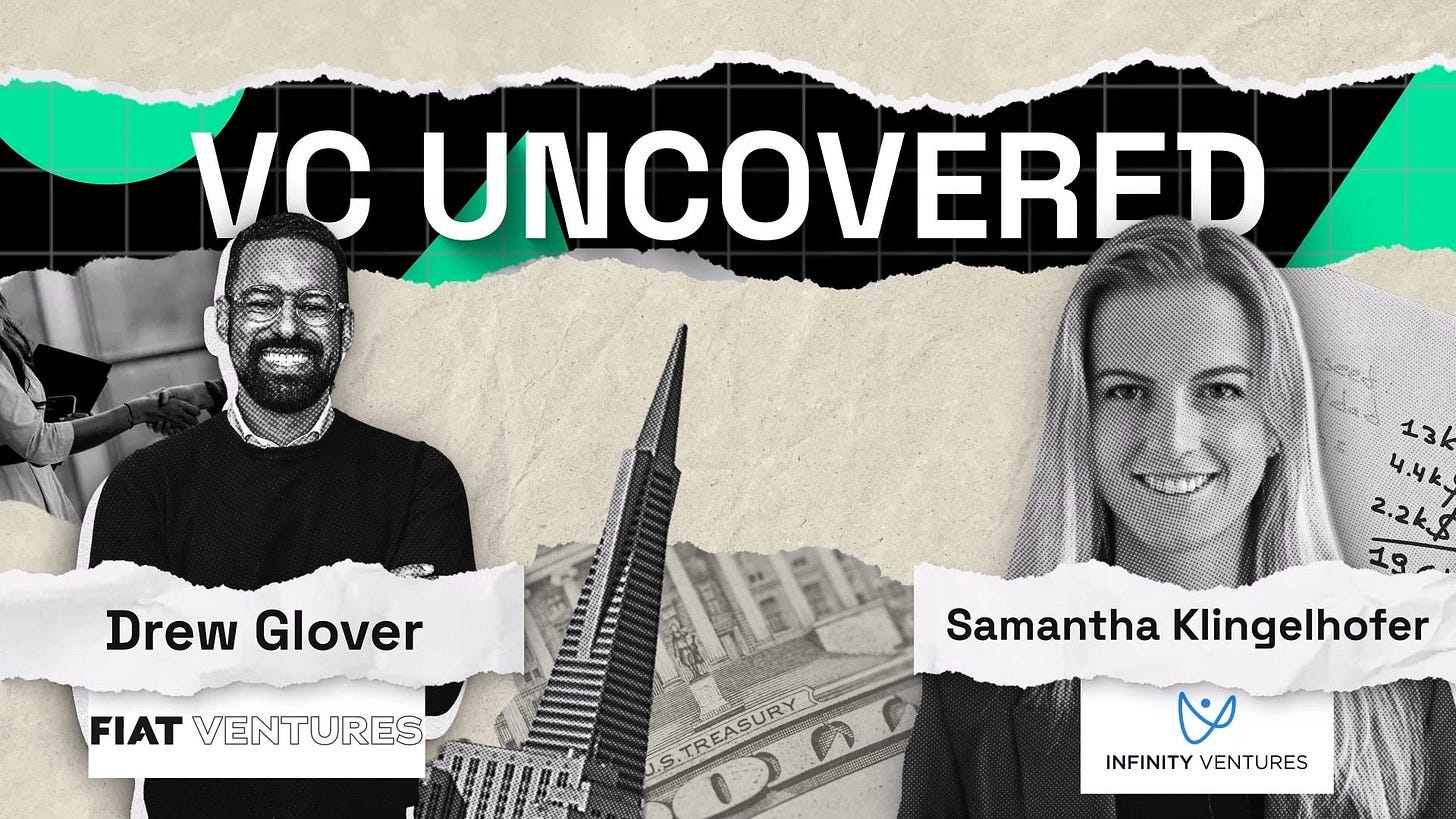
Samantha Klingelhofer (Infinity Ventures)
Read the VC Uncovered profile:
https://www.vcuncovered.com/p/samantha-klingelhofer-infinity-ventures
In This Episode
Drew Glover talks to Samantha Klingelhofer from Infinity Ventures on the obsessive mindset of elite founders and VCs. Sam explains Infinity’s “founder indexed” approach to B2B FinTech and commerce, and why she believes “constraints force clarity” and lead to better, more capital-efficient companies.
The conversation gets really interesting when Sam, an elite competitive cyclist, details her “psychotic” 15-20 hour-a-week training regimen. She explains how managing “pain versus progress” directly parallels the “totally obsessive” nature of the best founders.
She also shares the powerful story of her mom’s 30-year journey at Williams-Sonoma, rising from an entry-level buyer to becoming the longest-tenured female CEO in the Fortune 500, and how that front-row seat taught her that she “can do it all.”
This season is supported by SVB. Silicon Valley Bank, a division of First Citizens Bank. Member FDIC.
SVB is a trusted collaborator for the founders pushing boundaries and the investors who back them. We’re proud to have them as our sponsor.
Please note, this podcast is for informational purposes and is not investment, financial, or legal advice. The views expressed are those of the speakers and do not necessarily reflect the position of SVB.
More from Uncovered Media


Read the full transcript
0:00 I think in this world, it's of AI and these crazy evaluations is very easy to forget the point is to raise at least my money in possible and have the biggest exit. And obviously, you need to raise money to have that big exit for most businesses, but...
0:18 Welcome to VC OnTubber, the series where we highlight the next generation of investors who move faster, take bigger risks, and build shoulder to shoulder with founders. I'm your host, Drew Glover, co-founder of Theat Growth, and general partner at Theat Ventures.
0:33 Sam, thank you so much for joining VC OnTubber, the podcast is really just starting to kick off. I'm super excited. You had one of the highlighted newsletters did really, really well on social. Everyone was so interested in your story, so excited to dig in a bit more on
0:50 that. But with that, Sam, Infinity Ventures, tell me what you're working on, tell me what you're focused on, and what you're doing at Infinity Today. Thanks, Drew. Well, I'm stoked to be here. I think people probably like my article because VCs love biking, so there's
1:06 probably a bit of that. And, Infinity, we focus all on pre-seed seed and series A investments in B2B FinTech and commerce infrastructure companies. Obviously, there's a lot that fits into that category and scope can be nebulous .
1:21 But I think the way we think about it is we want to pack founders and spaces we know really well. And so, the GPs at my fund all came from PayPal. Jeremy, in particular, ran M&A Corp debt there for a long time, did a ton of transformational deals, including Venmo and Braintree and Honey that turned PayPal into what it
1:40 is. And then he started PayPal Ventures with the help of two other GPs, and they had a great run there, and so that's kind of where we focus, I think, me in particular, and us as the whole team, we're extremely founder and next, I think, as I mentioned, in
1:59 my newsletter, ideas do change, especially in this market, and founders change, but not as much. And so, we really want to back exceptional talent and founders, and that's why I spend my time doing it. I spend my time, basically, we call it internally me stalking, all sorts of
2:17 stealth founders and operators thinking about leaving their companies to start something so we can kind of get on their radar early. Very cool. And can you just let the listeners know a little bit more about the stages that
2:32 you guys are investing in most? And I'd love to learn a little bit more about your interest in Fintech. How did you kind of fall in love with the space? So pre-seed seed series, Chex says at the minimum is like a million and a half,
2:48 and then close to eight or nine, at the high end, we're investing out of a $184 million fund, too. And so, we really look to lead or to lead. We are low volume, high touch, and if we have 70 companies in our fund, we can
3:05 't give our founders the time and attention that we want to give them. And so, we really don't do that many deals per year, and we look to kind of get a little bit higher ownership upon entry, but that said, one do the right thing for the business and the founder, and so we've moved up and down accordingly.
3:23 For me, this is maybe not the answer that you want to hear, but I didn't have any background in Fintech at all. I came from big, bad private equity. I was doing HVAC roll-ups before they were cool, and then I worked at a VISTA
3:41 spin-out and I was doing software buy-outs, and we did some great stuff, and, you know, of course, there was a major, like embedded Fintech play for all of these vertical SaaS companies, and that's very real, but I wasn't outright investing in Fintech or commerce companies. I joined in Fintech because I love the guys, and I figured that I would make
4:00 the sector stuff work because I loved them and believed in what they were building, and I could've done it the other way. I could've been like, "This sucks Fintech," but that is totally not where I've landed, and so it's worked out great, and I do believe strongly in being a specialist.
4:19 Some of my mentors really, my career said, "When you know that you love something, go lean into that because there's real value in specializing," and that's not to shit on generalists at all. I started my career as a generalist, and I learned a ton doing that, mostly kind of learned what I did like, but I think that's valuable for sure.
4:37 That's super insightful, and going back to the fact that you started your career being a generalist, now you are a specialist. What have you taken from that generalist mindset, generalist approach to
4:54 investing that has helped you develop a superpower in the specialist sector? Good question. I think we can go really deep on things, and I think we can provide value to our founders in ways that maybe, at least I don't think I would be able to do if I was a
5:13 generalist. If I was learning about what a pay-fact was for the first time and looking at a company in that space, it would be really hard to get up to speed, like Fintech is complicated. As a result, we can lean in a bit more, I think our right to win with founders
5:30 comes from that, too. I really believe that in this world where there's a million VCs and everyone's really great and smart, like having that specialist edge, and also my team's all X operators. There's a level of empathy.
5:45 There are two with what founders are doing. I think it does make a real difference, or at least I'd like to think it does. No, yeah, I would 100% agree, and obviously, I've been in the Fintech space for a long time now, but I feel like my career leading up to the Fintech space was very
6:03 generalist oriented. Again, I think of it as like, you're an inch deep and a mile wide when it comes to being a generalist, or you're just 20 feet deep, but knowing a little about a lot has really helped me in the Fintech space, because Fintech is getting so broad now, like
6:19 we jokingly say that Shopify and Delta are making all their money as Fintechs, not as digital front-end website creator or a travel company. We're seeing a lot of these different Fintech companies.
6:35 The front door does it look like Fintech, but the guts of the business are very much Fintech. A lot of the generalist exposure that I got early in my career has been very helpful for me to understand from a go-to-market and marketing standpoint of these Fintech
6:51 companies that show up very differently in the world. Don't get me wrong, I've met a few generalists who I'm just amazed at how much they can cover and how deep they can go.
7:06 There's definitely people out there who can do that. That is not how I am. You give me every sector in the world that I'm going to be way too overwhelmed. At least to your point in Fintech becoming so broadly, I'm even overwhelmed there.
7:21 That's one bad that. It's good. It's also a self-throttling piece. For me, if you put me in a sandbox that's too big, I'm going to be in every corner. If you put me in a small one, I'm going to build something very cool in that space. Me personally as well, I got a little ADD with me, so that's just who I am.
7:40 I want to take a step back and dive a little bit more into some of the topics from the newsletter. The first one is something near and dear to me. I was a college athlete. I played sports my whole life. There is a level of discipline, a level of grit, a level of grime that you're
7:56 just willing to go when you are playing a sport, a part of a team, an individual sport. You're a cyclist, but I'm so curious how this obsession of sport and competition has affected and transferred over into your work.
8:14 First and foremost, we'd love to learn a little bit more about the type of sport that you are obsessed with, that you spend the most majority of your time doing, and then talk about how that affects the rest of your world. I play college soccer as well. I got a bunch of concussions, and honestly, it was just really focused on being
8:30 a college student. I actually only made it two years, but it was a good few years. I am extremely competitive to a fault, and I've had to do some self-work to make sure that's a healthy level of competition, build externally, and internally, I
8:47 think when I moved to San Francisco, and I'm from here, but I moved back, naturally, like everyone else I got in the cycling during COVID, it was actually my fiance who got me into it. I'm sure he fully regrets it now, as I've taken it way too far, but it was
9:07 something that was fun, and a lot of my friends did it, and I love the gear. I'm such a gearhead, so that was a big part of it, too. I was always good at it, and I had people tell me, like, "You should race. You should do this.
9:22 You should give this a go." I did it because I was working in private equity, and it was too much, and I didn't even know where to start this year, kind of around this time, last year, actually decided, "If I don't give this a go, I will look back on my early adult life, and I will say
9:41 , 'I wish I tried.'" I hired a coach, and I put things in a gear, and I started putting things on the calendar, and I had a really good season. It's been a big learning opportunity in many ways. I have not decided what I'm going to do next year or the year after, what that
9:57 's going to look like, but at my peak, I was probably training 15, 20 hours a week, and that was just on the bike that wasn't in the gym. It was over 200 plus miles a week. It was intense. I was waking up super early so that I could be in the office at nine, and then
10:14 my entire weekends would be devoted to going on six, seven-hour rides, and then my diet was super weird. I was in PT all the time, sleep was my number one priority. I was completely, like, I sound psychotic, and that's because, well, I was
10:31 completely obsessed with it. I got in a big crash, and, yes, I've actually got off the bike for a few months now, which has been a great reset, but I was basically optimizing every controllable
10:47 variable I could. I do feel like that's what the best founders do, too. They're totally obsessive. They're not just persistent. They're obsessed with every customer call, every iteration of the product, every metric in the funnel, they're obsessed with these feedback loops, and obviously things
11:04 change as your company grows, and you can't be involved in every single workflow or decision, but I do feel like that is something I see in our best founders and our portfolio. They're totally all consumed, and it takes a very specific and special type of
11:19 person to be that way. I don't think most people are, and probably for the best. I wish I was not this way. I think a big thing, too, is I was always managing, and this is also going to sense theistic, but like pain versus progress, and I do think founders do that, too.
11:36 There's a difference between exhaustion, where I guess you have so much exhaustion, but you also need to improve, and so how do you balance that and how do you make sure you're not plateauing? There's a lot of cheesy parallels between building a company and being an athlete, and
11:51 I think the founders I'm drawn to have that. I think he goes a big thing, too. I think what I realized, for racing this year, is there are women who are so much fucking better than me, so much faster, so much better than me. It is amazing. I race Leadville in August, which is a big mountain bike race in Colorado, and
12:09 this woman named Kate Courtney won, and she's actually from a brand, she was incredible. She was close to some of the fastest men's times, and the ego, it's humbling, like you
12:24 see that, and I think the best founders have that, too, they're very coachable. They realize that this is a changing game, and there's people who've done this, and they take advice from all over the place, obviously, they need to have confidence, too, in what they're building in the team that they've assembled, but I do feel, you know,
12:43 there are so many parallels that can be drawn between being an athlete and being a founder, and a VC, too. A confession on my end. I feel like I spent the early time, I say when I was in college, I would
12:58 actually argue with people that were cyclists while I was playing football in college, and saying, "Cycla Thorne athletes," I was so anti-all of that, and actually now, both being a founder, being an investor, I actually would argue that it is such a different type of mindset
13:21 because it's not based on, "Don't get me wrong, you need to be athletic, you need to be bored with some type of, you know, outside the ability to like, you know, athlet ically move on a bike." But there's a difference between being able to go dunk a basketball and never
13:41 play basketball before versus, or you be the fastest person on a bike, but not have the ability to push past that pain to win, and so as I think about the cycling, I'm curious from
13:57 your perspective, you've hit that wall, you're cycling, tell me a little bit more about the pain that you have to tap into and push through once you've hit that wall of like, all my athleticism,
14:12 everything I practice for, that doesn't matter anymore, like that second nature , now it's that extra gear. I mean, it's unlike anything I've ever experienced playing soccer, I think the one thing maybe it's akin to is like running ultras because, you know, marathon is three hours,
14:27 you know, all the races that we're doing were, you know, eight, nine, ten, and so it's just like, from the time perspective, it's very different. I think that brings up all sorts of like, mental games you've got to play with yourself. I distinctly remember the summer I was at a race in Colorado, and the big climb
14:45 gets up to like close to 13,000 feet of elevation, and you're on a mountain bike. That is the highest I've ever, ever been ever, there is no accident up there. I thought it was going to fucking die, like actually it was, it was shareable, people are
15:00 passing me, people are off their bikes, it's like quite technical, and there's just kind of a level, there's a gear that you click into where you're like, nothing else matters, fuck it, this is the most important thing I need to get through this, and this is temporary,
15:15 and I'll look back in four hours once I finish this race and be so incredibly stoked that I got through that. I mean, it's, you know, it's funny, I do feel like there's so many parallels to doing hard things, even just like day to day, like I have to go pick up a package from
15:32 like, you know, whatever UPS down the street, I don't want to do that, that's like on the back of my mind of something I don't want to do, and I know it has nothing, it's not even close to, you know, the pain you endure on an ultra bike ride, but like a bit of the same thing, like I'm just going to do it, you know, and getting through it, there's a lot
15:48 of those little choices you make every day, but it's definitely like it's, it is a, it's something I had to teach myself of just digging, digging deep and forgetting anything else matters, and it is meditative in some ways like you totally forget your life outside of
16:04 anything else, you're delirious and delusional, and all that matters is like, that next, because I would break my rides into increments that next mile or that next hill or whatever, and then that kind of gets you, get you through it, I know a lot of different athletes think about it in different ways, but that's how, how I do it.
16:19 That space in between of like, okay, the, the physical race is over now is the mental race, like to me that the connection back to what you were talking about earlier, back to the CEO is just so true, you can be as athletic as you want, you can found and sell as many companies as you want, as you have before, but there is still that
16:36 extra level of pain that you just have to like, tap into. I want to go to another, another piece coming out of the newsletter here, which is you talk about this concept of the power of constraints and actually think it's pretty well connected to sport and, you know, being an entrepreneur and I've been saying myself, even
16:54 going back to working out, when I haven't worked out a long time and I'm in a rut, like I 'm always like, I need to go find a gold gym, I need the grimiest gym ever, I need nothing, I need like, I just need those dirty ass weights and I need to like, I need to build up again
17:09 in this world where I just don't have access to everything, but can you tell me a little bit more about, you know, you don't necessarily need more capital to be better, you don't necessarily need the best of the best conditions to be better.
17:24 How does that track back to how you think about investing, how you think about founders, how you think about entrepreneurship? Yeah, I think, and not to type things back to biking, but I do think constraints force clarity on what actually matters, you know, you're
17:39 at the top of that hill and all you've got is yourself a new bike and you're like, you know, shittikus, and all that matters is getting, getting through it and I think capital efficiency isn't just about saving money, which obviously is a good thing, but it's about sharpening decision making.
17:54 I think we've lost the script a little bit, I think, like, this is the point to raise the least amount of money and then return the most to your shareholders and your investors and your employees. And I feel like, you know, sometimes you have these companies that raise a ton
18:09 of money and it creates like false signals and you have fat in your organization. And I think we really, and I think most VCs at this point too, there's been a noticeable change like really focused on founders who are resourceful and how to, like,
18:26 how they turn constraint into momentum. And then how, you know, that discipline compounds them and the capital does come in. We actually did an analysis of like all of our portfolio companies. It was quite simple. It was where they're at from an ARR perspective and then how many full-
18:41 time employees they have. And, you know, sometimes folks have contractors who loop that in. Like, the reality of it is that our best performing companies and our strongest founders have made more of less. And so, I don't know, I do think there's something, something there, and
18:59 obviously there's a there's a time when raising a ton of money makes sense and there are certain business models that are capital intensive and they need more funding. But I think in this world, it 's of AI and these crazy valuations is very easy to forget that the point is to raise the least
19:18 amount of money impossible and have the biggest exit. And obviously, you need to raise money to have that big exit for most businesses, but there's a level of it that's healthy. And so, capital efficiency is really, really important to us and how we evaluate companies. And as you think
19:33 about just constraints in general, how does that affect how you, you know, I'm assuming you guys are like leading a lot of rounds, you guys are taking the pin, how you are, you know, leaning in with the with certain valuations, like, are you trying to create worlds where
19:49 founders have more constraints or, you know, how are you underwriting the constraint as it pertains to investing? Well, we want to make sure the founders are backed up enough money to do what they want to do. Right. So it's like, we're going to low bottom and give them give them nothing
20:04 to see how it works. I think it's, you know, when we look at the company at the time of looking at the business, we want to see what they've done historically to get to where they are. And, you know, we have businesses that are going like crazy, and they've hired like crazy as a result. And that is, it's totally
20:20 justified and fair, too. And those businesses, like, they need that, especially when they have, like, Trump, and big album motions, or they have a big enterprise sales mission , they need a lot of folks on that, or they need to, you know, hire a bunch of, you know, developers and engineers to build these amazing new modules and products they want to build. But there's
20:38 a, there's a fine line to it. I mean, we all know many examples of companies that have even gone under, and they hired all these, all these folks, and it just went upside down. And so I know it's kind of a wishy-washy answer, but I think the founders that we have in our portfolio that have built
20:56 the most amazing businesses have struck that balance of, like, what is too much burn and what's the right amount, you know, and, you know, we, we do meet founders at the precinct to say, "Oh, I want to raise a million." And we push back and we're like, "Is that 24 months of runway? Is
21:11 that going to get you to whatever metrics you need to, to raise your next round?" And they say, "Well , no, not necessarily." And so oftentimes we actually do upsize ads, too. And so it kind of cuts build ways. Yeah. Yeah. And, and obviously there are many, many founders and many executive
21:29 teams that you don't necessarily have to spend all the money super fast, right? You can still create an environment where it's built and designed around constraints and then bring that money in on a need basis. And so, you know, I 100% agree. Like there are, that's where culture really
21:48 comes in of like, you know, let's be thoughtful. I think we're in the middle of this interesting time where coming out of 21, 22, there's still a lot of founders that are saying things like, "Oh, well, we want to be profitable after our seed round." I'm like, "Dude, I'm
22:05 investing, I'm a power law investor. I'm investing in a generational business. Don't get me wrong, like being cashflow positive is great. But if that means that it's going to take you 25 years to scale this thing up to what it could be instead of like 10 or 11, like I still want to have that
22:21 muscle where constraints don't hinder you from growing at the pace you should. I definitely don't think that we need to be getting back to, you know, working at, you know, 100, 100 million dollars in the negative, but like we should be striking a balance here. Great, totally
22:38 agree. I want to get to the last kind of meaty question here. And this is one that I pulled from you kind of witnessing your mom's 30-year journey through business. And you have this front row seat
22:55 of seeing your mom as this entry level employee over the span of many years to become a CEO. And I personally, I grew up seeing my mom start as an entry level teacher to become a principal. My dad ran a nonprofit, but I'm just such a big believer of like, you are a product of your
23:12 environment. And, you know, really diving a little bit deeper into the learnings that you got from being able to witness your mom really becoming an owner versus, you know, a colleague of
23:27 someone else. And so, can you tell me a little bit more about how that inspired you, how that kind of has pushed you, helped you, not helped you in your journey in business? Yeah, absolutely. And there's a lot of
23:42 ways I can go with this. Because obviously, getting raised by her has informed every single part of me. So I'll try to distill it and do a few things, but I'll give kind of a quick background. So, my mom graduated from college, moved out to San Francisco in her Jeep and got a
23:59 job as a waitress in services. So my dad was working at Bank of America at the time. She was actually working at a pie shop in the marina. And he would come, it's a great romantic story, come for pie. And he was at Maryland. And now she got an entry level job at the gap. And then ultimately
24:19 , I think it was in 1995, got a buyer job at William Sonoma, which is effectively entry level. She became CEO of the entire company in 2010. And it's actually the longest tenured female CEO in the Fortune 500. So,
24:35 she's been at that company for almost 30 years and really has had no other job since then. You know, it's funny. I think, you know, it's taught me many things. I think one that's directly related to business is like, I've seen what excellence looks like. And that is
24:53 something that not many people get to see. And I don't ever take it for granted. Like, I have been around her. And obviously, my work is not related to hers. And she never really took work home. So I didn't see it that way. But I saw in tidbits growing up. And more as I've gotten older
25:10 , the way she operates, how well she knows her business. Like, she knows it so granularly. And now it's a $20 billion company all over the world. And like, I've seen what it's like to be a world-class operator. And most
25:26 people don't see that. It's actually a way that we think about our founders of their background. Have they seen excellence at the company that they came from? Because, you know , your bar is as high as you know it to be. And my bar has been set extremely high. And obviously,
25:42 there's a lot of pressure that comes with that. And there are negatives to it that I have seen excellence looks like. You know, if I'm being candid, it's put a chip on my shoulder for sure. For many, many years, I never told people my mom did. And I was very hush-hush about it
25:58 because I didn't want people to put me in a box. And I'm sure they do. But that's also why I took a job in PE out of school. And why I worked the way that I did for many years, because I wanted to prove to everyone that I wasn't what maybe they expected me to be. I think most of all, though,
26:16 like, my mom did it all. Like, she never missed a game. She was always there. And, you know, that's probably not something I talk about enough. Like, she was always there. And it's taught me, especially as a woman with a job that is intense. And with the biking, like, it
26:34 's taught me that I can't do it all. And I think that's something that folks don't always, always talk about. And always, there's a lot behind the scenes to make that happen. I think a big part of it was my dad. Like, he worked at a hedge fund. And then he quit. And she became CEO. Like, he
26:50 had a real, real job. And he made that sacrifice for our family. And, you know, that was a big part of it, too. It's been a big part of me choosing my partner in the life I want to live and all of that. And I've tried to model their relationship as much as I can in the parts that I
27:08 want. So, you know, after all these years, they are still together and extremely happy. And she's still in the job. And so it's been, you know, an amazing example of what what excellence looks like and what balance can be and how to be a great mom and a wife and all of that at the same time.
27:24 I love that so much. Also, shout out to your dad for a man for taking one there and doing something that's not as conventional. Yeah. I bet he is. I bet he is. And also,
27:39 shout out to your mom for literally like joining as a buyer and becoming the CEO of William Sonoma, which is still an iconic, iconic brand. She's still a CEO. Still a CEO. And they've got a ton of brands now, including Potter, Barn and West Elm and, and all that stuff. So yeah, she's,
27:57 she's, she's still there. And they're still doing great. So, killer, killer. That's incredible. Okay. So, I typically like to emiss with a couple speed round questions. So, bear with me here. You ready?
28:12 I'll try. All right. Cool. What's your current bike kit? Give us the rundown. I am currently working with ASOS, A-S-S-O-S. Here's Swiss brand. They've been
28:28 super supportive and I love free stuff. So, I suggest anyone who's into biking to check it out and they'll be stoked. Me for saying that on a podcast. Yeah, I do. You will. Give us a code. We'll drop, we'll drop it in the, in the show notes. So, we'll be working on that. Cool. If you could
28:51 bring your bike, go to SFO right now and get a ticket to anywhere in the world, where would you be going? And if there's a trail you know in that place, please share it. If not, no worries. I trained in my workout for a bit this summer. I was actually there with my family. We did one
29:08 of those back roads trips, which were awesome. And, you know, half my family is on the bike and the rest was getting their ass kicked. But, my work is, it's amazing. I want to do the, the Alps, how they're, you know, parts of Europe, but it was incredible. It's a bikers paradise.
29:26 That's awesome. That's awesome. What is the first thing you do when you wake up in the morning? Have like four espresso shots. Four? And do you jump right on the bike after that? Or is that, like, four? Yeah, right on the bike. Yeah. Okay. Nice. Okay. If you could own
29:44 one sports organization, what organization would it be? That is a, that's a great question . Honestly, if we'll just come right, I'll watch sports or care about them much. But I don't know, I'm loving the Valkyries. Like, I went to a Valkyries game.
29:59 And, you know, the words are kind of done their thing. But it was the energy in the J Center. It was, it was amazing. And so, I don't know, it might be, it might be my one. I love that. I thought you were gonna say a racing team, but I like the Valky
30:17 ries. Seems like too much work. It's a lot. It's a lot. It's totally less. Last one. Any kind of like word that you have for young VCs that aren't necessarily like arty in, arty in venture, but just kind
30:33 of have like generalist backgrounds that want to get into the space. That's a good question. I think it's probably just me as many people as you can. And you never know what will happen with those meetings. I gave it my, my getting my role at Infinade was kind of random. And,
30:52 and you never know what leads to what. And I've made some best friends from folks I met through like coffee chats, honestly, as, as SF cringe letters to say. So, I just, I think take, take every call, take every meeting. And like some of them will suck. And, and that's how it
31:09 will be. But some of them will be great too. That's great. Take every meeting. I like, I can 't agree with that more. The amount of shitty meetings I've had have led to some of the best meetings I've had. This season is supported by Silicon Valley Bank. For decades, Silicon Valley
31:25 Bank has been a true partner to the innovation economy, helping both founders and funders grow. Silicon Valley Bank, a division of First Citizens Bank, member FDIC. Please note this podcast is for informational purposes and not investment, financial or legal advice. The views express are
31:45 those of the speakers and do not necessarily reflect the position of Silicon Valley Bank.
Transcript generated automatically; it may contain errors.
Originally published on VC Uncovered · By Drew Glover