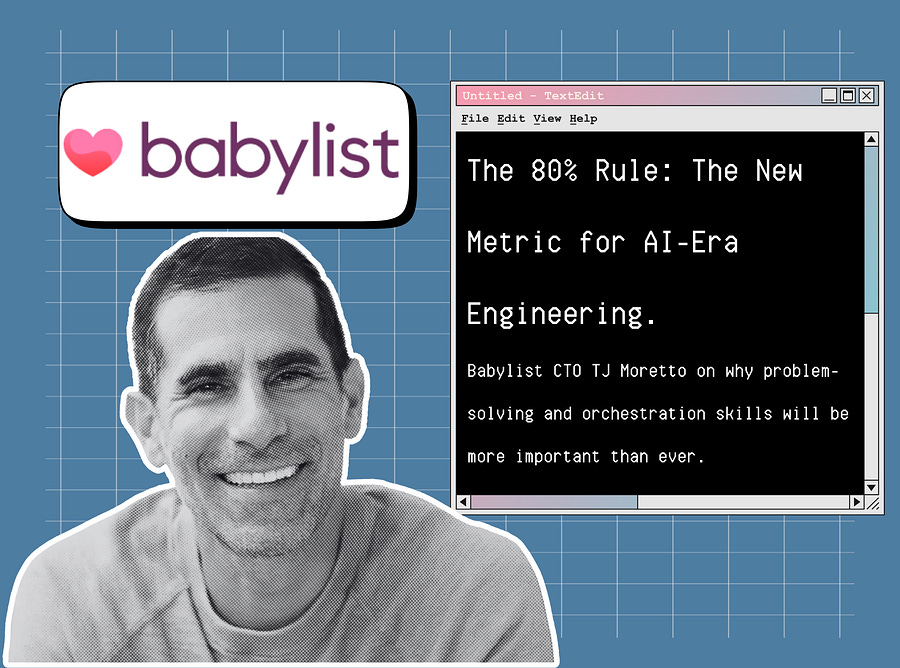
The 80% Rule: The New Metric for AI-Era Engineering
Babylist CTO TJ Moretto on why problem-solving and orchestration skills will be more important than ever.
The short version
TJ Moretto, CTO of Babylist, explains how the company is integrating AI into a 15-year-old Rails monolith while running a $1 billion GMV commerce and media platform. He argues AI should be writing 80% of the code, that AI is exceptional for backend logic but struggles with inconsistent frontend code, and that engineers must shift from writing code to planning, architecting, and orchestrating AI agents. The main takeaway is that closing the gap between merely integrating AI and becoming a true AI-first organization depends on fixing architectural inconsistency and investing in observability, not just adopting new tools.
- TJ Moretto states the '80% Rule': 'If you're writing 80% of the code, you're doing it wrong. The tool should be writing 80% of the code.'
- Babylist uses a two-tool AI strategy: a synchronous local agent like Claude for complex tasks needing immediate feedback, and an asynchronous remote agent like Devin for discrete background work.
- AI performs exceptionally well on Babylist's backend because the code is easily testable with fast feedback loops, but struggles on the frontend due to inconsistent frameworks and styles.
- After early AI success in Customer Service felt 'magical,' Babylist discovered its metrics failed to catch degrading performance, leading to major investment in evals, error analysis, and observability.
- The engineer's role is shifting from primary code producer to planner, architect, and orchestrator of AI agents, with junior engineers who become 'native AI builders' having a chance to leapfrog career levels.
- TJ Moretto believes agentic commerce won't replace Babylist's core business because gifting relies on human sentiment and social connection that generic AI agents cannot yet replicate.

CTO Uncovered’s View
Often described as a generational brand, Babylist is a leading commerce and media platform in the baby industry. For its CTO, TJ Moretto, the central challenge facing the enterprise today is clear: how do you drive billions in commerce and media while operating a 15-year-old codebase under the pressure of the AI revolution? The real battle for AI ROI is unfolding inside these scaled organizations; it is not just happening in seed-stage labs.

At Babylist, that battle is not happening on a clean slate. The company runs on a system that has evolved through multiple eras of product expansion, shifting teams, and changing technical standards. The codebase works and delivers real business value, but it was never designed for a world where machines are expected to reason, generate, and evaluate code alongside humans. Each attempt to introduce AI surfaces the same underlying question: is the system itself ready to support it?

TJ has spent nearly a decade navigating that tension. His role as CTO is not to chase the newest models; he must determine where acceleration is real, where it is illusory, and where architectural discipline matters more than tooling. In practice, integrating AI becomes less about the promise of the technology and more about the consistency, observability, and leadership required to make it effective at scale.
About Babylist
Babylist is the leading registry, e-commerce, and content platform for growing families. In 2021, they secured a $40 million Series C funding round led by Norwest Venture Partners. They are actively reshaping the $320 billion baby product industry, generating over $1 billion in annual GMV, with a mission to help parents feel confident, connected, and cared for at every step. What began as a universal registry 15 years ago has grown into a full ecosystem, including the Babylist Shop and Babylist Health.
TJ has been with the organization for nearly a decade, giving him deep institutional knowledge of this evolution as the technology organization scaled to approximately 120 people. Despite this massive scale, the core tech stack, largely a backend Rails monolith with various frontend frameworks, is a powerful but complex machine. This conversation defines the difference between merely integrating AI into that established system and being an “AI-first” organization; it examines what that difference means for engineering efficiency and for the millions of families who shop with Babylist every year.
Key Takeaways
The 80% Rule: “If you’re writing 80% of the code, you’re doing it wrong. The tool should be writing 80% of the code.”
The Backend Preference: AI is “exceptional” for backend development (building logic, algorithms) due to fast feedback loops, but struggles significantly with frontend UI.
Observability: Regaining Control of the AI-Augmented Process: Vendor AI solutions can be “magical” at first, but their performance requires dedicated investment in evals, error analysis, and observability to ensure continued accuracy.
The New Engineering Role: An engineer’s primary value shifts to being the planner, architect, and orchestrator of agents, not the primary code producer.
Meet TJ Moretto
The Journey to the CTO Seat: TJ progressed from an individual contributor to leading the entire engineering team throughout his tenure with Babylist. He does not describe his effectiveness in terms of technical brilliance; instead, he points to his ability to organize work, communicate clearly with business stakeholders at every level, and rally teams around solving real problems. That instinct for coordination over individual output has shaped his leadership style and has become increasingly essential in an era where engineering is less about writing code and more about directing systems of people and machines.
The Engineering Ethos: The culture is built to hire engineers who care most about the business and users, who want to “deliver value” and “win,” focusing on solving problems rather than “toy technical problems.” Babylist is structured in two areas: a Consumer Tech Org (apps and websites) and a Fulfillment or Supply Chain Org (backend technology for e-commerce). Within the consumer group, the team maintains traditional “product building pods.”
Leadership Philosophy in an AI Era: TJ maintains a strong, hands-on approach, stating, “being in the weeds does matter,” and that this makes for a good leader. He does a ton of skip-levels, reviews almost every document that comes his way quickly, and looks at data models and schemas.
The AI Goal Shift: Structured Adoption (OKRs): Following the initial phase of “messy experimentation” where all employees were given access to tools, Babylist recognized the need for a structured process to govern how AI would be implemented across the organization. They moved to a formal goal-setting process, implementing OKRs around AI adoption. These goals were applied to every aspect of the engineering product development process, including: shaping work or scoping it, building and testing, and code review. The aim was to systematically play with AI in each area to understand the results that could be achieved.

Deep Dive into AI Integration
AI as a Backend Accelerator: AI is found to be “exceptional” in the backend, specifically for building logic and algorithms. This works well because the code is easily testable, allowing for “fast feedback loops.” This is also effective for managing the existing 15-year-old code base, which has “lots of different patterns, lots of different corners and spooky things.” The organization employs a two-tool strategy: a synchronous, local agent (like Claude) for complex tasks requiring immediate feedback, and an asynchronous, remote agent (like Devin) for more discrete pieces of work that can run in the background.
The Consistency Debt: AI has demonstrated more limited utility for building in the frontend. The issue is inconsistency: Babylist has “lots of frameworks, lots of different styles,” and the AI struggles because the organization aims for a design system but does not yet have it at a level where AI can just take Figma and turn it into a perfect UI. TJ believes the mindset must shift; the initial impulse should not be to “fix the bad code” that the AI generates. Instead, engineers must figure out and fix the context that generated the bad result; this might be a realization that the architecture is too inconsistent and needs to be addressed.
The Observability Crisis: In the earliest AI adoption area (Customer Service), the solution initially felt “magical.” This rapid early success, however, led to the critical lesson that deep observability is paramount for long-term AI reliance. When the system grew in complexity, the engineering team realized they had inadvertently provided the business team with insufficient visibility, as the high-level metrics failed to capture that performance was degrading. This gap in monitoring prompted the organization to make a strategic decision to invest heavily in dedicated evals, eval platforms, and error analysis. This shift established robust technical ownership over AI performance, proactively countering the need to rely on intuition alone.
The Future Tech Stack & Workforce
The expectation has changed: “If you’re writing 80% of the code, you’re doing it wrong.” The role of the human has shifted to being more of the planner and the architect, thinking about how to break down work into different synchronous and asynchronous pieces for the agents. The essential skills are now about planning, orchestration, and judgment. TJ notes that while senior engineers who already excel with tooling are leveraging AI the best, there is a significant opportunity for junior engineers to really accelerate their careers. They can leapfrog multiple levels by coming in and being the native AI builder.
TJ views the advent of agentic commerce through the company’s unique product lens: the consumer behavior is driven by the need for credible, authoritative research during a low-knowledge, high-importance life phase. While AI is helpful for that research, the actual commerce happens through gifting from friends and family. Because gifting relies on human sentiment and social connection, TJ believes this experience requires a level of control that generic AI agents cannot yet replicate.
Challenges for Upcoming CTOs
Babylist faces a challenge when business users are tempted by AI vendor tools that appear “magical” but quickly get “blocked” and require a technical resource. This demands a sharp focus on ensuring that vendor solutions can integrate and be supported long-term, moving beyond the initial hype cycle. Despite using agents like Devin, the team ensures its most important technology still goes through its full software development loop. The human engineer still owns that code, even if it was mostly written by an agent.
The advice to an aspiring engineer is clear: a Computer Science degree is still incredibly valuable for the problem-solving skills it teaches. However, the application has changed; future engineers will write way less code, but their problem-solving and orchestration skills will be more important than ever.
Looking Ahead
The overarching question driving future architectural decisions is simple: “Is the gap between ‘integrating AI’ and being ‘AI-first’ closing, or are they becoming two completely different kinds of organizations?” TJ views the ongoing investment in fixing architectural inconsistency as the key to closing that gap. The strategic debate centers on the structural cost of maintaining and modernizing an existing system versus building a new one from the ground up. The outlook inside Babylist is defined by aggressive curiosity and velocity, but also restraint. The goal is not to chase every new model, but to learn precisely where AI compounds value and where it amplifies fragility.
More from Uncovered Media





Questions this answers
What is the 80% Rule that TJ Moretto describes?
TJ Moretto, CTO of Babylist, says that if an engineer is writing 80% of the code themselves, they're doing it wrong—the AI tool should be writing 80% of the code instead.
Why does AI work better for Babylist's backend than its frontend?
AI is exceptional at backend development because the code is easily testable with fast feedback loops, and it helps manage the 15-year-old codebase's many different patterns. The frontend is harder for AI because Babylist has inconsistent frameworks and styles and lacks a fully mature design system for AI to translate into UI.
What AI tools does Babylist use for engineering?
Babylist uses a two-tool strategy: a synchronous, local agent like Claude for complex tasks requiring immediate feedback, and an asynchronous, remote agent like Devin for discrete pieces of work that can run in the background.
How has the engineer's role changed at Babylist because of AI?
According to TJ Moretto, engineers now function primarily as planners, architects, and orchestrators of AI agents rather than as the main producers of code, with planning, orchestration, and judgment becoming the essential skills.
Why doesn't TJ Moretto think agentic commerce will replace Babylist's business model?
TJ Moretto explains that while AI helps with credible research during a low-knowledge, high-importance life phase, actual purchases at Babylist happen through gifting from friends and family, which relies on human sentiment and social connection that generic AI agents cannot yet replicate.
Originally published on CTO Uncovered · By Uncovered Media