Rick Galasieski
Super.com
The best growth teams know when the problem has changed.
Rick Galasieski arrived at Talladega prepared to explain Super.com.
The company had become an official savings partner of NASCAR and set up an activation where fans could learn about its products. Rick assumed most visitors would be meeting the brand for the first time. Then people began walking up to the tent, opening the app on their phones, and showing him that they were already members.
He adjusted the conversation. Instead of explaining what Super.com was, he began asking which parts of it they had used. A customer who knew the travel product might not know about cash advances, earnings tools, or credit building. What looked like a broad awareness campaign became a chance to help existing members understand more of the company they had already joined.
Over five years at Super.com, Rick has watched the business move through a series of growth stages that demanded different answers. Travel created acquisition. Membership extended the relationship. A wider set of financial products made retention and cross-selling more pressing. NASCAR entered the picture when Super.com believed familiarity and credibility had become constraints of their own.
Every product is at a different stage
Super.com began as SnapTravel, a company focused on discounted hotel bookings. By the time Rick joined, travel had already become a reliable way to bring customers into the business. He came in to build embedded financial products around that base, including cash advances, credit-building tools, an earnings platform, and a digital wallet.
Rick does not evaluate all of those products through the same set of numbers. He first considers where each one sits in its life cycle. A new product has to prove that customers can be acquired at a workable cost. A product with several years of history faces a different challenge: keeping those customers long enough to support the economics.
Travel has nearly a decade of operating history behind it. Super.com’s cash advance product has been running for about three years, giving Rick a clearer view of acquisition costs, channels, and the levers available when the company wants to increase volume. The newer credit-building product is still establishing those basics after more than a year spent working through compliance and regulatory requirements.
That makes a debate about customer acquisition cost versus lifetime value too simple for Rick. Both matter, but not in the same way at every stage. When Super.com introduced its membership program, the company tested three price points and tracked conversion, retention, customer acquisition cost, lifetime value, and return on ad spend before deciding how to iterate. The metric follows the question the product still needs to answer.
This life cycle view also helps explain why Super.com began spending more heavily on brand. Its performance channels still worked, and the company could continue acquiring customers through travel and other product-specific entry points. Rick believed the larger opportunity required more people to recognize the company and feel comfortable exploring a broader relationship with it.
Brand needs a defined job
Super.com did not choose NASCAR only because Rick likes sports.
The company studied the audience and saw a close match with the customers it already served: everyday Americans trying to save money, stretch their income, or improve their financial position. NASCAR offered reach and credibility with a community that had a strong relationship with the sport and its partners.
That credibility became more useful as Super.com grew beyond the product that first introduced it to customers. A company called SnapTravel could explain discounted hotels, but it could not easily hold travel, cash advances, earnings, credit building, and a membership program under one identity. Super.com hired agencies and consultants, studied customer personas, narrowed a list of possible names, and chose a domain it did not yet own.
The domain purchase was well worth the investment, returning far more than the initial investment. The name works as the company’s identity, website, and message. A billboard can say only Super.com and still tell people where to go. That simplicity became more valuable as the product expanded.
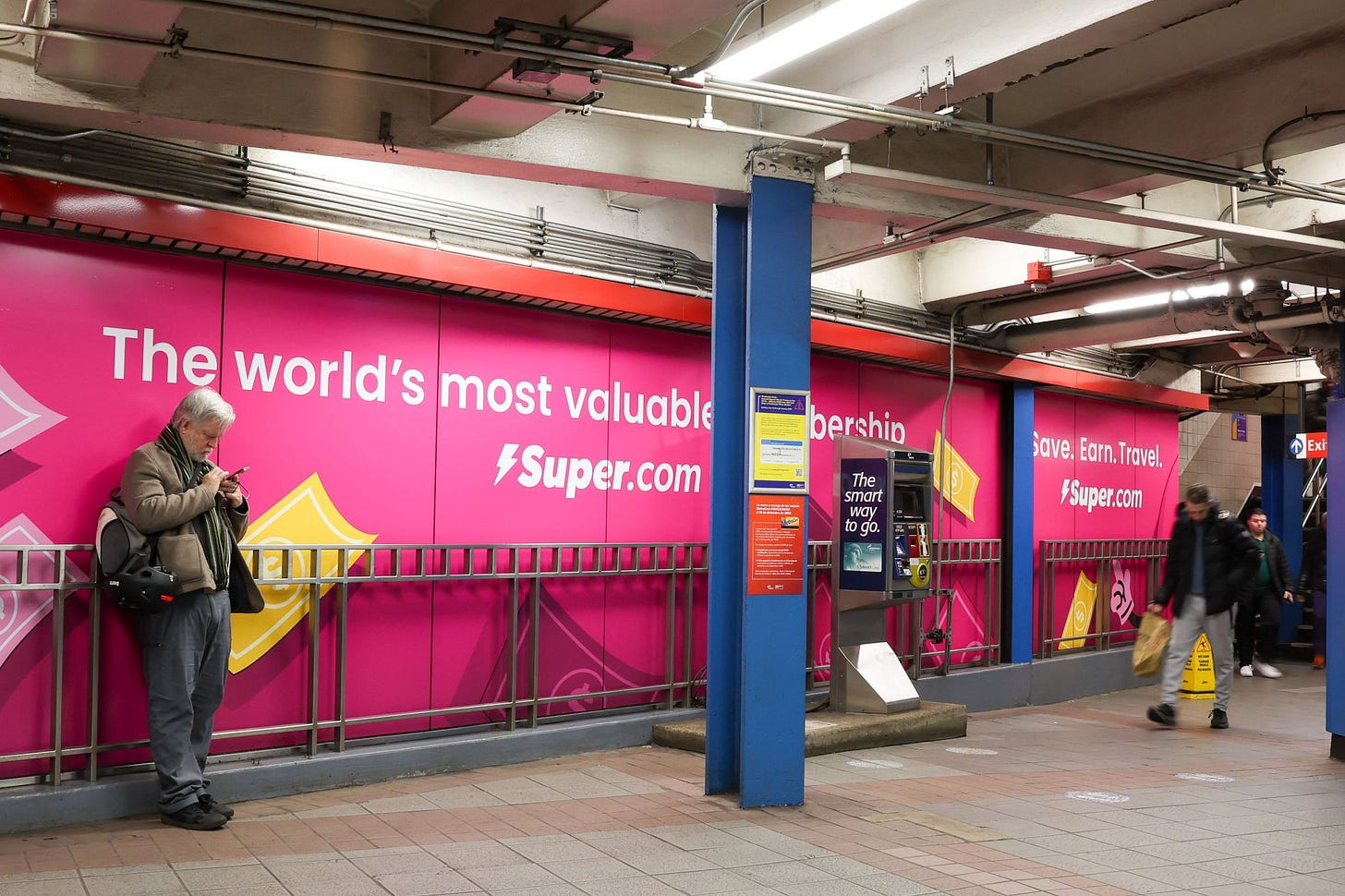
The NASCAR relationship followed similar logic. Super.com had already experimented with airport, subway, and sports advertising, but NASCAR offered a more concentrated customer fit. The partnership also required approval from both sides. NASCAR vetted the company before associating its brand with Super.com, adding another layer of credibility to the arrangement.
At Talladega, Rick found that many fans needed no introduction. Their familiarity did not make the activation unnecessary. It changed what the company could do with the interaction. Once he knew they were members, he could focus on the products they had not yet discovered.
The front door should lead somewhere
Travel remains one of Super.com’s most effective entry points.
A customer looking for a hotel may find Super.com listed beside larger travel platforms at a lower price. During checkout, the company offers the option to join Super Plus for $15 per month and receive an additional 10% off that booking and future hotel reservations. According to Rick, the program is approaching 1 million paid members.
The membership gave Super.com a way to extend the relationship beyond a single trip. It also made the rest of the product ecosystem more consequential. Someone who enters through travel may later use credit building. Someone who arrives through cash advance may need a way to earn additional money. The value of acquisition increasingly depends on whether the company can make the next product relevant.
Super.com recently rebuilt its home page around that question. The company knows which product brought a customer into the ecosystem and uses machine learning to determine what to show next. A customer who arrives through cash advance is more likely to see the earnings platform because the original behavior suggests an immediate need for money. Rick says the first version has already increased engagement and return visits to the home page.
He has also spent years pushing teams to repeat key messages more than they think necessary. A product manager may see a call to action sitting plainly on a page and assume the customer has noticed it. Rick assumes many people have not seen it, understood it, or encountered it at the right moment. That is why the same recommendation may appear through the home page, customer relationship management messages, and other prompts across the experience.
Each interaction is meant to make the path through the product clearer. The membership gives customers a reason to stay, while personalization helps determine what they should see when they return.
Speed needs a feedback loop
Super.com moves quickly, but Rick does not treat speed as evidence that a decision is right.
Early in his career, during the dot-com boom, he and a partner wrote a business plan and raised $2 million within weeks. The company grew to more than 200 employees before closing when the market turned and its burn rate became unsustainable. The experience taught him how easily capital and momentum can hide weak economics.
At Super.com, the operating model shortens the time between an idea and reliable evidence. Teams test pricing, customer flows, ads, and landing pages, then use the results to determine what deserves more investment. Growth employees sit within product teams, while finance, product, and marketing review performance against shared objectives. Rick is wary of marketing metrics that look successful but do not support the product or financial targets above them.
That structure allows the business to move quickly without separating experimentation from accountability. Rick may use instinct to identify where to look, but he expects the data to determine whether the company continues. His role reinforces that discipline. As general manager of financial products and earnings, he owns the profit and loss statement for Super.com’s non-travel businesses, so marketing spend eventually has to connect to revenue, retention, or product adoption.
The company applies the same approach to artificial intelligence. Super.com expects employees to use AI tools, provides internal training, and asks teams to demonstrate agents and workflows during weekly reviews so others can reuse them. Rick now uses Claude, connected to internal analytics systems, to answer some data questions that previously required waiting for an analyst.
The value is the time recovered between seeing a problem and learning whether the proposed answer works. Travel showed Super.com how to acquire customers. Membership gave them a reason to return. Personalization now helps decide what each customer should encounter next.
Rick’s job is to notice when one question has been answered well enough to start asking another.
This season of CMO Uncovered is supported by CleverTap. CleverTap is the world’s leading engagement platform, helping brands build meaningful relationships through data-driven personalization. Powering over 2,000 customers globally, CleverTap’s AI-powered engine processes billions of data points daily to help marketers predict behavior and automate engagement at scale. From onboarding to advocacy, CleverTap provides the infrastructure needed to optimize every stage of the customer journey. For the CMOs building the next generation of iconic brands, CleverTap offers the precision and scale required to win in a crowded market. To learn more, visit clevertap.com.
More from Uncovered Media





Read the full transcript
0:00 "We are a data-driven company. We will always be driven by the data." "I wish I could say, you know, I trust my gut and I just fall in my gut, but I 've been burned too many times over the years, right, with that, so." Rick Galaszewski runs financial products and earnings at super.com, a savings
0:15 app with close to a million paying members. And he'll tell you, he doesn't mark it on instinct, he mark it on proof. "I like the gut to guide you and then put data behind it and trust the data, and that's what we did with this partnership. We did a takeover of the United Terminal up
0:31 in San Francisco. We also sponsored a New York City subways. I've always been a firm believer, you know, you try as many things as you can, throw it against the wall, see what sticks. But you gotta trust the data, you gotta follow the data, you gotta know where your customer is and try to meet your customer, where they are."
0:48 "I have at least seen you talk about brand, has always been that branding needs to earn its keep. And I think you're a NASCAR decision, why are you chose to do that?" The NASCAR relationship that we've looked at the customer base, these are everyday Americans who want to save money. A lot of these people would paycheck to paycheck. And
1:05 that's who we serve. So the demographic was right for us in that particular customer base. I'm sure all of our listeners are like, "How the hell do you even approach a partnership with NASCAR?" So, welcome to CMO Uncovered, which is proudly sponsored by CleverTap, the all-
1:25 in-one engagement platform helping brands turn customer moments into measurable growth. If you're serious about retention, lifecycle marketing, and using AI to drive smarter engagement, CleverTap is the partner you want in your corner. All right. Rick Galaszewski, so honored to have you here on CMO Uncovered. We
1:43 've known each other for almost two years now since you've been at Super. And it's been an honor to get to know you, have you on stages that you've shared with me and Bernal. And excited to dive a little bit more into your philosophy around growth and marketing. I'd
2:00 love to kick things off with you just giving us a little bit more insight of who you are and some of the stuff you're working on at Super.com. Yeah, absolutely. Guys, thank you so much for having me on. This is very exciting. Any opportunity that I have to hang out with you guys. I'm always game, so
2:15 appreciate the invite. Rick Galaszewski, I am the GM of Financial Products and Earnings at Super.com. We are a savings app, so we're here to help our customers save money, earn money, manage their money. I've been here a little over five years now. Really excited opportunity that I
2:36 had to join this team back when they were still getting started. They were just a travel company at the time and I came on board to build out embedded financial services inside of our ecosystem and see what other cool products that we could develop. So we launched a digital
2:52 card inside a digital card, which turned out to be also a physical card that you can have shipped to you. But it's a secured charge card. It's a very unique product that people can report to the Big Three credit bureaus. You can build your travel through
3:12 the travel product where we do discounts on the travel, big hotel network that we've built on the card side, the credit building side. We report to the Big Three bureaus. We've built a cash advance program that people can go ahead and apply and get up to $250 instantly
3:29 on the spot through our cash flow underwriting system. Then we built a whole earnings platform where you can play games, do tasks for cash, surveys, to earn a little bit of money. All flows back into your super.com digital wallet. You can spend it on the card.
3:44 You can transfer it out via ACH or you can use it towards future travel purchases. That's a super finance app, right? The name is not hiding what it really does. Everything is financial. I think every time Rick, we've spoken and I think we've had
4:05 really fun conversations about branding and more often than not, I think we end up on the same side of the argument. I think more often than not, the way I have at least seen you talk about brand has always been that branding needs to earn its keep. Be it through the right reach,
4:22 frequency or precision targeting. It's always been that, hey, branding just for branding sake, it doesn't really add value. There's always a business decision behind it. I think your NASCAR decision,
4:38 like being at NASCAR, we saw that post, loved it. I think that also going really was coming from that philosophy, that, hey, it is a branding moment, but it's a branding moment with our
4:53 customers, like people who are already members. Was that really the genesis of NASCAR and would love to hear your thoughts on why you chose to do that and your experience at NASCAR? Yeah. When it comes to branding, there's different forms of branding and it's a
5:10 conversation that I've had with you guys previously. What are you trying to brand? Are you trying to brand the corporate brand? Are you trying to raise capital, get awareness, looking for new investors? As you know, we had a billboard up off of 101 up there in San
5:28 Francisco that we've run from time to time. That was specifically for more corporate branding and trying to get the name out more in the business world where it be to see company. There's the
5:45 whole consumer aspect. What we're really good at is performance growth marketing, PMMC fits. We've got these different product lines and so we're not just trying to generate people to come to our app,
6:00 download our app, come to our website by branding super.com. We're really going after product specifics. If you're looking for a discounted hotel room in, say, Las Vegas, we 're going to performance growth marketing. We're hitting all those channels. We're on all
6:17 the meta sites, anything that's out there, the Google, the world, and all these other travel sites. We're trying to position ourselves there. That's how we're doing consumer branding, but it's performance growth. That's changing. As we evolve as a company, we're getting bigger. We
6:37 have this super plus membership program. We're really now making a shift of really starting to do some more consumer branding, just general brand in order to generate not just awareness,
6:52 but really going after trust with the consumers. That's where the NASCAR deal came from. We are the official savings partners of NASCAR. We're really trying to get that out there to a recognized
7:07 brand that is a trusted brand. They have their own really trusted demographic community. We are trying to show those people like, "Hey, we have some really great products that you should look into where the official savings app of NASCAR, come and check us out." Really working on that
7:24 trust factor now is what we're trying to do. I've seen a number of brands make this leap from just consumer acquisition to this trust graduation. I'm curious as a
7:42 marketer, as a brand mind, at what point did you learn enough about your consumer? Also, did you get to a certain level of growth where you said, "Okay, now it's time for us to get to this level of—to
7:59 start spending money on trust and trust awareness?" Yeah. We are—the evolution—it is. It's different. It's phases, right? As I've gone through, you look at my—we could talk about some of the other stops and the startups and stuff I've done in the past. It's the evolution of
8:16 the company. Where are you in the overall company lifecycle? For us, it started off as just that travel company, discounted travel. We built this whole unique ecosystem that has multiple
8:32 products to really help the everyday Americans save money, earn some money, manage their money if they so choose to. But that evolution really comes from—as the company grows, it's a product lif
8:47 ecycle. We hit that point. We're like, "Okay, the normal channels that we're doing, we can continue to grow there." But we're ready to go. We just got to make sure we're going up and to the right , up and to the right, always, right? But now I want to do one of these, like a jump, right?
9:05 That's kind of what we decided to get in the consumer branding and really start to get our name out there. I mean, we're fortunate that we're a heavily funded company. We have the dollar's allocation in our budget to put towards this, but we didn't have to before. We still don't. We're
9:24 a profitable company. We're doing all the right things, but we want to go from here to here. We want to become that household name. We want people out there talking about super.com. So that's really the inflection point that we've hit right now is we want to
9:42 make that leap. I love that. A little bit more about NASCAR. Did you call them? Tell me that. I 'm sure all of our listeners are like, how the hell do you even approach a partnership with NASCAR? Exactly. Yeah. So when you start looking at the big brands that are out there,
10:02 where are they marketing? Where are they pushing out their names? But I'm a sports guy. That's the first place that I'm thinking, because I watch a lot of sports. We've talked to some NBA teams about
10:17 doing some jersey patches and doing some sponsorships within their arenas and NHL. We've talked to them and we've done a few things. So like in the arena, on the ice rink, the ads that go around the whole rink there, we've done some things where we
10:35 put the super.com brand out there. So we've dabbled with a bunch of different things, but it was the NASCAR relationship that we looked at the customer base. These are everyday Americans who want to save money. A lot of these people would paycheck to paycheck.
10:50 And that's who we serve. So the demographic was right for us in that particular customer base. And so that's kind of why we started leaning in. And we have a business development, corporate development team in-house, and they just started making calls to all
11:06 these different organizations and saying, hey, we're super.com. We've got five million members coming through our system. We've got over almost a million members on our paid a super plus membership program. So once you also have to have a big membership base and you got to have some
11:22 dollars, right? You got to have some dollars to be able to do these types of partnerships. So the NASCAR one was they have a lot of different partnerships. So we really had to talk to them and say, you know, they had to understand our brand. It wasn't just like, okay, cut us a check and you can have the NASCAR logo. Like they had to vet us. They had to make
11:40 sure that they wanted their brand associated with super.com. So it's a two way street. It really is. And then, you know, there's a partnership team there and we talk to them on a regular basis. We do these activations at the race events where we have a tent there. We're talking to customers. My
11:58 favorite part about this whole NASCAR deal that we did was I was in Talladega. So the Tallade ga Speedway in Alabama and we have one of these experiences that we set up and, you know, people coming up to
12:13 our tent and, you know, you see, I just assumed, you know, that not a lot of people know who we are. I was wrong to sit there and have people come up to us and then he tried to tell them like, hey, we're super.com and this is what we do. And someone be like, oh, I know
12:29 exactly who you are. You go, I'm a member and he pulls up the app and shows me his membership. And I 'm just like, oh, this is awesome. And then that just, it just kept happening. So then I stopped just assuming no one knew who we were and I've switched. And now I'm saying,
12:44 you know who we are. Let me make sure they understand all the products and services that we have for them. So that must have been super validating, right? Like, you know, you, you decided that you need to be at NASCAR and then you realize that, hey, this, this, this is actually not just in,
12:59 like a brand awareness acquisition event. This is now a retention event, right? Like, now I'm reengaging with my, my people, right? Like, and then suddenly you're, you're now talking about what more they can do. It's about now, hey, can I increase the lifetime value of this user? Can I add more value? So that must have been a very validating moment there.
13:17 Yeah. Well, 100%. And with the NASCAR relationship, we actually took it up another level. And we partnered with Rick Ware Racing, where we actually sponsor an actual NASCAR. So the number 51 race car is the Cody Ware car. And we picked, we don't do every race. There's a lot
13:36 of them that they do. There's like 36 total races during a race year, but we sponsor a bunch of them that we do a car takeover. And we just did it this past weekend at the super.com car. The number 51 car was running up in Sonoma County. By you guys. Yeah. So it's really, it's really cool. And
13:55 the week before that, I was down at Coronado on the Coronado Island race, race track and down there with everyone. But that was also, you know, we talked about this trust factor. It also by sponsoring a car and having a car running in these races, it really hits on that credibility factor,
14:13 right? Who is the super.com company? If you don't know who we are, but then you see their official savings partner of NASCAR. Not only that, they actually have a NASCAR car, you know, that's all labeled with super.com
14:29 all over it. And even our logo, our mascot spotty is we threw through spotty on the car, which I think was was pretty cool. Then from what I'm hearing, Rick, the decision to go with NASCAR was a data driven one. It wasn't like a gut feel that, hey, this is where they're likely
14:46 going to be. You knew that this was your audience. And you know, like, you know, these are, you know, people living paycheck to paycheck. It's people. And those are the people you service. And you just went for that. There was never a gut feel that, Hey, more like, like, you know, an instinct call that
15:01 maybe NASCAR, or was there something else that you were potentially debating versus NASCAR? And you picked NASCAR because of a gut call over the data. We, one of our core values as a company is we are a data driven company. We should always be driven by the data. You know, we trust, I wish I
15:20 could say, you know, I trust my gut and I just fall in my gut. But I've been burned too many times over the years, right? With that. So, so I like, I like to the gut to guide you and then and then put data behind it and trust the data. And that's what we did with this partnership. You know,
15:35 there's lots of different things that we can put our marketing dollars behind. You know, we've done some other really cool stuff like we did a a takeover of the United Terminal up in San Francisco. So the San Francisco airport, you know, we took over all all their the ads that
15:52 you could be in there. And it was all super calm, travel related, right? We did that. We got some good results out of that. We also sponsored a New York City subways. So, you know, on the subway, we did a whole subway station takeover. And then every fifth car through that running through
16:10 the subway system there had, you know, on the top there where they put the different advertisements, we had super.com all over it. So we're dabbling with a lot of different things. I've always been a firm believer, you know, you try as many things as you can, throw it against the wall, see
16:28 what sticks. But you got to trust the data, you got to follow the data, you got to try to figure out who you got to know where your customer is and try to meet meet your customer where they are. Yep, I love that. I love that. And I want to just just just take take us down
16:44 the the super the super.com user journey. Because I think it's so fascinating. There's many times where I've been looking for a flight. And one of the options that pops up is super.com
16:59 basically saying, we'll give you $100 off this flight. And you go through the you go through the funnel and they're like, great, if you want to redeem this, like, you know, sign up for, you know, the super plus membership. And you know, you do that. And it's a net win because it's $100 off
17:16 $20 a month, I believe. And then all of a sudden you've saved 80 bucks. And now you have this like membership to super plus. And you get dropped into what I think the world like what I think folks in FinTech, like deep in FinTech would call a super app. But really, it's it's this thing
17:34 that you guys have obsessively curated in a way where like every single aspect of the guts of super.com adds value to the users you've designed it for. But I love the front door of the product
17:49 of you never left the the snap travel product because it still takes advantage of travel. But you get dropped into this this super world of financial apps that helps you save earn and and
18:05 and just just optimize. But can you just take a take us through the journey a bit here for the user and like, how has been so well optimized and oiled? Yeah, like I said earlier, I joined five years ago before that the company's been around for 10 years. So they had already had a
18:22 five year runway there. And I joined right before they closed their series be around of funding. So it was really it was cool to be there and understand what was built. And then it was say, okay, you guys built some really cool stuff. Now, where do we take this? What can we do? And you know,
18:41 that's when we started building the other products, some of the you know, the FinTech type products that we did in the earnings platform. But the travel is and and who knows for how long it'll it'll continue to be the bread and butter in terms of customer acquisition. And and we look at each one of the
18:56 products that we have built. And we not every single one of them has its own acquisition driver. But a lot of them do. And we'll use travel for the example is because you brought it up. You know, someone is looking to book a hotel room or booking a flight. They land they see an ad on the internet
19:14 . They'll see a comparison with us for say a hotel room. And though it'll be up against, you know, Expedia bookings, price line, but where it'll show us a little bit cheaper. The land on our website. And then it's at that opportunity that, you know, they'll go through the flow. And
19:32 before they check out, we will offer them an opportunity to become a super plus member. And the super plus member fee, the monthly membership fee is $15 a month. Now the enticing part there is is right when they're about to check out. We say, Hey, on this already low rate, you're going to get
19:50 on your hotel room. How would you like to get an additional 10% off today? And 10% off all future hotel bookings by becoming a super plus member today? We added the membership
20:05 program. That was kind of that was the one thing where we all looked at each other and said, yep, that was a missing link. And we just got it. It was really, really exciting moment when we launched it. And it's, you know, it's like anything else, you're like, okay, are people going to sign
20:21 up for it? And it's something that I'm so proud of that we did, because we now have, you know, we 're closing in on a million members that are monthly super plus paying members. And it's, it's just
20:36 it's growing and just continues to grow because we're offering these great discounts, right? 10% already on your lowest hotel room you can get. I mean, it's kind of like a no brainer, right Drew? Yes. And from what I've read, I think about, like, you know, the membership
20:54 program is reportedly so some about 62% of US hotel bookings. I think this is a stat that I was reading just, you know, just doing some research for this conversation. And I just wanted to ask, right? Like, at what point does this super plus, like, how do you judge a program like this, right?
21:13 Like, how do you evaluate a program like this, especially when you're trying to see if it's a genuine moat, right? Or is it really just, you know, you're paying a high cost to discount potential loyal customers? How do you know the difference, right? Like, how do you know that you, this is
21:30 the reason why they're still with you? And this is not just discounting people who would already be with you, even if you're not getting them that discount. And how do marketers decide how to, how do businesses decide what's happening with you? Yeah. Well, you don't trust the
21:47 gut. You follow the data. And so we do a lot of experimentation and rapid experimentation. super.com moves faster than any company that I've ever been a part of my entire
22:02 career. I mean, when I walked in the doors at first, I was blown away by the speed that we operate. So the speed of our experimentation and iteration is, I think, what separates us from a lot of companies out there. We move at lightning speed, but when we trust the data. So we're constantly,
22:19 and our data team is a second to none compared to any other stuff that I've ever been. And I've had some really good data teams in the past. But the way we are able to set up experimentation, parse the data, crunch the numbers, and look at it, you know, we come up with those experiment
22:36 ations, but then we let them run its course, and we, you know, look at it, and then we make decisions, we iterate off of that, and it continues to evolve, right? You know, we originally launched the super plus membership program. We didn't know what price point was going to
22:51 resonate with folks. We had, we didn't know we did some user, you know, focus groups, talk to people , stuff like that. But you never know how those go, but that helped guide us to the initial experimentation. And then the experimentation, you know, we tested three different price points, and then
23:08 you ran it in, and you're looking at different things. You know, what is your customer acquisition cost? How many people, what's your click-through rate of people who land in? Are they clicking through the next page? You know, where are they going through the funnel? What is your conversion? Once you get them in the door, you're like, okay, great, we got a customer. But what is your
23:26 retention on them? So then you got to wait to that too, right? Because then now you're trying to evaluate your LTV to CAC. Because at the end of the day, that's really what matters. And you 're checking, you know, okay, where are we with, you know, row as on here? You got to be row as
23:41 positive, and how positive can you be? And so that's where the experimentation, the iteration goes as you're working through these numbers, as you're working on, you know, trying to increase that LTV to CAC. Right. So are you, are you at a stage where, and I don't know if you can
23:57 actually answer this question, but are you at a stage where LTV matters way more than CAC? Like, like, and maximizing LTV is what you're looking to do, especially because if it's a membership program, then it's a retention program, right? Like, and you need to consistently keep adding value to that
24:16 user so that they stay a member, right? So do you see that shift happening internally, where, you know , you're focusing more on retention, you're focusing more on CLV, and, you know, ensuring that there is the right product, right upsell, crosssell at the right time. Do you see those
24:32 strategies evolve more now, then, then when you join, how is that turning out to be? Yeah, you're kind of taught you're describing product life cycle without saying , you know, product life cycle. So you got to start somewhere, and you first start with
24:49 customer acquisition, and then you're trying to figure out what your CAC is, in order to get started. But as, and we have a lot of different products that are in different stages of their life cycle, like the travel program, hotels, flights, all that stuff that falls under the travel
25:07 bucket, you know, that stuff started 10 years ago, but we didn't have flights originally. That's evolved and is still evolving. And then you look at some of our other products, the cash advance program that we've built. We really are making a push right now with credit building,
25:22 and bringing folks on directly into the super plus ecosystem through people who want to build their credit. I mean, we've built one of the coolest credit building mechanisms out there. This platform we've built all behind this secured charge card product that
25:41 comes with a $5,000 trade line is something that I'm extremely proud of and took me over a year to get through all the compliance hurdles and potential regulatory hurdles to make sure we built the right product. But that's in its brand new life cycle, right? So that one we're just trying to
25:58 figure out customer acquisition, whereas you have my cash advance program, which we've had for three years, right? So I know what our CAC is. I know what those numbers are. I know where to acquire customers. I know which levers I can pull if I need to increase membership, the one that's
26:15 going to cost me. And we've worked through that where it shifted to more of, okay, you can get them in the door, but how do you get them to retain, right? Otherwise, you got a leaky bucket, and you got to make sure you don't have a leaky bucket. Yeah. Let me ask you this question. Let me know if I'm over engineering this in
26:34 my mind, but if someone comes in and signs up for Super Plus and the first product they use after that is cash advance. Is there some type of decision tree where you're like, if they
26:49 use cash advance first, then I know this is going to be the next product that I put in front of them. And once they use that, then I'm going to send them there. And if they, for some reason, use gaming first, then I know I'm going to send them to this product afterwards. Because you have so many different
27:04 options, is the data that specific? The data is there, and we're finally - It's that the data is there and we're finally starting to really leverage it and tap into it and thank you to our machine learning
27:19 and our AI friends, right? We literally just, we did our homepage. And the homepage now, as we know which PMMC we acquired a customer or a member.
27:34 And we know what is the most likely product to cross sell. So someone comes in from cash advance. The most likely thing that we can cross sell them into is our earnings platform, right? Because someone came to us looking for money, they need money.
27:49 Well, let's, if we can give them a couple dollars, great. Let's also turn them on to the opportunity to go earn some money. So machine learning now in our homepage is it's all AI personalization driven.
28:06 And it just launched as, you know, call it version 1.0, but already the numbers that I've seen in terms of engagement, return rates, coming back to the homepage, going to seeing the product we want them to see,
28:22 or their numbers are, we couldn't be happier with where they are. And when it comes to, you know, marketing, I've always, I've said this for a very long time. It takes seven ways to Sunday to get someone to do what you want them to do.
28:38 Like you've got to show them seven different times this one thing that you might thought that you put right in front of them, but they never saw it, they didn't comprehend it, so they didn't do that cause to action that you wanted them to do. That call to action, you've got to get them to do what you want.
28:53 So you got to make sure you're showing them what it is you wanted them to do seven different times, right? To get them to do that action. And it took a long time for me to convince my people, internally of that, because there were a lot of people just like, "Oh no, look, it's right here." I'm like, "No, trust me."
29:09 Now that you've showed it to them, what are we doing with the CRM? Are we sending them a message? Well, when are you sending them that message? The stuff we're doing with machine learning right now and the personalization, the next, you know, couple months is, I want to say the next year,
29:25 but we know how fast this is moving right now. My eye is, and who knows where I'm going to be in a month from now, two months, three months. - Can we dive, I want to go back even further now. And I want to learn how you guys got super.com.
29:40 I think it's so undervalued today of like the importance of a single word.com and what that means from a searchability standpoint, what it means for like literally having your.com be your logo.
29:56 Like the billboards you had, literally said super.com on there. And he was like, "Okay, cool, let me go to super.com." But what has been the importance of that? And maybe if there's an origin story as well. - Yeah, the origin story was, you know, the company originally was a travel company.
30:12 It was called Snap Travel. But here we are, you know, building five years ago, we're building out all these other different products that just don't go with a brand called Snap Travel. So we had to come up with a new brand. And, you know, we hired agencies, consultants.
30:29 Like we said, this is something we only want to do once. So let's put some expertise behind it. Let's find some subject matter expert to help us really land on the right brand. But it really came down to our marketing department, understanding who our customer base is, right?
30:47 Understanding our demographic and what truly is going to resonate to that group. And that's where then it started going, okay, this is where, you know, we know our customer personas, right? We've got a, there's a couple of them
31:02 that we have that are different customers that come in our ecosystem and looking at their personas and trying to figure out what is really going to resonate for the brand for us, for not just today, but for the future. And so it came down to a couple of different,
31:17 we narrowed it down to like, you know, went down to like five, then it went down to three. And then we honed in and said, okay, we want it to be super.com. Well, there was one problem. We didn't know in super.com. (laughing)
31:32 Wow. So, so that's a whole another conversation and not one that I would deliver to to divulge. But I can tell you, acquiring a domain like super.com is not cheap. Yes, yes.
31:47 But at least from a brand and a marketer perspective, do you believe the cost of it as far out ways, weighed the positives that you've seen today? Tenfold, I think us without even putting a dollar figure
32:03 on, you know, what it is, it costs us to acquire that brand name. It is come back, you know, tenfold in dividends. This is something that I really love about
32:18 every time I talk to Rick, right? Because you have a, you are in a role with a core P&L background, right? You're focused on P&L. But there are certain decisions that you've taken that typically someone who owns P&L wouldn't take, right?
32:34 Like for example, betting on super.com, right? Like I just wanted to understand, right? What is the thing that, you know, what brand, like brand market is treat as a core principle that looks obviously wrong once you're holding onto that P&L, right?
32:51 Like, how do you discern that this is not the right decision, but this one is from the lens of P&L? Because I'm in marketing, you know, as marketers, we're always fighting for budget. And a lot of times we're always thinking that we need more money to do more things.
33:06 And you know what, this is money we should spend. Super.com, it's a no-brainer. We should absolutely do this. But where does the P&L lens really come in, right? And how does one look through that? Okay, so if you, I am a marketer at heart, right?
33:22 I got my degree in business marketing, you know, launched my first couple startups. So I've always had, I've always looked at things from a marketing background. And then for 10 years there, I ran a marketing company with those mostly digital.
33:39 And then we did a lot of stuff that we branded like radio, TV, too, that we drove people online. So I am a marketer at heart. And so I understand the value of the brand and having a strong brand.
33:55 I understand the value behind spending the money and the return you can get from it. But, you know, in my role today, as the GM, I own the P&L for everything that's non-travel related, right?
34:10 So all the financial services products and earnings products that we've built. So I am at the end of the day, I am now loyal to the P&L. And the decisions I will make be according to that. But however, I know in order for me to, you know,
34:26 drive revenue, I've got to spend money. But it's spending wisely. We just don't spend the spend. I mean, we, the company is, we make very smart decisions of where we put our dollars.
34:42 You know, we put together our strategic action plans, what we're going to do. Like everyone else does, right? You know, you have your 12 months, your plan, you got your five-year plan, right? But everyone throws that out the door a couple months in. It's in a constantly-free forecasting.
34:59 So it's a partnership with the product team, the marketing team and the finance team, right? No, so they got a coordinate. We got to understand the dollars. So what, how many dollars do we have to spend? Okay, so then you have your growth team that says,
35:14 this is what I want to do. And the product team is saying, well, let's look at all the numbers. Whereas what's the CACs? What's the return on this in finance? It's just, working with the players, collaborating the communication with your team,
35:29 you know, gets you to a good spot. Effectively, you know, vanity, the vanity metric problem is not just about impressions, versus conversions, right? Like it's about, it's also about what the marketer is in sight, incentivized for, right? To report on versus what the business needs are.
35:46 Because it's in the structure you defined, the marketing team is actually focused on metrics that matter to the business. But when the business itself says that, hey, you as marketers need to be looking at vanity metrics, then that's what they'll be incentivized to report, right?
36:03 And then they'll always be like, hey, these many impressions, this was my reach. And it's consistently going to be that. And so is that what really solves for this problem, which is right metric for the marketers? - So OKRs are something that's very, very important.
36:20 In my opinion, we do them quarterly basis. And they're done at different various levels. We have, you know, the company OKRs, we've got the two vertical OKRs, and then you have the different teams that we have working on these different products.
36:37 And then you have growth, which is embedded onto these teams. And then they have to work. And we also set OKRs for the performance growth marketers as well. Because to your point, the vanity metrics, and I've seen it, we've all seen it right there.
36:53 They'll be like, well, look, I'm hitting my numbers, but the numbers don't hit the products team's numbers, which there doesn't go up to the finance numbers. So that the key is you have some baseline where everyone is held accountable for.
37:09 But it's the communication, the collaboration is what makes it work. So you have to have, we do like monthly calls with finance and growth, right? And then growth does calls periodically with products to make sure what they're, where they're spending,
37:26 where they're driving traffic into, you know, what are the ads into the, what is the landing page, which ultimately then the product team owns. So everyone's got to be communicating, and everyone's got to be on the same page. And then I guess she could say, everyone needs to play nice in the sandbox.
37:42 - Cool, so now just shifting gears a little bit, right? And I want to, like, and we've had this conversation a lot, Rick, about your time you just touched on this a while ago. You started your career in marketing, right?
37:57 Like, I think if I remember correctly, you ran an email marketing agency. If I'm not mistaken, right? What are some of, what experiences from that time do you think is relevant even today,
38:12 and especially in the age of agent take, right? Like in the world of AI, what are some of those core first principles that you've picked up in, you know, in the early part of your career that you still think are absolute first principles today that maybe people like me might not even realize
38:29 are first principles, right? Like because I was a baby when you were doing things. So, you know, just enlighten us. - Oh, wow, okay. So actually I started my career as a technical recruiter out of college. - Wow. - And I was during the, to date myself, the .com heyday.
38:47 And it was, my mind was blowing about how there was money just being thrown around to anyone. I talked to some new person who just raised somebody and it blew my mind, and so I went to a friend of mine. So we got to write a business plan. It's like, what are you talking about?
39:02 I'm like, just trust me. We're at a business plan. Someone's gonna give us money in. And I kid you not. Two weeks after we started shopping that business plan, we had two million bucks in the bank. And we were up and running. So I got experienced to a lot really, really fast. We grew that company to over 200 employees
39:20 before the dot boom happened. And unfortunately we had to close the doors like so many other people did 'cause our burn rate was crazy. And then we moved on. And my partner and I, we actually hopped on a plane. We had a URL. We bought a one-way plane ticket and a URL pass
39:36 and we just cruised around Europe after that, trying to figure out what else we were gonna do. But, you know, came back, we started another company and then we sold that. And then I was, this internet thing was getting really, really hot. And it was like, okay, I gotta do something with this.
39:53 And it was like, let's, my marketing background, I wanna do something with that. And we started this digital marketing company and a big part was in the email marketing and, you know, up and running and go. So the first two experiences,
40:08 I brought those first two companies because there was some people there who had a lot more experience than I did, right? I didn't know how to start a company. I didn't know anything of what I was doing. So I was really getting and understanding how to put structure around, you know,
40:23 and putting procedures in place and really putting that org together. But communication and collaboration is one of the things that stands the test of time. You wanna get people invested, you wanna get people all on board.
40:40 If you can get everyone buying in to what you're selling. Internally as the company, you know, you've got a real shot to build a successful company. - Invade. - So that was something that was, that will always take forward.
40:55 And me being a sports guy, I always think about teams. We talk with, there's no individuals. We don't, I don't hand out individual accolades. It's all about, you know, the team and what are we doing? What are we building? And that's why when we look at our OKRs and we hitting our OKR goals and how are we doing?
41:10 We celebrate that as a team. - Right. - So I'm a big believer in keeping the focus on the team and the overall mission and goal. But you gotta make sure everyone is aligned to what it is that you are doing because you don't want any, you know, bad apples around.
41:27 You want everyone on that same page. - Right. Yeah, I think I call myself the Chief Delusion Officer of my company, right? Because I'm the guy who's chasing that impossible dream and convincing everyone else that we can do this, right?
41:42 Like we can do this, right? And it's a delusion, it's a mass deluge. You need to literally hypnotize your team members into believing into this delusion that this is going to work, right? When things are falling apart, there's that one person who sort of brings that together.
41:57 And I think that's really important. And I think that's at least from what you said, that's what came to my mind. - Yeah, you know, it's funny you said that 'cause one of our mantras inside of our walls
42:13 is we continue to build new products, right? You know, I feel like my side of the house is like a startup within this growth stage startup company that's been around for 10 years. But we always say when we come up with a new idea
42:28 and we flush it out and you know, you got the naysayers, you go, "Hey, how hard can it be?" - Yep. - Yep. - Is that simple? How hard can it be? Let's go. Let's do it. Let's get it done. Let's find a way. And that's the other one. Hey, it's find a way. - Yep, yep, absolutely.
42:44 What with, now that we're in this era of kind of AI and the fact that you can, I mean, there are folks that can have 10X the output they had yesterday because now they have access to this shortcut from data structuring
43:01 to, you know, creative output, whatever it may be. How has that kind of changed how you hire or assess people on your growth team? How do you kind of think about the office of the growth team transitioning and evolving?
43:19 - Day by day, really is how we think about it, right? Because it's changing, it's changing such a rapid pace. And we've made the point to be an AI first company. Like it's, get on, get on board the train, right?
43:35 The train has left the station and we want to be a part of it. So we've really made a big initiative that we want to embrace AI. And we want to figure out how everyone in the company, it doesn't matter what your position is. How can you leverage AI to make you, you know,
43:54 that much stronger? And like you said, 10X what you can't, you do. So we've been doing a lot of like internal trainings. We flew a big group up to our office in Toronto, super.com's a remote first company. We've got employees literally all over the world.
44:11 But we went up, we got a home base up in Toronto. We flew people up there to do some training. You know, if you're, if you're not using these, like we use cloth every day. I mean, I got cloth co-work. I've got all these agents run around doing things. The biggest thing for me is on the data side
44:27 where I used to have to wait for it to eat an analyst to say, hey, here's what I need. Can you get this to me? And then they're prioritizing it three days later. I'm like, hey, I really need this. Well, guess what? Now I just go talk to my friend Claude. You know, and Claude is synced into our data analytics
44:46 programs we have. And I say exactly what I'm looking for. And you know, within a couple of minutes, I have exactly what I was looking for. - I know. Claude is awesome. - So the hiring part is we haven't gotten there yet. So we are just focused on internally right now.
45:01 - Cool. - But everything we do going forward is, you know, we want people to know that you were joining an AI first company. And we expect you to be using AI tools and leveraging them to increase your output and your productivity.
45:16 - Yeah, love that, love that. And yeah, are you one of those like token maxer type of managers, you better run out of tokens. I want to know that you're breaking the system or how are you kind of pushing?
45:32 How are you pushing people's engagement with this? Or is your goal to not push them at all, just expect it? - It's, we're doing both. We expect it and we're pushing it. So it's a combination. So every opportunity I have to, like if someone,
45:50 you know, did something and I found out they built something or, you know, built an agent or a skill, a Claude skill, something like that, we'll showcase it. We'll showcase it during our weekly business reviews. I also do a weekly team huddle where it's a vertical huddle
46:07 of everyone shows up and someone's got something because we all want to learn from each other, right? We want to learn and we want to be better. And so if you've got something, please don't hold it back. Let's show it, let's showcase it and let's see who else can leverage it. So we're trying to encourage it.
46:22 And I would love token maxing as many people, let's go ahead because I see what's happening. Our productivity is going through the roof. You know, our experimentation is going through the roof. Everything is across the board and everyone for the most part feels like they're embracing it.
46:39 No one is outwardly internally saying like, I don't want to use AI, I don't want to, I just want to do things the way I used to. We haven't had that because I think everyone internally sees like, oh wow, either I have to embrace this or, you know,
46:56 I'm going to have to go find something else to do because we are 100% in. - Nice, nice. We are just about up on time. There's one last little piece that we do here where we just ask a couple speed questions, real quick answers and then we just wrap things up.
47:12 Cool with it? - Yeah, let's do it. - All right, cool. What is your dream sports activation? What's the biggest thing you could think about it? If you dripped it, the answer is yes. - Yeah, for me, I bleed purple and gold.
47:27 I'm a huge Laker fan. So if I could do something cool with Lakers, or do it tomorrow. - All day long. You've got to do it for LeBron leaves, dude. - You already left. - I know right now. - I saw, dude, I saw.
47:42 - Where is he? He's going to go to the Warriors? I don't know. Do you say where he's going to go? - I think the Warriors are going to build a super team. They're talking about trying to get Anthony Davis. - I know, dude. I'm in the Wizard. - Seeing these things all over social right now where I can't tell what's real and what's not. See, exciting part of the sports.
47:58 - Cool. What's outside of Claude? What is like one AI tool or hack that you can't live without? - You know, internally we use glean, and it's tied into all our systems. So if there's like, it's, I could live without it
48:14 'cause I've been here for five years. I could get away with it, but it's indispensable for new hires because instead of them like coming to people and asking questions, they just go ask glean and glean. You know, a lot of times gives them that answer and then some. - Yeah, very cool.
48:30 If you had to go work in another industry and you could be the CEO of one of those companies in that industry, what company would it be? - Oh man, I'm going to stick with this sports theme that I want to become the CEO of the GM of the Lakers.
48:47 (laughing) - I love how deep you are in the Lakers world, man. That's awesome. That is it, Rick Galaszewski. Great to hang with us. And this was awesome. Really appreciate you joining CMO Uncovered. Bernal and I are so honored. We're also thankful for your friendship.
49:03 So we're excited to see you at the next event in the FinTech space. Hopefully it's at a NASCAR event where we can go hang out with Michael Jordan. - Yeah, let's do it guys. Hey, thank you so much for having me on. Do you guys have a great day? - Thank you, Rick. - Thanks for your time. - Thank you. - Bye.
Transcript generated automatically; it may contain errors.
Originally published on CMO Uncovered · By Mrinal Parekh